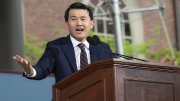
In his afternoon address, President Lawrence H. Summers focused on “perhaps the defining development of our time,” the “growing integration” between the developing and the developed worlds, and Harvard’s role in teaching students about the world, attracting them from around the globe, internationalizing research, and effecting all of these goals through a presence in the world, tangible and virtual. He began introducing the University’s obligations this way:
All of this is to say that we are at a hinge point in history. The twenty-first century can be a far better one than the twentieth, with less brutality and more human freedom, and many more people lifted beyond bare subsistence. But it need not be so. What happens will depend more than anything else on ideas, and on the wisdom of people who are in positions to use them.
Isaiah Berlin famously observed that “philosophical concepts nurtured in the stillness of a professor’s study could destroy a civilization.” Berlin might have continued that wars can start or end depending on what leaders do or do not understand about history or religion or culture, that economies can grow or contract depending on what policymakers do or do not understand about economic theories and models, that people live or they die depending on what we do or do not understand about biology and medicine and public health.
 |
| Lawrence H. Summers |
| Photograph by Jim Harrison |
A great university like ours, rooted in an American traditioncommitted to education, to spreading and creating knowledge, to ideas and the people who bring them forthhas a responsibility not just to our students, but to our nation and to the world. History will judge our generation on how we build on Harvard’s strong foundation to meet this responsibility.