
Main Menu · Search ·Current Issue ·Contact ·Archives ·Centennial ·Letters to the Editor ·FAQs
Please note that, where applicable, links have been provided to original texts which these letters address. Also, your thoughts may be sent via the online Letters to the Editor section.
With this issue Elaine Bradley concludes her service as Harvard Magazine's art director. She directed the redesign of the magazine in early 1996, and made each issue more engaging and attractive from front to back. As she begins a new job in Washington, D.C., Elaine takes with her the complete appreciation and thanks of her colleagues here.
~The Editors
"GAY LIKE ME": THE LETTERS
As a medical school graduate, I have not felt overly affiliated with the College or its Cambridge campus, so I've not contributed to the upkeep of Harvard Magazine until now. Your March-April issue provided a needed correction for my previously distorted view of reality. Hence, I thought it only proper to express my thanks in a tangible way.
Here's the background. For the past several years, I've been suggesting to my gay patients that they're using too much energy being discreet (secretive) about their sexual status. I'd say things like "This is the 1990s; except for a few rednecks and late adolescents, you don't have to guard yourself against big-league prejudice in an educated community." Then I read the letters to the editor (March-April, page 6) about Andrew Tobias's "Gay Like Me" (January-February, page 50). WOW!
I've apologized to my patients for my extreme naiveté. But it is kind of embarrassing for a psychiatrist to have to admit that he's less in touch with reality than his patients.
Philip R. Sullivan, M.D. '57
Sherborn, Mass.
While I thought the publication of the article was admirable, the publication of the responding letters is even more so. What a breadth of reaction to this topic! These letters demonstrate the complexity of the Harvard community and of the entire question of sexuality.
Christopher A. Nolan, M.Arch. '79
Germantown, N.Y.
I find it appalling that so many alumni of Harvard--considered to be the epitome of enlightened, informed, and intelligent citizens--so unabashedly express a deep-seated, irrational prejudice toward gay men and lesbians. I suppose just as anti-Semitism was accepted in Harvard's past, so homophobia is not considered contradictory to a tolerant, open-minded, worldly perspective.
Rebecca E. Klatch, Ph.D. '84
San Diego
I'm sure you're already bursting with pride, but I wanted to add my congratulations to the deluge you will no doubt receive for your January-February issue.
Its crowning glory, of course, was the extensive cover story celebrating Harvard homosexuals. This has to be outstanding even for the 1998 Ivy League. But you did not neglect other important issues of social justice. I noticed a prominent article complaining about income inequality and the heartwarming news that "thy sons" no longer throng to Fair Harvard's jubilee.
However, atheists and agnostics may look askance at "and with blessings surrender thee o'er," and references to "ancestors" and "first flower of the wilderness" have a decidedly Eurocentric flavor. There remain enough vestiges of a saner age to provide much additional gratifying work.
M. Lester O'Shea, M.B.A. '63
Walnut Creek, Calif.
I was moved by Tobias's story of feeling that he had to hide what, for him, was a major part of who he is. What almost all of the letters seemed to miss is that he was telling a personal tale; he was not proselytizing, he was not gloating that he is a member of a more au courant minority. He was simply telling how it was, being gay and afraid to let people know.
I am not gay, I am not a Democrat, I am not in favor of many of the judicially created rights that have recently been inflicted on us by a judiciary taking sides, in Justice Scalia's phrase, in a Kulturkampf, and I think that Romer v. Evans is a judicial abomination. But none of that has anything to do with my ability to empathize with Tobias's story. It is a human one, and I find it odd that so few of your correspondents seem to understand that at all.
Steven M. Cooper, LL.M. '90
Vansant, Va.
I'm still seeing red. Tobias's article didn't shock me. What shocked me--and stirred in me feelings of unreality that this could be happening in a Harvard environment--was the hostile mail that arrived in response. The mark of a liberal education, I thought, was the ability to entertain various points of view. Tolerance itself might be the result. For generations, Harvard has valued student diversity as a component of that civilizing process.
How on earth can your correspondents make of their homophobia, which I'd have thought would have been their private shame, a public statement of principle? And how can various of them be so ignorant as to represent gays as a proselytizing sect or their orientation as pathology; and how can any of them suppose that, on a population basis, suicide is a greater risk in an accepting community than in one that eulogizes heterosexuality? I wish they'd read Tobias more closely. How, finally, can they be so illiberal as to suppose that the voice of this 10 percent of Harvard's sons (and daughters) should be silenced? These are people whose Harvard education has failed them.
Ellen Faust Zaslaw '63
Ithaca, N.Y.
Does the "H" on my sweatshirt now stand for "homosexual"?
Lewis J. Chizer '53
Lawrenceburg, Ind.
Gays and lesbians are part of our natural social landscape. Always have been, always will be. We have no say over that, and we may as well grow up and get used to it. We can only choose how nasty and repressive we will be toward them. Is there really any reason to get exercised about someone loving the wrong person? If you claim that something is immoral, you had better be able to specify what harm it does. Love is not harmful. Life is short and too often harsh. Love is not the problem; hatred is.
Trenton, Me.
The chorus condemning Tobias's article was so sad. What a disheartening proof of the irrationality of homophobia, that his lucid and heartfelt discourse could be read but not heard by these fulminators of staunch prejudice--nearly half the respondents! I am enthusiastically queer ("fellatio ergo sum") as well as profoundly interested in the burgeoning of peace and bliss, and I request that anyone claiming homosexuality is "destructive of morality" and "undoes us all" back up the charge. I could mention a few heteros whose behavior is less than exemplary.
Know what I think is more likely to screw up civilization than guys kissing guys? This obsessive belief that morality is based on sex. Morality is based on kindness.
Stephen Mo Hanan '68
New York City
Dr. Charles W. Socarides '45 asserts that Tobias "is claiming a freedom to alter the basic design of life itself and thus to promote the most radical of all social movements." It is demonstrable that heterosexuality is not part of "the basic design of life" for some portion of humanity, and cannot be made so. On the other hand, except for those few for whom celibacy is a religious or philosophical calling (as opposed to a kind of enforced exile), romantic intimacy is an essential element of that basic design. To deny it arbitrarily to a portion of the population, or to force it underground so that it becomes distorted, is the crime against nature. To characterize such repression as "defense of the traditional family" is either superstitious or demagogic.
Brad R. Roth, J.D. '87
Detroit
Of all the hateful and homophobic comments published, the letter from Dr. Socarides stands out. He wrote that homosexuality is a threat to the nuclear family. Gay men and lesbians aren't anti-family--we are part of everyone's family. Socarides should know this. His son, Richard, who works for the Clinton administration, is openly gay and has been quite publicly out of the closet for many years.
Alan L. Light
Iowa City, Iowa
The rabid homophobia of some Harvard alumni makes me despair of the humanizing effect of a liberal education and ashamed to be in their company. Only the most insecure and bigoted could be offended by the Tobias article. My only regret was that it took so long for the magazine to run a story of this type. You should have run it 20 years ago. Other universities, e.g. the University of Chicago, have been much more up-front and open in supporting their gay students (and faculty).
James A. Glazier '83
South Bend, Ind.
I appreciate your giving Tobias's piece such a prominent place in the magazine. My partner's copy of the issue coincidentally arrived in the same batch of mail as the winter '98 issue of the magazine from my alma mater, Baylor University in Waco, Texas. Baylor's magazine prints a letter criticizing the editors merely for acknowledging the same-sex partners of two graduates as survivors in their death notices. "By including these individuals among a deceased's survivors, the Baylor Line has bestowed legitimacy on a relationship neither condoned by Scripture nor by law," the writer complains. "The granting of survivor status to these two companions in a male-male relationship presents a disconcerting editorial viewpoint." Her words provide powerful (and sad) evidence of the importance of articles like Tobias's.
Steve Taravella
Washington, D.C.
Every one of my group of close friends at Harvard eventually came out, but none of us while in college, not even to (let alone with) each other. We all remained securely locked in our individual closets. Now, this semester, at one of the country's more conservative universities, the University of Virginia, I am for the third time since 1992 teaching a course in the history of homosexuality. Every time I enter the classroom I am slightly startled to see 50-plus faces looking back at me. Such a course would have been inconceivable when I was in college (or for many years thereafter), and if it had existed, surely almost no one would have dared enroll in it.
Nicholas Edsall '58, Ph.D. '66
Professor of history, University of Virginia
Charlottesville
Ah, yes--once again Harvard Magazine prints an article about an openly homosexual alum or student, and once again all the bigoted codgers sharpen their quill pens and leap to the attack! They cancel their subscriptions, prescribe eternal damnation, and offer cures for the dread illness of (gasp!) gayness. How quaint.
It makes perfect sense to me that Harvard Magazine would be no less gay-friendly than the rest of my Harvard was. I'm sorry if this perturbs the more narrow-minded members of older classes. I hate to shock you, but Harvard has changed in the decades since you attended, and canceling your subscription is only going to put you further out of touch (if that's possible). Yup, openly homosexual men and women have a well-established presence on the campus nowadays--they even let 'em into Lamont!
Mary Barr "Polly" Sisson '92
Astoria, N.Y.
Reading Tobias's article wasn't nearly as much fun as reading the letters in response to it. Phew! Reading rabid letters from old Harvard codgers railing against people like me, when they've never even met a homosexual...well, it's a kick, if a strange one. The world has changed. It's a done deal. The hate is dying out.
Thanks for your courage; your magazine has been a lot more interesting lately than it has any right to be. It's gotten to where you have to read it, which is a very good sign.
William P. Meyerhofer '89
New York City
I was physically sickened reading the responses to Tobias. It is your editorial responsibility to print letters that represent the entire range of readers' responses to an article, but this does not give you the right to print vile statements of hatred. The "poem" of Edward Sargent is basely offensive, especially given the fact that an estimated third of teen suicides are commited by gay youth. You would not have dared to publish such a response if it concerned an African American, a woman, a Jew, a disabled person, or a white heterosexual man.
In addition, your decision to print the letter from the doctor advocating "therapy of homosexuality" was irresponsible. The American Psychological Association removed homosexuality from its listing of "mental disorders" 25 years ago. It has also firmly stated its policy that there is no scientific evidence that "conversion therapies" work, that such therapies do more harm than good, and that it does not support such efforts by its members. Thus, this letter-writer represents a member of a fringe group, completely outside of the accepted current thinking in psychology. Would you give voice to such quackery in other fields?
Michael Bianchetta, G4
Ph.D. program in neuroscience
Harvard Medical School, Boston
Good to see my alma mater (well, Harvard though not Radcliffe) doing a long-overdue story about gays (well, gay men) on campus. But what is going on? When the Radcliffe Quarterly asked me to mark my twenty-fifth reunion in 1994 by writing an article about how our class was on the cusp of feminism and related movements, they edited out what I wrote about the phobia about and invisibility of lesbians when we were Radcliffe undergraduates (as well as what I wrote about racism there and then). Now Harvard Magazine runs 12 pages of text including discussion of 41 gay men, virtually ignoring lesbians and bisexuals on campus.
The apologia accompanying the article, attempting to justify the nearly total exclusion of women on the grounds that Tobias is not competent to write about women's experiences, is neither worthy journalism nor worthy editorial judgment, especially when the white Tobias feels himself competent to report the experiences of men he says are not white and men he apparently never met (including one from the seventeenth century).
Paula J. Caplan '69
Providence
I am appalled (but not all that surprised) that this article focusing, from the very first words provided as a teaser on the cover, on the emergence of gay male visibility from previous invisibility at Harvard, perpetuates lesbian invisibility.
Evidence of Tobias's disinterest not only in lesbians but also in women in general and even in certain types of gay men can be found throughout the article. To Tobias, women are largely narrative markers in the male coming-out story, the "cover" a man takes until he finds the courage to pursue his gay identity; a good woman is the wife who encourages her husband to explore his desire for other men, but she is as quickly dropped from the story as any other wife once the man decides he is definitely gay. I understand that many gay men, like many lesbians, still feel uncomfortable enough with their sexuality that they enter marriages with opposite-sex partners hoping to find fulfillment, but to have the discarded wives of such men as just about the only women discussed is pretty telling.
Similarly telling is the absence of any mention of bisexual men, men who feel sexual desire for both men and women. Including these men would mean working to understand how men can relate to women in a direct way, a subject as taboo to Tobias, it seems, as he felt homosexuality was during his undergraduate days.
It is a category of gay men who fare the worst in Tobias's story, the derided "flit." Rather than recognizing that these gay men, ostentatiously out even during the greatest days of compulsive heterosexuality at Harvard, are the truly courageous ones, and quite probably the brave souls whose presence helped effect the greater visibility and comfort queer students enjoy today, Tobias at best ignores the experiences of the flamboyant nellies, and at worst seems to continue to disdain the effeminacy of these men. At these points in the article, it is clear that Tobias continues to harbor internalized homophobia and misogyny. His emphasis on football players and other butch men indicates that he still subscribes to a system that values the "red-blooded American boy" over all others, and his goal now is to prove that one can be such a boy and have a lover who is also such a boy. I am happy to recognize that all kinds of men are and have been gay, but the vilification of flitty gay men is not something to be tolerated, even--especially--when perpetrated by another gay man. The fact that Tobias obsesses on enumerating the "success" of gay men, as measured by material wealth, fame, and power in mainstream politics, suggests that he is still very much invested in proving to himself as well as to his straight male cohorts that being gay is okay. He is perfectly free to play out this psychodrama in the pages of a magazine if he wishes, but real psychological growth and acceptance require a level of self-examination, of challenging the homophobia and misogyny he still has, rather than abandoning the position of lesbian women, ignoring the possibility of bisexuality, and denigrating the sexuality of queeny gay men.
Lois Leveen '90
West Hollywood, Calif.
Tobias's article is theoretically unsound because it reproduces the closet in the Harvard community. By closet I mean the official, cultural, and, in this case, self-regulatory practices that accommodate heterosexual dominance at our expense. The article follows the tradition of having gays take the initiative in their own self-repudiation in a couple of ways.
First, the article casts the issue as a personal rather than structural problem. Only persons act: homophobic ones--Wigglesworth, Pusey, a Catholic typesetter--and, mostly, a suffering cast that reads like Homosexual Morbidity and Mortality Today. Focusing on individuals without generalizing about the ongoing institutional operation of homophobia at Harvard obscures cause. The author's approach encourages acceptance of the homosexual on an exception basis, without disturbing the bias as a whole. As a result, the author's coming out acts as a red herring. (This is a particularly insidious form of the closet because it is hard to criticize confessional writing.)
Second, the article's dated expectations make activists' current demands for change sound shrill and ungracious. The article's homely accolades for University officials reflect pre-Mattachine expectations. For example, Dean Epps had a legal duty to defend the gay student group (cf. Tobias, "Archie Epps was good enough to go"). Anything less would be active discrimination. Similarly, why exude gratitude for President Rudenstine's attending the Caucus dinner? The article works hard to create a false sense that things are okay. Yukk.
José M. Gabilondo '85
Washington, D.C.
THE STERILE WORLD OF IVF
Harbour Hodder's "The New Fertility" (November-December 1997, page 54) is a symptom of our profound ignorance of Earth's real problems.
I have experienced the heartache that accompanies infertility between a couple who want to create a family, and naturally one of united biological descent. After two rounds of surgery and four attempts at in vitro fertilization (IVF), my wife and I were faced with a decision either to remain committed to a system that continuously assured us we were good candidates and that success comes to those who persist (we heard of couples who went through eight and nine rounds of IVF before a viable pregnancy occurred), or to close that door and refocus our lives on the abundance we already had. Perhaps we would explore adoption, something never broached by the medical infertility specialists.
My realization that we were caught in a web of technology, driven by big business and an alienating application of science, occurred during round four of IVF when our doctor called an ad hoc meeting. My wife, Katharine, was handed an oversized black binder containing a database of statistics on sperm donors. Our doctor casually informed us that a "back-up" was necessary in case my "count" was lower than needed the day of egg retrieval. Bluntly, the schedule was set and nothing was to interfere with a successful outcome. The limiting vantage point Western epistemology had offered the medical staff, the hospital, and ultimately us, became crystal clear. Good intentions notwithstanding, IVF was discordant with my most intimate experience of nature. In retrospect, our life had become inextricably bound up with an obsession to have a biological child, an emotional gestalt that excluded any middle ground. From fertility drugs to home administered injections to single-minded, almost desperate, attention to procreating via our own genes, we were physically and emotionally exhausted.
The world of adoption opened. It was vital and refreshing in its own right, but especially when compared to the sterile and mechanical world of IVF. We are now parents of Coelin Pei, a three-year-old girl from China's Hunan Province whom we met in 1996. Not a cell in my body experiences our daughter as not my own, either biologically or spiritually. I have never looked back at what could have been and every day give thanks to what is. We got off the dizzying merry-go-round of technology and looked in our "own backyard" for a child to love--a life that the world had discarded as garbage. The desire to create children from one's own material essence arises from deep within us. However, must we be controlled by our biology? How do we reconcile our "evolutionary imperative," which hangs incongruously between people and technology, with the sacrosanct attitude that society owes us biological children vis-à-vis human rights? We can't.
When we buy reproductive technology while ignoring millions of dispossessed children who ache for love and desperately need families, then I believe we fall far short of the mark as sentient beings. Human nature has gone awry. Maybe we would better serve ourselves and the world to sublimate biology. Maybe we need to become conscious Homo sapiens--by letting go of what we want and cherishing what we already have.
John Scibetta '81
Somerville, Mass.
ETERNITY IN ROME
|
The brief biography of Richard Henry Dana by Castle Freeman Jr. ("Vita," March-April, page 48) rightly dwells on the twilight existence of a Boston Brahmin who had failed to acquire the recognition and honors his merits as jurist and writer deserved. Yet more than once Dana expressed the insight that his fame as a public figure was derived genuinely from the success of the book of his youth and the almost mythic experiences he had undergone.
Two Years before the Mast as a literary achievement belongs to California rather than Boston, for it is nearly the earliest account in English of provincial life in Spanish-Mexican California, a way of life that was to disappear with the arrival overland of "Americans."
Missing is any reference from Freeman to recent scholarship and criticism (Hart, Shapiro, Gale, et cetera) establishing the literary structure of Two Years as an authentic story of initiation (trials toward manhood) as well as diaries re-worked into permanence as a self-portrait, not unlike Joyce's case in Portrait of the Artist.
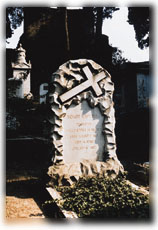
Dana lived the final phase of his life in Europe, seemingly like an expatriate. His remains lie overseas, in Rome's Protestant Cemetery. His family chose burial there to interment in the family crypt in Cambridge. I took the enclosed photograph on a visit to Rome in 1990. Dana's name was not on the list of prominent persons (such as Keats) whose graves are pointed out to visitors in the official guide kept in the custodian's office.
L.A. Murillo, Ph.D. '53
Pasadena, Calif.
PATHOGENS IN THE WATER
I read with interest "The Micro-Menace of Biofilm" (November-December 1997, page 12). Tim Ford of the Harvard School of Public Health is correct, as quoted, that "public drinking water pipes provide a viable home for a variety of opportunistic pathogens." The article, however, paints only part of the picture. The casual reader would assume that the nation's water utilities are ignoring, or are incapable of addressing, the biofilm problem.
In fact, the water utilities, through the American Water Works Research Foundation, have funded over $27 million in research to find control measures for biofilms and other water-quality issues in the water-distribution systems.
Water utilities have been using the results of this research to reduce the risks mentioned by Ford. Improved water-quality monitoring and control, routine cleaning of pipes, and replacement of older pipes more subject to biofilm problems are just a few of the methods being used to protect the public from pathogenic organisms.
Ford states, "Frankly, I'm surprised that more such outbreaks haven't occurred," referring to the waterborne outbreak in Milwaukee in 1993. The reason is simple: drinking water professionals are actually doing an excellent job of producing safe drinking water. Although tragic, the Milwaukee outbreak did re-emphasize the importance of protecting drinking water sources from contamination. As a result, water utilities are stepping up efforts to establish sound management practices for their watersheds.
Jack Hoffbuhr
Executive director, American Water
Works Association, Denver
THE COMPLEXITY OF CHILDHOOD
I have a serious problem with Kiku Adatto's ideas on childhood innocence and sexuality as reported in "The Eroticized Child" (March-April, page 22). To argue that the eroticization of children is something new--the result of the counter culture gone wrong by being tinged with the racy fashion chic of Helmut Newton-- flies in the face of a vast amount of common evidence to the contrary.
|
The whole argument is problematical. The eighteenth century, which Adatto sees as giving birth to the idea of childhood innocence and purity, produced countless images especially of sexualized girl children. One need think only of Boucher's pre-pubescent goddesses or the cottage children of the later Gainsborough, to take just two diverse examples of such sexualization. One might better argue that the idea of innocence is inextricably linked with its inverse, whether in the eighteenth century or otherwise.
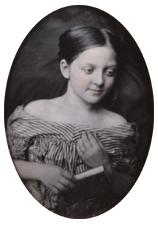
Even the nineteenth-century photograph used to illustrate the article, to contrast with Calvin Klein's Kate Moss, is eroticized. At first glance the child may seem the model of demureness, but at the same time the downcast eyes, slight smile of the blush-tinted mouth, dress off the bare shoulders, hand on breast may just as well suggest the confluence of innocence and sexuality. Lewis Carroll exploited that confluence in some of his photographs of Alice Liddell and other girl children. His photograph of the nude Evelyn Hatch in a traditionally erotic pose--prone, body turned towards the viewer, arms raised framing the head--can match anything in the work of Sally Mann or Jock Sturges, both of whom, I believe, have been charged (happily unsuccessfully) with child pornography.
And I might add that Lewis Carroll's models, though considerably younger than Kate Moss, are every bit as aware of their own sexuality and power. The Calvin Klein ad makes the whole business explicit through the name of the scent and its target group--"Obsession for Men." But even with the text, the image is hardly transparent. It can be read the other way--it is the model who has an obsession for (mature, older, sophisticated--take your choice) men. And then again in the photo there is a slight suggestion of adolescent androgyny that would give the whole image another turn.
The point is that both photographs used to support Adatto's argument are in themselves complex and contradictory. That's what makes them interesting. To extract a simple meaning from them may be convenient, but it is also misleading. Though it is often held to the contrary, images are not prima facie in their meaning.
Freud has taken a lot of hits recently, but there remains little doubt that his considerations of childhood sexuality have deepened our understanding of the complexity of childhood. All that seems to have disappeared in what appears to be Adatto's rather sentimental view of children free of even a hint of libido. There is some accumulated knowledge here that should not be avoided.
Finally, if the choice is only between Beavis and Butthead (assuming that they are really about grossed-out pre-adolescents) and Howdy Doody, there's no contest. It's Beavis and Butthead all the way.
Baruch D. Kirschenbaum, Ph.D. '66
Providence
HARASSMENT: NAMING NAMES
Tara Purohit's "Undergraduate" column about "Julie's" sexual harassment at the hands of a faculty member ("Breaking the Silence," March-April, page 71) left me with more questions than answers.
I don't doubt that she was harassed. I don't doubt she found little serious administrative sympathy, and now in addition to her sense of violation, feels angry at and let down by Harvard.
But if Julie faults the University for failing to "go public" with her case, allowing her harasser to "walk away," why does she choose to go anonymous in the article? I'm sure many of her classmates, and perhaps colleagues and employees in the offender's department, would like to hear her full story.
I would hope that the larger Harvard community--the readers of this magazine--is not interested in sweeping sexual harassment under the rug. I wish Julie felt the courage, strength, and support of her friends and classmates to come forward, name names publicly, and let her offender defend himself or respond as he feels appropriate.
Stephen J. Harris '83
Saratoga, Calif.
EMENDATIONS
May I offer a correction to "Good Will Sidis" ("The College Pump," March-April, page 80)? In the film, Will Hunting lived in South Boston, not the South End, a rather different part of Boston.
Georgia Frank, M.T.S. '87, Ph.D. '94
Hamilton, N.Y.
In "Leaving Leverett," ("Brevia," March-April, page 89), you commit two errors in one item (tsk, tsk). Professor John Dowling does his research at the Marine Biological Laboratory, Woods Hole, not at the Woods Hole Oceanographic Institution (not "Institute").
MBL was founded in 1888. WHOI was spun off (with Rockefeller money) from MBL in 1930. The first scientific organization in Woods Hole was the federal government's, now part of the National Marine Fisheries Service. It arrived with the railroad in the 1870s. Another federal organization, the U.S. Geological Survey, arrived about 1963.
Harold L. Burstyn '51, Ph.D. '64
Syracuse, N.Y.
Horrors! Regarding "Harvard in Epigram" ("Centennial Harvest," January-February, page 36), I wish someone had checked that statement attributed to me with me before it was published. The sentence came from an article in Holiday in 1961; it had been heavily rewritten by a couple of male editors in their fifties--they were trying to make the piece sound girlish. Hence a small joke went astray.
Nora Sayre '54
New York City
AN INCIDENT AT HARVARD
In his book Coming Apart: A Memoir of the Harvard Wars of 1969 [reviewed May-June 1997, page 24], Roger Rosenblatt erroneously attributes to me the statement "Mr. Dean, you are a liar" during an exchange I had with Dean Franklin Ford at a faculty meeting on April 15, 1969. I never uttered those words nor any others in which I accused Dean Ford of lying. Considerations of space prevent me from fully documenting this here, but what I have said is directly confirmed by the transcript of the exchange sent to me by then registrar Robert Shenton on March 16, 1970. Furthermore, the reports of that exchange in the New York Times and Boston Globe of April 16, 1969, make no mention whatever of my saying what Rosenblatt attributes to me. Finally, I received a cordial note from Franklin Ford on April 19, 1969, after I had written him to express my hope that he would recover quickly from a mild stroke he had suffered just after the faculty meeting. Ford's reply was not one that even the most forgiving person would have written to someone who had publicly denounced him as a liar four days earlier.
Morton White
A member of the faculty of the Harvard
philosophy department, 1948-1970
Princeton, N.J.