
PYRAMID BUILDERS
I read withgreat interest "Who Built thePyramids?" by Jonathan Shaw (July-August, page 42), describingMark Lehner's magnificent discovery of the lost city of the pyramidbuilders.
The article leaves intact the usual theory ofconstruction, that the blocks were quarried, then pushed or pulled intoplace using rope and inclined planes. Some of the blocks weighed ninetons, and there seem to have been bigger ones at Pharaoh Khufu'schamber, more than 15 tons, as heavy as a bulldozer. They would havebeen a problem no matter how much rope and wood the buildershad.
There is another theory, propounded by French chemist JosephDavidovits, that the blocks are concrete. Some of the argumentsofferedair bubbles in the stone; jumbled fossils, rather thanlayered as in natural limestone; waves in the stone; unusual minerals inthe stone; less-dense top portionsare rational and scientific. Thetheory is not accepted by all, but it is important enough to bementioned.
Edmund R. Helffrich'49
Allentown, Pa.
Mark Lehnerreplies: Davidovits's hypothesis does not stand up to on-siteobservations. First, if concrete, the blocks certainly were not pouredin molds, because they have no standard sizes. To this Davidovitshimself once responded, as we chatted about his idea at the northwesternfoot of the Khafre Pyramid, that the blocks could have been poured informs built successively ad hoc against the previously poured and setblock. A single seam between adjacent stones can range anywhere from afew to 20 centimeters wide at the top, to millimeters or direct contactbetween the stones, to several centimeters wide at the bottom. Theirregularity of a single seam is because nonenot oneof theblocks is square, and few of the blocks even have a single flat face. Ifthe builders poured the material of these stones, which comprise part ofthe core of the pyramid, they would have to have poured into irregularlyshaped bags! In fact the masonry is even more irregular than I have sofar indicated, with limestone chips of all shapes and sizes stuffed intointerstices between stones. Further, the outer casing stones at the topof the pyramid are not flush, so it is highly unlikely that these pieceswere poured as liquid concrete and set in place.
Where pyramidcore or casing stones are not smoothed, the surfaces often show themarks of chisels, picks, and hammers, suggesting the builders shapedthem with tools, which also renders the hypothesis of poured concreteimprobable.
My observations make the concrete-pyramid-stonehypothesis highly improbable to me. I think it, like so manypyramid-building ideas, deals with a mental template pyramid, composedof rather standard, or at least regular, courses and blocks. The actualfabric and texture of the pyramids is something quitedifferent.
The person who "painstakinglyreconstructed" the boudoir furniture from the tomb of QueenHetepheres (page 46) was not the excavator, Professor George Reisner. Hecaused them to be reconstructed, by master furniture craftsman JosephGerte of Bostonfather of Albert Gerte '41 (who assisted in thereproduction work) and my great-grandfather.
Cranford,N.J.
ROOT PROBLEM: SHEERNUMBERS
Jody Heymann's "
At least we should remind peopleof the relationship between population size and many human problems, andemphasize the importance of trying to contain future population growth.If we do not do this, I expect nature will do it for us.
Bethesda,Md.
I would add to Heymann's solutions theprovision of adequate family-planning services. It is a nationaldisgrace that the present Bush administration has withdrawn U.S. supportfor international family-planning programs.
M.P.O'Meara, M.D. '50
San Carlos,Calif.
WITCHCRAFT ANDTERRORISM
John Demos's review of Mary Beth Norton'sIn the Devil's Snare, on the Salem witch trials ("
Our administration has, indeed, much improved on thejudicial procedures of the seventeenth century, when the accused wasallowed to confront his accusers. Zacarias Moussaoui, currently beingtried under Bush's USA PATRIOT Act will not be allowed to question theperson who has sworn he is a terrorist won't even be allowed tosee him. Yes, we've come a long way from witch trials.
Kamuela,Hawaii
Professor Demos seems unable to resist thetemptation to bend the powerful metaphor of the Salem witch trials tofit his prejudices about the role of the U.S. government in confrontingcontemporary international terrorism. The metaphor fails badly as an aidto understanding the truth, however, because, in the case of the Salemwitches, there was obviously not a shred of rational evidence for theallegations of witchcraft. In the case of international terrorism, fewpeople the world over would say we are addressing a maladeimaginaire. While there may be legitimate public dispute about howto address actual terrorism, Demos's witchcraft reflections suggest thatthere exists such a degree of wrong-thinking on the subject as topreclude civilized discussion on the terrorist question and possibleresponses to it.
Jerome A. Collins,'57
Kennebunkport, Me.
HARVARD'SAMICUS BRIEF
Quentin L. Kopp ("
But a federal statute, Title VI of the CivilRights Act of 1964, forbids racial discrimination in "any programor activity receiving Federal financial assistance." The statuteapplies to Harvard and other private universities that receive federalmoney: virtually all of them. If the Supreme Court had found theMichigan Law School admission system unlawful, instead of upholding it,Harvard's admission program would have been unlawful. Far from being"meddlesome," the University had a direct and urgent interestin the Michigan cases.
Anthony Lewis'48
Cambridge
NAUSEA ON THECHARLES
You report ("
My father was known to make wisecrackcharacterizations about some of the College's more modern designefforts. He likely would have dubbed this monstrosity "Nausea onthe Charles." With its uncontrolled use of brick and block of everyshape and hue, its cutesy uneven window treatment, and the blearyswirling of bricks as installed, it reminds me of a very large Italianmeal which, having been joined by an excess of wine, is deposited on thesidewalk. My only thought is to plant massive amounts of fast-growingivy to hide the damn thing.
John H. Finley III'58, M.B.A. '63
Boston
CONTROLVOLUNTARY SPENDING
"Tuition Takes Off"("Brevia," May-June, page 57)reports the ever-escalating bill for tuition, room, board, and fees atthe College. Private universities seem to engage in a voluntary cycle toreinvest in the finest facilities on the basis that they are needed toattract the finest professors, who are needed to attract the fineststudents. The burden of these wholly voluntary decisions falls directlyon the middle class and precludes their children from participating. Itsimilarly precludes all but the wealthiest internationalfamilies.
The cycle has to be controlled. More of the endowmentneeds to be allocated to the operating budget. Personnel costs,particularly now in the face of global price deflation, do not have torise every year. The governing boards should reflect on their largersocial obligations to bring the levels of voluntary expenditure more inline with the realities of the external world.
G.Mansfield, M.B.A. '74
Hong Kong SAR,China
MORE ABOUT duPONT
While Henry Francis du Pont plannedmagnificent gardens in the British style of "educated nature,"he was in no way responsible for the children's Enchanted Woods, as isstated in Shirley Moskow's "Vita"(July-August, page 40). The woods are a rather recent addition toWinterthur, part of a multifaceted attempt to make the place moreaccessible to the general public.
Philip A. DeSimone, G '71
Pleasantville, N.Y.
Shirley Moskow's entertaining"Vita" doesn't tell the reader anything significant that wasnot related in Ruth Lord's fine biography of her father, published fouryears ago. And of course the book tells a great deal more than doesMoskow's one page. Henry F. du Pont and Winterthur (Yale)received many favorable reviews. Why then did Moskow not evenacknowledge the book which could have been the complete bibliography forher little piece?
Richard B. McAdoo'42
Cambridge
Shirley Moskowreplies: Ruth Lord's book is more complete than my short article.However, there is information in the article that is not in the book.Every writer makes choices. I used many sources, among them materialsobtained during a visit at Winterthur, newspaper and magazine files, theInternet, books, and voluminous class notes in the Harvard Archives. I also read Lord's book. Perhaps I could have mentioned the book, but I was limited by space and trying to include as much information about du Pont himself as I could. I cited the Saturday Evening Post because I quoted from the magazine. On the Enchanted Garden, I stand corrected.
GUARDING AGAINST BOMBS
Here in Chicago, the feds have put some reasonably nice-looking bollards ("Sidewalk Bulwarks," July-August, page 14) around the Dirksen Federal Building: some kind of stone, squarish, about waist-high, and pretty civilized. As I was contemplating them, I realized suddenly what they reminded me of. Stonehenge isn't an astronomical clock or a large-scale face of a goddess. It's a circle of bollards, protecting something in the middle (now archaeologists can start trying to figure that out) from drive-by chariot bombings!
Marian Henriquez Neudel '63, Div '67
Chicago
UNIVERSITY, CORPORATE ALLIES
Derek Bok decries the increasing involvement of corporations and commercial interests in the affairs of universities ("The Purely Pragmatic University," May-June, page 28). He states: "The encroachment of commercialization on educational values is particularly unfortunate because it depends, at bottom, on a willingness to take unfair advantage of students." I respectfully disagree.
Corporations and other commercial interests in our country are what has made this nation rich and powerful, and its citizens among the wealthiest that the world has ever known. We build the industry, the roads, bridges, and universities; we pay for the government, we employ the citizens, and we generate the technology that is the hope of mankind, from science to medicine. You are not separate and apart from us; we are one.
Bok warns that commercial interests have a corrupting influence on universities, bending their integrity and thrashing their purely academic interests. Again, I disagree. There is a symbiotic relationship between universities and employers. You train the workforce, we provide them with employment, they donate money to the university (as do we), and you train the next generation for the workforce. No fortress needs to exist between us. You are welcome within our walls, and we have dined at your collective table.
Universities are at their best when they respond to the needs of the commercial interests, the military, and our society. Academic interests, if anything, need to become more responsive to these institutions, not more guarded. We, in turn, try to meet your needs, and I have not known a shy university that hesitates to ask for donations from corporations or wealthy alumni.
Certainly there must be balance, and excessive commercialization must be curbed and prevented. Yet, more often than not, it is the university that is not meeting the needs of industry and government, not the other way around. We need more technical workers who have been trained in the most advanced methods. We need people who have been trained to be practical and productive. We need graduates who have been taught to be proud of their country and their military, and who are eager to serve both. Meet these demands, and you uplift the nation and its people.
We commercial interests are not the enemy, nor do we seek to make you one. To engage us further, to understand our needs, and to befriend us warmly is a much better foundation upon which to build a mutually beneficial relationship. Don't take our money with one hand, and shake your fist angrily when we turn away!
As a vice president in a Fortune 500 Company, as a Law School graduate, and as an officer in the U.S. Naval Reserve, I have hired and supervised many graduates from many universities. I have visited many colleges, and I have seen a great many graduates who were left unprepared for civilian and military employment by their expensive universities. The solution is not in building a better and taller ivory-towered castle; in my opinion, it is in a closer embrace.
I firmly state that the perceived encroachment of commercialization on educational values is not based on a willingness to take unfair advantage of students. In part it may be based on a desire to create personal and corporate wealth; in part it is based on a belief that exposure to capitalism and commercial interests will benefit students and the universities that educate them. Let the haze clear from your cannon fire, and look upon the faces of your allies. Please do not fire upon us again!
Charles Facktor, J.D. '90
Alpharetta, Ga.
FIRST FLIGHT IN NEW ENGLAND
John Lenger's article on aviation pioneers ("Conquest of the Air," May-June, page 32) provided a thorough, entertaining account of the 1910 Harvard-Boston Aero Meet. He did not mention events on the North Shore of Massachusetts earlier in the year that included some significant aviation firsts and that also had Harvard connections.
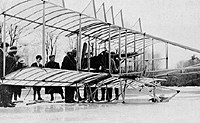 | 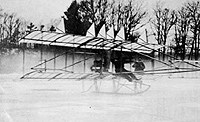 |
| Preparing Herring-Burgess #1 biplane for its maiden flight | Moving. Herring is at the controls. |
| Courtesy of Burgess Aviation Museum, Plum Island Airfield, on loan from Bartlett Gould Collection | |
Most importantly, the first airplane flight in New England occurred almost two months earlier than Lenger reported. On February 28, 1910, the Herring-Burgess #1 biplane, piloted by Augustus M. Herring, took off from the frozen surface of Chebacco Lake in Hamilton. The host for the flight was Norman Prince '09, LL.B. '11, a Law School student who, as legend has it, invited W. Starling Burgess '01 and Herring to try out their flying machine at his family estate while his parents were in Europe and young Prince was supposed to be studying. (Prince later cofounded the Lafayette Escadrille, a corps of American aviators who flew for France prior to the U.S. entry into World War I. He was killed in a crash on a mission in 1916.)
Burgess (1870-1947) completed his undergraduate studies at Harvard but left without receiving his diploma. The Marblehead yachtbuilder became interested in aviation following the first public demonstrations by the Wrights in 1908. In early February 1910, Burgess displayed his first aeroplane at the Boston Aero Show held at the Mechanics Hall on Huntington Avenue, a noted center of interest in aviation. Herring had been experimenting with flying machines since 1895, when he began testing gliders on the south shore of Lake Michigan with Octave Chanute, considered the father of aviation. The inventive, ambitious Burgess and the mercurial but persistent Herring were a good match in this endeavorBurgess provided the craftsmanship; Herring the aeronautical knowledge.
Following the single flight on Chebacco Lake, Burgess moved his operation further north, to Plum Island in Newbury. During the spring and summer of 1910, the Plum Island aviators thrilled the local populace with test flights over the marshes and dunes. (One of the better flyers, William Hilliard, was reported by Lenger as the pilot of the first airplane flight in New England. The date reported by Lenger, April 17, is indeed the date of the first flight at Plum Island, but the pilot of that first flight was again Herring, not Hilliard.)
The Herring-Burgess biplanes were not particularly airworthy, but at the September Harvard-Boston Aero Meet, Burgess's craftsmanship impressed the best aviators in the English-speaking worldthe Wright Brothers and Claude Grahame-White. The Wrights and Burgess signed the first known aircraft manufacturing license, and Burgess built Wright flyers for several years thereafter. Grahame-White, the dashing English aviation hero wonderfully described in Lenger's article, purchased several of Burgess's airplanes, believed to be the first export of airplanes from the United States. Burgess went on to design and build more than 100 airplanes, including the world's first flying wing and the first airplane to both take off from and land on water.
The events of 1910and later Burgess aircraftare documented in a photographic display in the Burgess Aviation Museum at the Plum Island Airfield in Newbury/ Newburyport.
Edward S. Russell '78
President, Plum Island Community Airfield Inc.
Byfield, Mass.
REPARATIONS
In "The Price of Slavery" ("Right Now," May-June, page 12) Harbour Fraser Hodder reports about a survey conducted by Professor Michael Dawson and others in which blacks and whites were asked whether they support federal initiatives apologies and monetary paymentsto address past wrongs.
Securing reparations for the descendents of American slaves has been an ongoing attempt, by organizers of those conceived to be "outside the conventional electoral system," to raid the U.S. Treasury. "Regarding monetary reparations to descendents of slaves," Hodder writes, "two out of three blacks voiced support, against a mere sliver (4 percent) of the white respondents...." Well, no kidding. This isn't a "racial gulf of 63 points," it's a taxpayer gulf, a point supported by the survey result that "more affluent blacks of both sexes are less likely to support federal payments for...slavery...."
Dawson expresses "surprise" at the "visceral reaction" this issue provokes. The "visceral reaction" is that of a person whose pocket is about to be picked.
Completely ignored in squaring accounts are the following:
The more than 500,000 white lives in the Civil War taken in the struggle to end slaverya blood payment.
The trillion or so taxpayer dollars already spent in the "War on Poverty" and similar government programs (not to mention the multimillions spent by private charities), which largely accrued to the black sector of the population.
The amount, and basis for discrimination, of reparations, viz., how a blood relationship with a particular slave may be established, given the paucity of records and the passage of time, and, in the absence of records, what might be the "presumptions" of slave ancestry necessary to establish a draw on the Treasury. These issues are pregnant with further divisiveness.
It seems to me that people of good will and their elected representatives can formulate an expression of national sorrow and regret for the fact of slavery in the United States. Monetary reparation is an issue without a rational basisthe bill has been paid.
Frederic H. Smith III, M.B.A. '67
Peachtree City, Ga.
Hodder misrepresents both the terms of General William T. Sherman's Special Field Orders, No. 15, of January 1865, and the land provisions of the Freedmen's Bureau act of March 1865.
She writes that the general "granted the now legendary '40 acres and a mule' to 40,000 freed slaves along the Atlantic coast." The short response to this statement is: Not quite, no, and no one fully knows. At no point in this order does Sherman promise "freed slaves," in the general sense conveyed by Hodder's language, 40 acres. The reserved land was to be distributed to heads of families, and in parcels of any size up to but not surpassing 40 acres. At no point does Sherman make provision to supply mules to those heads of families. A subsequent directive did make possible the loan of unserviceable mules to settlers, but this was not a provision of the original order. At no point does Sherman write of the settlement of 40,000 freedpeople. That figure appears much later, when in the fall of 1865, General Rufus Saxton estimated the number of former slaves he and his subordinates had helped settle on the reserve since its creation in January.
Hodder's summary of the land provisions of the Freedmen's Bureau act is perhaps even more misleading. Congress did not give, as she states, "Southern blacks 40 acres to farm for three years." The act provided for the assignment of not more than 40 acres to every male citizen (a category that included former slaves and loyal white refugees) with the expectation that the recipients would be permitted to rent their plots for up to three years, during which they could elect to purchase the land outright from the government.
Land for the freedpeople was a hotly contested topic as war gave way to peace, and one that defies easy generalizations. Certainly, there were those in Lincoln's, and later Johnson's, administrations who, along with countless former slaves, understood that the best freedom would be one grounded in land. But accepting that notion in principle left unanswered the question of how former slaves would come to possess their own land. Sherman offered one extraordinarily radical response. Congress, in March 1865, offered a more moderate proposal by limiting the acquisition of government-controlled land to male citizens of means.
Susan E. O'Donovan
Assistant professor, Afro-American
studies and history
Cambridge
CREATIVE TOUR GUIDES
Thank you for referencing my article "Everyone's Wild About Harry" in "The College Pump" (July-August, page 92). Shortly after the article appeared in the Harvard Library Bulletin, I heard a tour guide speak yet another myth about Harry Elkins Widener worth repeating: "If Harvard ever neglects to have flowers delivered to the Widener Memorial Room, the entire library becomes the property of the City of Cambridge."
Denison J. Beach
Cambridge
THE TROUBLE WITH TENURE
It is not hard to figure out why Anita Levy of the American Association of University Professors ("Letters," July-August, page 6) thinks so highly of tenure. Who wouldn't want a guaranteed lifetime job teaching five to six upper-level courses eight months a year in one's field of interest for very healthy pay?
But she and her colleagues are in a better position than most Americans to protect their intellectual freedom. They do not need to be set above the mob as a special class. What tenure has become is a privileged institution used by those who hold it to perpetuate their own privileges and to exclude dissenters, not all of whom are people of color by any means.
In my English department at a large state university, one woman was granted tenure six years before she had published a single book. She was, however, the close friend of the chair. When, three years later, still unpublished and with no special rewards to boast, she wanted her husband, let go from another university, to get a job, her friends managed to have one created for him. Since he was from India and dark skinned, they used the myth of his being an affirmative-action hire to slip him into a tenure-track job without peer review. Tenure is an arbitrary system, not a meritocracy.
Any freshman sociology student will recognize that power entrenched gets abused, nepotism such as this being only one of the crimes. The worst part of tenure is that while the tenured travel from conference to conference reading their papers to each other at state expense, underpaid and benefitless adjuncts do the hard work of the university without protection. The creation of a leisure class requires a toiling class. Nor does tenure encourage the timid. Every dean knows that the threat of denying salary increases, study leaves, and sabbaticals is more than enough to keep most of the tenured professors in line.
To find people willing to take risks, you have to go outside of the tenured ranks to teachers who, because of the oppressive atmosphere created by the Tenured Lords, put our jobs and careers at risk just by writing letters like this one.
David R. Williams '72, M.T.S. '75
Fairfax, Va.
IMMUTABLE SUMMER HOUSES
The excerpt from George Colt's book Big House ("Open Book," July-August, page 24) certainly struck home. While we have remodeled our California house many times in our 30 years here, the New Hampshire house remains resolutely unchanged. There are notes about the plumbing in my mother's hand posted in the bathrooms, and years-old directions for getting to our house by my father (Nathan Comfort Starr '17, Ph.D. '28) in the desk drawer.
But the note the grandchildren always quote is the hand-lettered sign taped to the side of the fridge, next to the dishwasher. In big letters the sign said, "NO WOODEN HANDLES IN THE DISHWASHER, PLEASE." Two years ago, when that old 1953 refrigerator died (a wonderfully designed GE, with a foot treadle for hand-less opening and rotating shelves), we bought a new one. The old fridge, with the plea about wooden handles still affixed to the side, went out to a truck to be hauled away, with the sign facing the rear. I actually waved goodbye to the sign and the fridge. I felt as though I was throwing away a piece of my mother's personality, our family's history. At the beginning of this summer, I wrote in heavy grease pencil on the side of the new fridge "No wooden handles in the dishwasher, please."
And yes, there are keys in the basket by the front door that have been there for generations. No one knows what they open. Maybe someday....
Penelope Starr '57, M.C.P. '64
San Anselmo, Calif.
ADDENDA
A report ("Brevia," July-August, page 78) that Robert A. Caro, Nf '66, had won the 2003 Pulitzer Prize in biography, and that Nicholas Dawidoff '85 had been a runner-up in that category, neglected to note that the other finalist in biography was also a Harvard affiliate: Lewis Lockwood, Peabody research professor of music, for his Beethoven: The Music and the Life.
Also in "Brevia," the caption to the architects' rendering of the School of Dental Medicine's building under construction might have noted, but did not, that Rothman Partners Architects designed the new facility.
SPEAK UP, PLEASE
Harvard Magazine welcomes letters on its contents. Please write to "Letters," Harvard Magazine, 7 Ware Street, Cambridge 02138, or send comments by facsimile to 617-495-0324, or by e-mail to yourturn@harvard.edu, or use our Internet site, www.harvard-magazine.com. Letters may be edited to fit the available space.