
The scene, at least the one framed by the family-room proscenium of the television screen, remains indelible. President George W. Bush emerged from a navy jet that had just landed on the aircraft carrier Abraham Lincoln on May 1, 2003. Swathed in flight gear, he cradled a helmet under his arm and told the press that he had flown the plane, and “I miss flying, I can tell you that.” Hours later, he reappeared on deck wearing a business suit and spoke beneath a huge banner reading Mission Accomplished. Bush announced that “major combat operations in Iraq have ended” and exulted in the defeat of “an ally of Al Qaeda,” declaring that “no terrorist network will gain weapons of mass destruction from the Iraqi regime, because that regime is no more.”
 |
Photograph by Robert Adam Mayer |
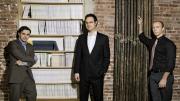
Frank Rich on West 43rd Street |
Scheduled for East Coast prime time on a Thursday, the night with the highest television viewership, Bush’s speech drew a large audience and played well with both the public and the drama critics of the political stage. “That was great theater,” gushed Morton Kondracke of Fox News; on Meet the Press, the Washington Post’s David Broder rhapsodized about the president’s “physical posture” that communicated “authority and command.”
Now compare these raves with the response of a professional theater critic who long ago quit reviewing Broadway plays and refocused his gaze on the dramas called “news.” Each Sunday, Frank Rich ’71, a New York Times theater critic for 14 years and a Times columnist since 1994, scrutinizes pseudo-events like the aircraft-carrier scenario in a quest to distinguish the smoke of real fires from the ubiquitous fumes of smoke-making machines.
In his recent book, The Greatest Story Ever Sold: The Decline and Fall of Truth from 9/11 to Katrina, Rich describes Bush’s “May Day double feature” of carrier landing and speech, analyzing its elements using a theatrical vocabulary, like his mention of the “three-hour intermission” between the two components of what he called a Top Gun reenactment. There was costume: Bush emerged from the cockpit “draped in more combat gear than a Tom Cruise stunt double,” and the crew members in the official audience wore color-coordinated garb. There were set design and choice of props: a White House advance team supervised renaming the plane Bush flew—normally used for refueling—as Navy One, and painting George W. Bush, Commander in Chief on its fuselage. The Mission Accomplished banner “was positioned high up so that it appeared as a halo hovering above the president,” Rich writes.
Of course there was a written script, and cinematography, too. The president’s address began “precisely at dusk in the West—Hollywood’s so-called magic hour, much prized by cinematographers for the golden glow it bestows on any scene.” And while the uninitiated might have thought the Abraham Lincoln was far out to sea, those directing the show had simply positioned the carrier to evoke that appearance: “...if the camera angle had been different,” writes Rich, “it would have revealed the San Diego skyline, fewer than 40 miles away.”
Characteristically, Rich also mentions certain rather inconvenient facts that fell outside the camera angles. For one, Bush, was not officially announcing the end of the war, because, under the Geneva Conventions, doing so would require the release of more than 6,000 POWs. Second, Rich follows a line from Bush’s speech, “With those [9/11] attacks, the terrorists and their supporters declared war on the United States, and war is what they got,” with his own observation that “...this war happened to be against a country that had nothing to do with 9/11,” a fact “largely overlooked in the excitement” of the victory celebration.
Another small thing: the “eagerly homeward-bound troops” aboard the Abraham Lincoln had their return to San Diego “stalled by a day to accommodate the pageantry of Bush’s tailhook landing”—a minor delay, perhaps, for troops whose “deployment at sea had already been extended from six months to ten, the longest by a carrier in thirty years, to help fill the maw of an understaffed war.” The networks’ editing rooms also omitted any untidy details of the president’s own military record, like his erratic attendance while serving in the Texas Air National Guard, where whatever flying he did was thousands of miles distant from military combat. And in the final analysis, Rich says in an interview, “The Top Gun image of victory trumped the reality that the insurgency was underway.”
Image wins out over reality more and more in the battle for attention and belief. Virtually every public event now arrives filtered through a lens, laptop computer, or recording device, and hence nearly all our daily news has been “produced” and woven into some kind of narrative. Old-fashioned, relatively unmediated reality at times appears obsolete. In this environment, Rich’s New York Times columns attempt to redress the balance as he rips holes in the scenery of the image manipulators to reveal stagehands frantically hauling on ropes, and drags unwelcome truths onstage. His column “derives from his unique experience,” says Bill Kovach, a former curator of Harvard’s Nieman Foundation for Journalism who chairs the Committee of Concerned Journalists. “He sees politics as theater. His vision and his voice are the result of the skills honed as a theater critic who expanded his reach to broader cultural criticism and then narrowed it again to political criticism. One result of this grounding in theater is his need for a narrative: his approach can make greater sense of the political world than [those of] other columnists who treat everything as a distinct thing, separate and apart.”
Regarding Iraq, says Rich, “There were two fictional story lines: the weapons of mass destruction, and a continuous effort to link Iraq with 9/11. Over and over again, Dick Cheney went on the air saying there’d been a meeting in Prague between an Iraqi official and [9/11 hijacker] Mohammed Atta. But there was nothing to it, no evidence of a meeting. Still, if you try hard enough, you can manufacture connections between anyone and anything. And the public will start to believe them if you don’t have an opposition party or an aggressively skeptical press. The biggest questioner of this phony link wasn’t Tom Daschle or Richard Gephardt, it was a fake news show, Jon Stewart on The Daily Show.”
“Why was their sales pitch so effective in sending the United States to war in Iraq?” Rich asks. “In September 2006, President Bush said that the war had nothing to do with 9/11—‘We never said that Saddam Hussein ordered the attacks of 9/11.’ And they never did say that. But they said it in other ways: by the allusions used, and the linkages implied. They’re sending a message and pounding that message in with the tools of modern mass media. They do it in a very creative way. We need to understand the difference between what’s actually happening and the perception that is being sold by the people in power.”
Though his own political leanings are generally liberal, Rich is equally eager to expose hypocrisy, dissimulation, and phony images emanating from the political left; he’s a muckraker at heart. “If there was a day that Kerry lost the election, it may have come in August [2004], when he took reporters’ questions while posing against the macho landscape of the Grand Canyon,” writes Rich in The Greatest Story Ever Sold. “Asked if he still would have voted to authorize the use of force against Saddam Hussein if he knew then that there were no weapons of mass destruction, Kerry answered yes. Would Kerry have also answered that a Senator should have voted to authorize the Vietnam War even if he knew that the Johnson administration had hyped North Vietnamese attacks on American ships in the Gulf of Tonkin? Hardly. His answer about Iraq was a moment of supreme intellectual dishonesty that sullied his own Vietnam past as surely as the sleazy Swift Boat character assassins had.”
In the 2000 presidential election, Rich gave Al Gore no easier a time. “Mr. Gore is repeating his familiar pattern,” Rich wrote. “It was not until years after his sister died of lung cancer that he stopped taking tobacco money and boasting of his tobacco farming so that he could tardily declare Joe Camel Public Enemy No. 1.” Earlier, he had noted, “Al Gore…may be the first public figure in history who has gone overnight from having the personality of a tree to that of a chainsaw mowing down anything in its path.”
Long ago, we entered the era heralded by Joe McGinness’s 1969 book, The Selling of the President, 1968. Rich uses the word sold advisedly in the title of his new book, whose two main sections are called “Making the Sale” and “Buyer’s Remorse.” “There’s a huge synergy between marketing products and marketing politicians,” he explains. “It’s increasingly hard to distinguish between the two in terms of their techniques.” One of Rich’s chapters takes its title from former White House chief of staff Andrew Card’s explanation for why the administration delayed making its case against Iraq until September 2002: “From a marketing point of view, you don’t introduce new products in August.”
Rich inherited some of his grasp of sales and marketing techniques: his father and grandfather, and the young Rich, worked together in retailing in Washington, D.C., running a store called Rich’s Shoes. In his 2000 memoir, Ghost Light (the title refers to the theater superstition of leaving a light burning onstage to prevent a ghost from moving into a totally dark house), Rich describes his parents’ troubled marriage, which eventually dissolved, and how his childhood obsession with the theater helped him escape tensions at home. “I was stage-struck and a theater nut,” he says; in a 1994 New York Times Magazine reminiscence on his career as a critic, he wrote, “By my early teens, I had become so conspicuous a Stage Door Johnny that the manager of the National Theater…took pity on me and hired me as a ticket taker, at $4 a show.”
There was very little theater in D.C. then, but plenty in New York, and “the place to read about that was in the New York Times,” says Rich. “I was a fanatic about the Times; it was a sort of strange presentiment of my career.” In the late 1950s and early 1960s, he devoured Al Hirschfeld’s drawings of plays and Brooks Atkinson’s reviews in the Times, as well as Walter Kerr’s reviews in the Herald Tribune. Of course there were also train trips to Manhattan to take in shows.
Like a proper Washingtonian, Rich was also obsessed with politics and, when he arrived at Harvard, he concentrated in history and literature, a field that reflected his twin passions. At the Crimson he was the main theater critic and also reviewed films. He covered not only Harvard productions but Boston tryouts of Broadway-bound shows, like the Stephen Sondheim musical Company in 1970. And as the Crimson’s editorial chairman, he ran the paper’s editorial page in 1970, at the height of the Vietnam War. “In my era, there were two guys who arrived at the Crimson fully formed,” says Boston Globe writer John Powers ’70. “Frank Rich and [Washington Post and Slate columnist] Mike Kinsley [’72]. In terms of style, voice, and well-grounded opinions, Frank was years ahead of where the normal writer would be. Some critics work with cleavers and hacksaws, but Frank always operated with a stiletto; he had a creative maturity that was rare.”
The first piece Rich ever sold (during his senior year at Harvard) was a New York Times op-ed on Charles Reich’s controversial bestseller The Greening of America. That year he also met an MIT teaching fellow, Daniel Ellsberg ’52, Ph.D. ’63, who “started hanging out in the Crimson newsroom and telling these stories about Vietnam, Robert McNamara, the Pentagon, all based on his firsthand experience,” Rich recalls. “The week I graduated, the Pentagon Papers story broke in the New York Times, but no one knew who the source was. From the first installment, we immediately recognized that these were Ellsberg’s stories.
“On my way to the Class Day exercises, I stopped to buy cigarettes and saw Ellsberg buying a pile of copies of the Times,” Rich continues, “and I knew he had to be the source. I asked, ‘Could I do a profile of you?’ He said, ‘I’m going underground,’ and gave me the name of his lawyer. I was enrolled in the Radcliffe Publishing Procedures Course, but I rarely went because I spent that whole summer reporting this story. I had a contract with Esquire.”
Rich turned in his story, which Esquire ran later that year, and left for England on a Shaw Fellowship. The following year, along with Garrett Epps ’72, Peter Galassi ’72, and Lynn Darling ’72, he started The Richmond Mercury, a muckraking weekly newspaper in Richmond, Virginia. In 1973 he headed to New York City as an editor and film critic for New Times magazine; a year later, he was hired as a film critic for the New York Post, then owned by Dorothy Schiff. When Rupert Murdoch bought the Post in 1977, “The editor called in the entertainment staff and said, ‘From now on, we’ll have to take our advertisers’ views into account when we review things,’” Rich recalls. He resigned and went to Time magazine as a film and television reviewer until in 1980 the New York Times recruited him to succeed Walter Kerr as chief drama critic.
Returning to New York that summer from the Williamstown Theater Festival, Rich crashed his rental car, which skidded across the country road and overturned. “On an examination table back in Manhattan,” he later wrote, “an orthopedist inspected my fractured collarbone. As the doctor manipulated my shoulder, making me writhe in pain, he looked solemnly into my eyes.
“‘Tell me something,’ he said. ‘Could you get me a pair for Barnum on Saturday?’”
Rich calls that moment his introduction to “the omnipotence that strangers attach to the job of drama critic at the New York Times.” He himself seems mostly amused by the epithet, “Butcher of Broadway,” that British comedian Rowan Atkinson applied to him in 1986 when he panned Atkinson’s revue. A collection of Rich’s reviews, Hot Seat: Theater Criticism for the New York Times, 1980-1993, includes an appendix that lists hit shows Rich panned, and ones he loved that flopped. “It is a long list,” Rich says, mentioning that he “didn’t love Phantom of the Opera, and it’s still running, 20 years later.”
To preserve the spontaneity of his response to a new show, Rich developed a practice of not reading about plays (or reading their scripts) before seeing them, and not talking with his friends about them, either. “This allowed me to still feel that rush of anticipation and surprise when the curtain went up,” he wrote.
He aimed to write his reviews as stories that evoke the play’s impact, rather than as report cards. “The lowest form of criticism—actually worthless, in my opinion—is, ‘I give this an A or an F, or I give this four stars,’” he says. “What matters is making the case for why Stephen Sondheim’s Sunday in the Park with George is a visionary show, or why you feel the Bush White House is disingenuous as to how it sold the war in Iraq. The easy part is having the opinion. The fun part is telling the story of how you got there. Anyone can say, ‘I went to King Lear and I cried,’ or ‘I went to The Odd Couple and I laughed.’ The creative aspect is looking at all the elements, all the moving parts, to see how they fit together, and trying to crack the puzzle of how it produces that effect.”
In the theater, Rich championed fresh writing talents like David Henry Hwang, August Wilson, Beth Henley, and Tony Kushner. Sometimes, when he was nearly alone in liking a show, as with Michael Bennett’s Dreamgirls, he enjoyed swimming against the current. Sondheim’s Sunday in the Park with George opened to generally hostile press, but Rich responded deeply to the play and continued to write about it, developing his case in the pages of the Times. It eventually won a Pulitzer Prize. “If Frank liked what you did, it was thrilling,” says librettist John Weidman ’68, a three-time Tony Award winner who has collaborated with Sondheim on three shows, including Assassins and Pacific Overtures. “But if he didn’t, the emotional recovery time could be quite lengthy, because you respect his work and the way he approaches material.”
Michael Frayn’s Noises Off was the single funniest play he ever saw on the job, Rich has written; the worst one, Moose Murders, was “a murder mystery set in a hunting lodge in the Adirondacks. It reached its climax when a mummified quadriplegic abruptly bolted out of his wheelchair to kick an intruder, dressed in a moose costume, in the groin.” Nonetheless, Rich stayed to the end, obeying his policy of never walking out of a play he was reviewing. His hilarious review describes the set, studded with moose heads, and then observes, “Though the heads may be hunting trophies, one cannot rule out the possibility that these particular moose committed suicide shortly after being shown the script that trades on their good name.”
Despite such adventures, after 20 years as a critic, Rich says he felt “sick of reviewing. I was getting very antsy and bored. Theater was shrinking in New York—big-budget tourist musicals and the economics of the business made it prohibitive to produce new plays, or much that I found intellectually exciting. I felt I was reviewing the same five people over and over again; if you’ve reviewed five David Mamet plays, what are you going to say about the sixth one, other than it was a little better or worse than the last?” And in 1991, Rich’s mother was killed in a car crash. “She had played a big role in shaping me as a theater lover,” he says. “When she died, I felt I lost a deep connection to theater.”
At the end of the 1992 season, Times editors Joseph Lelyveld and Howell Raines suggested an option that Rich himself had not thought of: becoming a columnist. “They saw something in my writing, the way I mixed culture and news,” he says. That summer, Rich and his friend Maureen Dowd joined forces to write a daily column from the Republican and Democratic conventions. “I remember Frank being really jazzed about reporting, which he hadn’t done in some time,” Dowd recalls. “As we trolled around the convention hall, he raced ahead of me like a husky bounding across the Arctic tundra, totally comfortable in this new element. We threw in references to King Lear and Death of a Salesman and Oklahoma! and had a really fantastic time. And of course, Frank was a political junkie, so he knew as much as all the self-important pundits put together.” Rich and Dowd reprised their pas de deux during the week of the Clinton inauguration in 1993. The pair went on a National Public Radio show, where Rich dismissed it as a “K-Mart inaugural” and the switchboard lit up with complaints. But, says Dowd, “His theatrical assessment was correct, as always.”
Soon, both Rich and Dowd were appointed Times columnists; Rich’s last theater review ran the day before Thanksgiving in 1993. Writing theater reviews and political columns “are in a number of ways analogous,” he says. “In both, you need strong opinions. The biggest difference is that as a critic, your agenda is set: if Cats is opening Thursday night, you’re covering. As a columnist, the news may guide you, but you can pick your shots, choose your topics. At first it’s terrifying, because no one is assigning you what to cover.”
Though Rich believes the theater critic’s influence is smaller than most imagine, he is even more skeptical about the impact of a political columnist. “In this era, you will not move mountains and have enormous influence, like Walter Lippmann or James Reston, or even Brooks Atkinson and Walter Kerr,” he says. “That was a different world. Now, there are so many sources of news and opinion in so many competing media, from the Internet and radio and television to print, that no single voice can have that kind of impact. You just hope to stimulate debate, raise questions that aren’t being talked about otherwise, and be part of the mix.”
Popular culture, though, does have a sizable effect, he feels. “Al Gore’s movie [An Inconvenient Truth] has had a real impact,” he says. “It has even awakened some evangelical Christian leaders to environmental issues. Culture has taken over what journalism once did. Actually, this has been going on for a long time: look at the role of Uncle Tom’s Cabin in raising awareness about slavery in the nineteenth century.”
Rich’s subject matter, the overlap of culture and politics, is as old as human society, though the modern entertainment industry offers new types of synergies. His parents got tickets to the now-famous 1961 inaugural gala that ushered in the Kennedy years, and Rich recalls his fascination with the performance that mingled the high art of Leonard Bernstein with Rat Pack celebrities like Frank Sinatra and Joey Bishop. “In the electronic age, there has been a pretty constant connection between showbiz and politics,” he says. “Witness FDR’s ‘fireside chats,’ a calculated image projection using the most powerful mass medium of his day.
“The 1960 presidential-campaign debates were a turning point,” he continues. “People who listened to the debates on radio or read about them thought that Nixon had won. But television viewers saw this dashing, charismatic figure pitted against this sweaty guy with five o’clock shadow. They thought the movie star had won. Image trumped content.” Jumping to the Reagan years, Rich explains that adviser Michael Deaver “literally had a movie star as president, a very good B-movie star who knew how to hit his mark. Deaver was brilliant at creating imagery that would trump content. When Reagan was, say, cutting funding for senior citizens, on that very day Deaver would have him cut a ribbon to open a new senior-citizens home. That’s all people will remember.”
The start of Rich’s career as a columnist coincided with what he calls a “seismic shift” in the co-mingling of entertainment and politics, when Bill Clinton ran as the first Baby Boomer presidential candidate who was thoroughly at home in show-business culture. “Clinton goes on MTV to talk about whether he wears briefs or boxers,” says Rich. “He plays sax on the Arsenio Hall Show. The Republicans desperately tried to keep up—they had Dan Quayle decide to carry on a political debate with a fictional sitcom character, Murphy Brown. In the last weekend of the campaign, George H.W. Bush appeared on MTV, and looked like he would lose.”
Today, any aspiring politician must successfully exploit the icon-generating machinery of mass culture, less to articulate specific positions on issues than to project image and character. “Right before George W. Bush runs for president, he buys a ranch—one that isn’t really a ranch—to establish the image that he is a red-state shit-kicker rather than the scion of one of the most aristocratic families in the United States, a graduate of Andover, Yale, and Harvard. In the 2004 campaign, you have another Yale aristocrat, John Kerry, driving a Harley Davidson onto the set of the Jay Leno show. That’s just like Bush clearing brush on his ranch. All of us need to question this level of cultural manipulation.”
The rush for the brush and the motorcycles grows from an increasing awareness of how powerful visual images have become in forming perceptions. Yet images can cut both ways. “Politicians are going nuts about it,” says Rich. “They are very chastened now by what happened to [former Virginia] Senator George Allen, who was caught on video insulting a young man by calling him ‘macaca’ or [former Montana] Senator Conrad Burns, caught dozing off during a hearing. Any video can be slapped up there and come back to haunt them. The Bush White House, which was so masterful at controlling imagery, using the Statue of Liberty and the aircraft carrier as a backdrop for Bush, has really lost its mojo. One example is the hanging of Saddam Hussein—that video has done the Iraqi government, and the Bush White House, enormous damage. Another is Bush’s speech announcing the troop surge in Iraq: he looked scared, very anxious, and was in the strange setting of the White House library instead of the Oval Office. Bush did not look in command.
“The power of the visual is enormous,” Rich continues. “My generation grew up with Walt Disney building Disneyland. Disney created the idea that you could have an artificial reality, a Main Street, U.S.A., that is spotless and perfect. That has now spread everywhere, from gated communities to towns built according to a planned image. We’ve seen a whole theme-park-ization of society and culture.”
Even so, Rich says that he has “a lot of optimism, particularly about the generation that my children are part of.” (Rich, who is married to novelist and Times reporter Alex Witchel, has two sons from his first marriage to Gail Winston: Nathaniel, a senior editor at the Paris Review, and Simon ’06, whose humor collection, Ant Farm and Other Desperate Situations, will appear this spring.) “They, much more than we were, have been sold products, practically from the crib, by mass media,” Rich explains. “Boomers grew up in a relatively idyllic time—three television networks, and you weren’t spending time before computer screens. The MTV-and-PC generation is much more discerning and cynical about these messages, and that’s a plus, because they know when they are being sold a bill of goods. People who buy network TV commercials have been sent into a tizzy by TiVo and digital recorders that allow you to fast-forward past the ads. One of their first solutions is to increase the number of product placements within shows—having a character, say, hold a brand-name soft drink in her hand. But the early indications are that this is failing, because young people immediately recognize product placement when they see it, and they laugh at it.”
In addition, the alternative world of “guerrilla media”—like blogs and the on-line video available at YouTube—“have the effect of loosening the establishment’s grip on the control and shaping of information,” Rich says, citing the example of Republican presidential candidate Mitt Romney: YouTube has been flooded with viewers seeking the video of his debate with Senator Edward M. Kennedy during a 1994 senatorial campaign in Massachusetts, in which Romney expressed views diametrically opposed to his current positions. “Spin can now be deflected very, very quickly,” says Rich, “not by counter-spin, but by documentary evidence that can be disseminated so quickly and vividly in the new digital world.”
If such grassroots media are restoring balance to the marketplace of information, it may be not a moment too soon, because images and the meanings they evoke have become so dominant as to seed the culture with vast distortions, Rich charges. “It’s a cultural pattern now: empirical reality doesn’t penetrate as well as it should,” he says. “I have to hope that given the price we’ve paid in Iraq, as a society we’re going to learn something from this. With the world a more dangerous place than ever, and after the wreckage of the Bush years, America has got to get its act together and address these problems. If we can’t agree on what the facts are, then we have no hope. We need to distinguish between facts and showmanship, facts and propaganda. If you can’t agree on the fact that the house is burning down, you can’t put out the fire.”
Craig A. Lambert ’69, Ph.D. ’78, is deputy editor of this magazine.
The Critic
Andrew Lloyd Webber, the composer who is second to none when writing musicals about cats, roller-skating trains and falling chandeliers, has made an earnest but bizarre career decision in “Aspects of Love”....He has written a musical about people.
Whether “Aspects of Love” is a musical for people is another matter. Mr. Lloyd Webber continues to compose in the official style that has made him an international favorite, sacrificing any personality of his own to the merchandisable common denominator of easy-listening pop music. [The musical]...generates about as much heated passion as a visit to the bank. Even when women strip to lacy undergarments, the lingerie doesn’t suggest the erotic fantasies of Frederick’s of Hollywood so much as the no-nonsense austerity of Margaret Thatcher’s Britain.
...What neither Mr. Lloyd Webber nor his collaborators can provide is a semblance of the humanity that is also, to some, an aspect of love. The misogyny in this show is more transparent than in other Lloyd Webber musicals where the general rule is to present principal female characters as either prostitutes (“Evita,” “Cats,” “Starlight Express”) or sainted virgins (“Jesus Christ Superstar,” “The Phantom of the Opera”)....Their men, meanwhile, are overgrown English schoolboys who have no idea that women can be anything other than girls they pick up at Harry’s Bar or the nearest stage door.
~ On Aspects of Love (1990)
…as written by Mr. Kushner with a witty, demonic grandeur worthy of a Shakespearean villain, and played with maniacal relish by the braying Ron Leibman in high, red-faced dudgeon, [Roy] Cohn is the Antichrist of “Angels in America”: the witchhunting accomplice of Joe McCarthy is seen in his final guise as an unofficial Mr. Fixit in the Ed Meese Justice Department and New York City’s most famous closeted gay AIDS patient. In one brilliant passage, Cohn argues that he is a heterosexual who has sex with men rather than a homosexual because gay men, unlike him, are “men who know nobody and who nobody knows, men who have zero clout.” It is Mr. Kushner’s sly point that gay people could learn something from the despicable Cohn about the amassing of political power, and it is one of the play’s most provocative strokes that this cutthroat often has the funniest and smartest lines.
~ On Angels in America (1992)
As befits a show whose subject is the creation of a landmark in modernist painting—Georges Seurat’s “Sunday Afternoon on the Island of La Grande Jatte” (1886)—“Sunday” is itself a modernist creation, perhaps the first truly modernist work of musical theater that Broadway has produced. Instead of mimicking reality through a conventional, naturalistic story, the authors of “Sunday” deploy music and language in nonlinear patterns that, like Seurat’s tiny brushstrokes, become meaningful only when refracted through a contemplative observer’s mind.
~ On Sunday in the Park with George (1984)
The Columnist
I have long felt that it will be up to Mr. Bush’s own party to ring down the curtain on his failed policy, and after the 2006 midterms, that is more true than ever. The lame-duck president, having lost both houses of Congress and at least one war (Afghanistan awaits), has nothing left to lose. That is far from true of his party.
It’s another Vietnam-Watergate era flashback. It wasn’t Democrats or the press that forced Richard Nixon’s abdication in 1974; it was dwindling Republican support. Though he had vowed to fight his way through a Senate trial, Nixon folded once he lost the patriarchal leader of his party’s right wing.
That leader was Barry Goldwater, who had been one of Nixon’s most loyal and aggressive defenders until he finally realized he’d been lied to once too often. If John McCain won’t play the role his Arizona predecessor once did, we must hope that John Warner or some patriot like him will, for the good of the country, answer the call of conscience. A dangerous president must be saved from himself, so that the American kids he’s about to hurl into the hell of Baghdad can be saved along with him.
~ “He’s in the Bunker Now,” January 14, 2007
Under the guise of not speaking ill of a dead president, the bevy of bloviators so relentlessly trashed the living incumbent that it bordered on farce. No wonder President Bush, who once hustled from Crawford to Washington to sign a bill interfering in Terri Schiavo’s medical treatment, remained at his ranch last weekend rather than join Betty Ford and Dick Cheney for the state ceremony in the Capitol rotunda....
Yet for all the media acreage bestowed on the funeral, the day in Mr. Ford’s presidency that most stalks Mr. Bush was given surprisingly short shrift—perhaps because it was the most painful. That day was not September 8, 1974, when Mr. Ford pardoned his predecessor, but April 30, 1975, when the last American helicopters hightailed it out of Saigon, ending our involvement in a catastrophic war. Mr. Ford had been a consistent Vietnam hawk, but upon inheriting the final throes of the fiasco, he recognized reality when he saw it.
~ “The Timely Death of Gerald Ford,” January 7, 2007
Enter Barack Obama. To understand the hysteria about a Democratic senator who has not yet served two years and is mainly known for a single speech at the 2004 convention, you have to appreciate just how desperate the Democrats are for a panacea for all their ills. In the many glossy cover articles about Obamamania, the only real suspense is whether a Jack or Bobby Kennedy analogy will be made in the second paragraph or the fifth. Men’s Vogue (cover by Annie Leibovitz) went so far as to say that the Illinois senator “alone has the potential to one day be mentioned in the same breath” as Richard Wright, Ralph Ellison, Abraham Lincoln, and Martin Luther King. Why not throw in Mark Twain and Sammy Davis Jr.?
~ “Obama Is Not a Miracle Elixir,” October 22, 2006