On a Friday evening in January, Katie Benzan ’20, the general manager for the Salt Lake City Stars—a minor-league affiliate of the Utah Jazz—sat along the baseline at the Portland Expo, pumping her fist as a Stars player soared for a dunk against the Maine Celtics. The youngest female general manager in the history of the G League (the NBA’s minor league), Benzan was 27 when she got the job last June.
She wasn’t the only Harvard alumna that night whose path had led to the NBA. While Benzan cheered on the Stars, Allison Feaster ’98—one of the Ivy League’s best-ever players, who is now a Boston Celtics executive—sat in a suite at Boston’s TD Garden watching her team beat the Toronto Raptors.
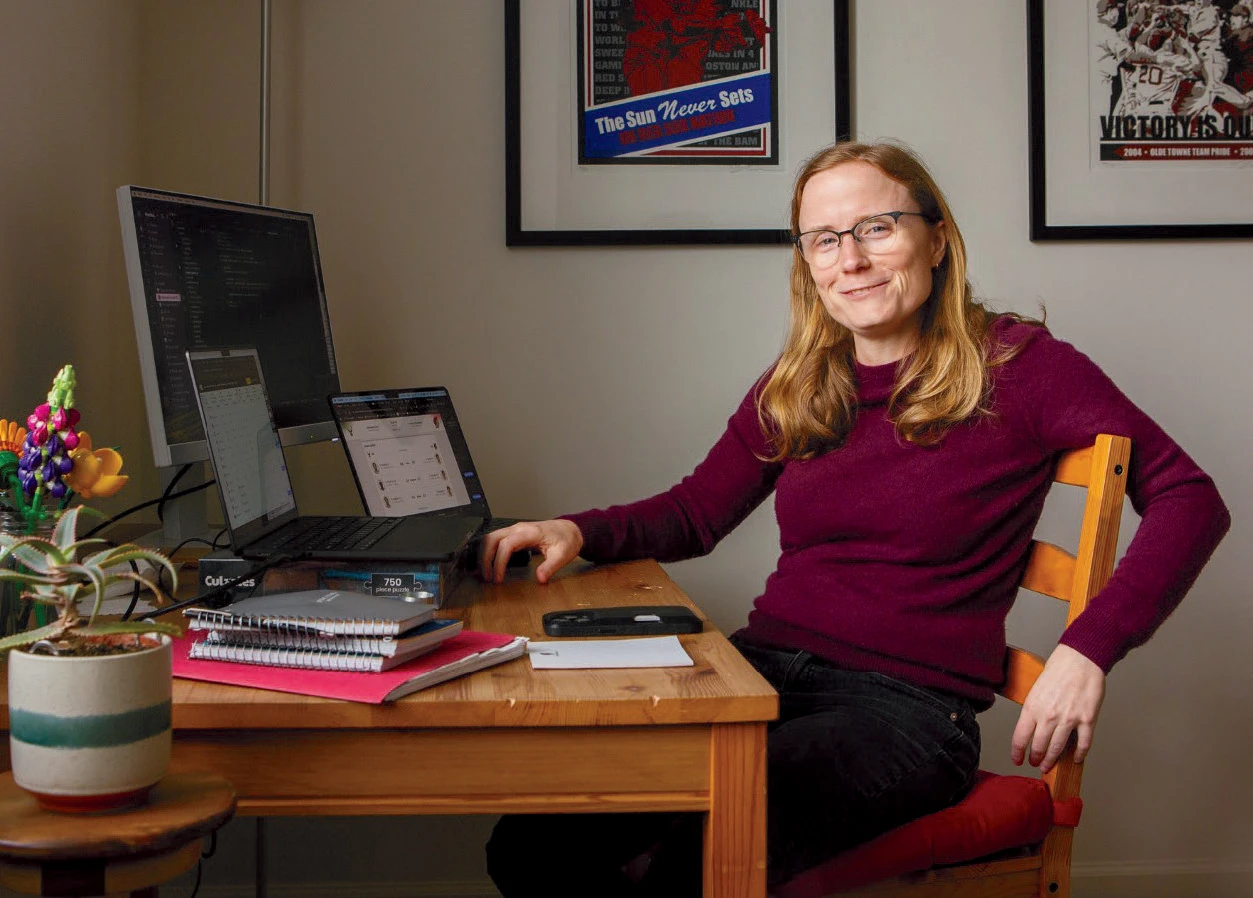
A few hours later, Katherine Evans ’08, Ph.D. ’17—a basketball analytics expert for the Portland Trail Blazers with a doctorate in biostatistics—took a break from working on a team report in her East Coast office to watch her squad on TV as they defeated the Houston Rockets.
These women are part of a growing cadre of female leaders who have taken high-profile roles in the NBA. As the WNBA and women’s college basketball have skyrocketed in popularity—minting megastars like Caitlin Clark and Angel Reese and drawing historic surges in TV viewership—they’ve opened opportunities for women to apply their skills to the men’s league. In return, women are having a palpable impact on everything from coaching to scouting, often applying skills that they honed in women’s sports.
“The general assumption is that working in a male-dominated industry being a woman is hard,” Benzan says. “It is difficult,” she says, but it also can be an advantage. “I see things differently, coming from the women’s game.”
FOR MANY YEARS, opportunities for women were scarce in the upper ranks of men’s professional sports, basketball included. Then came the Women’s National Basketball Association (WNBA), which launched in 1997 with support from the National Basketball Association (NBA) and is part of the NBA family of properties. A number of WNBA franchises share ownership groups and arenas with NBA teams, a proximity that facilitates connections. Becky Hammon, the NBA’s first full-time female assistant coach, played for the WNBA’s San Antonio Stars—which at the time shared an owner with the NBA’s Spurs—before joining the Spurs’ coaching staff in 2014. (She’s now the head coach of the WNBA’s Las Vegas Aces.)
Since then, more than a dozen women have become assistant coaches in the NBA; many have also taken on high-ranking front office roles. And the NBA has promoted opportunities for WNBA players and other women. The league hosts networking events for women in basketball operations at the NBA’s all-star weekend and has opened pathways for current and retired WNBA players—such as the Coaching Development Program, which provides training to help transition from playing to coaching.
In 2016, at the end of an 18-year professional basketball career that included 10 WNBA seasons, Feaster enrolled in the NBA’s Basketball Operations Associate Program, designed to give retired players experience in NBA front offices. She spent time with five teams, including the Celtics, and worked in the G League before returning to Boston. Now, she serves as the Celtics’ vice president of team operations and organizational growth and describes herself as a “culture ambassador” for the organization. Her responsibilities range from providing input on personnel decisions to collaborating with the team’s charitable fund.
In 2018, the Indiana Pacers hired the NBA’s first female assistant general manager, Kelly Krauskopf, who had spent 18 years as general manager of the WNBA’s Indiana Fever. People magazine gushed that she was “shattering the NBA’s glass ceiling.” By the time Katie Benzan was searching for jobs in 2022, working in the NBA was a realistic possibility. Benzan had been an all-conference guard at Harvard and the University of Maryland, where she transferred after graduation, and played in the WNBA before joining the Jazz front office—a job she got after connecting with the team’s CEO.
Not every female NBA executive is a former player. The rise of analytics during the past two decades has also helped women gain a foothold. That was the path for Evans, who grew up near San Francisco during the Oakland Athletics’ pioneering years in baseball analytics—immortalized in the book Moneyball: The Art of Winning an Unfair Game and its movie adaptation. As a doctoral student, she attended statistics conferences with sports sessions and got into basketball after befriending fans of the game.
“I would see things happening on the floor,” Evans recalled, “and think, ‘Oh, that’s a trend I feel like I’m seeing. Does the data back it up?’”
In graduate school, she started sharing her data insights on Twitter, drawing the attention of the Toronto Raptors, which hired her to serve as director of strategic research in 2019. Two years later, Evans became the first woman to lead an NBA analytics department with the Washington Wizards before joining the Trail Blazers.
For women operating in a male-dominated environment like professional sports, statistical evidence can help rising executives command respect from their peers. “Analytics is an equalizer,” says former Harvard basketball player Jessica Gelman ’97, M.B.A. ’02, now a leader in sports analytics as the CEO of Kraft Analytics Group and cofounder of the MIT Sloan Sports Analytics Conference.
“Of course, women have strong voices,” Gelman adds. But they face “unconscious societal influences to not necessarily always be the loudest or whatever it might be in the room. A comfort with data and analytics provides a different perspective and lens that can have a lot of value, impact, and differentiation.”
Many women leaders also bring a distinct perspective on the game based on their playing experiences. Sheer size is less of a factor in women’s basketball than in men’s. And the WNBA tends toward more collaborative offenses rather than the individual shot-creation that can characterize NBA gameplay.
“The women’s game is just inevitably a little bit different,” Benzan explains. “We have our elite athletes, but I think it’s a little bit more cerebral, especially the level that I played at Harvard.” With the Crimson, she says, the goal was not only to “outwork” opponents, but “outsmart” them.
In addition to being the Stars’ general manager, Benzan manages pro scouting for the Jazz. Just as teams she played on employed creative game plans, Benzan tries to be imaginative in identifying players whose attributes would benefit her NBA teams, by spotting what she calls “the why and the how, not necessarily just the what.”
“I personally believe—maybe this is just because I’m a five-six [tall] point guard—that sometimes skill and IQ can outweigh a limited height, limited athleticism,” she says. Superstars like the Denver Nuggets’ Nikola Jokić and the Golden State Warriors’ Stephen Curry were overlooked at first because they didn’t fit the NBA’s typical physical profile. “They clearly had physical limitations,” Benzan says, that made people underestimate them. And they strove to prove the doubters wrong.
This insight helps Benzan discern players’ potential in ways straightforward statistics fail to convey. Take Stars guard Matthew Murrell, who didn’t accumulate the most steals as a college player, but who has a subtle impact on the court. In a February game against the San Diego Clippers, when Murrell was guarding Clippers forward Cam Reddish, he shifted his torso to contest a shot with his left hand, causing Reddish to launch an airball. For Benzan, seeing Murrell play like that—anticipating and dictating his opponent’s moves, rather than reacting on defense—helped explain his value.
“If you look at a box score,” she says, “he may not have the most steals or the most blocks. But he probably alters a lot of shots if you’re watching.”
IN march, the WNBA and its players association reached a new collective bargaining agreement that will more than quadruple minimum player salaries to $270,000. It’s a step toward closing the longstanding gap between women’s and men’s salaries. In the 2024-2025 season, the minimum NBA annual salary was approximately $1.16 million; in the WNBA, it was about $66,000. Such pay discrepancies forced female players to be resourceful, building skills they can put to use in NBA roles.
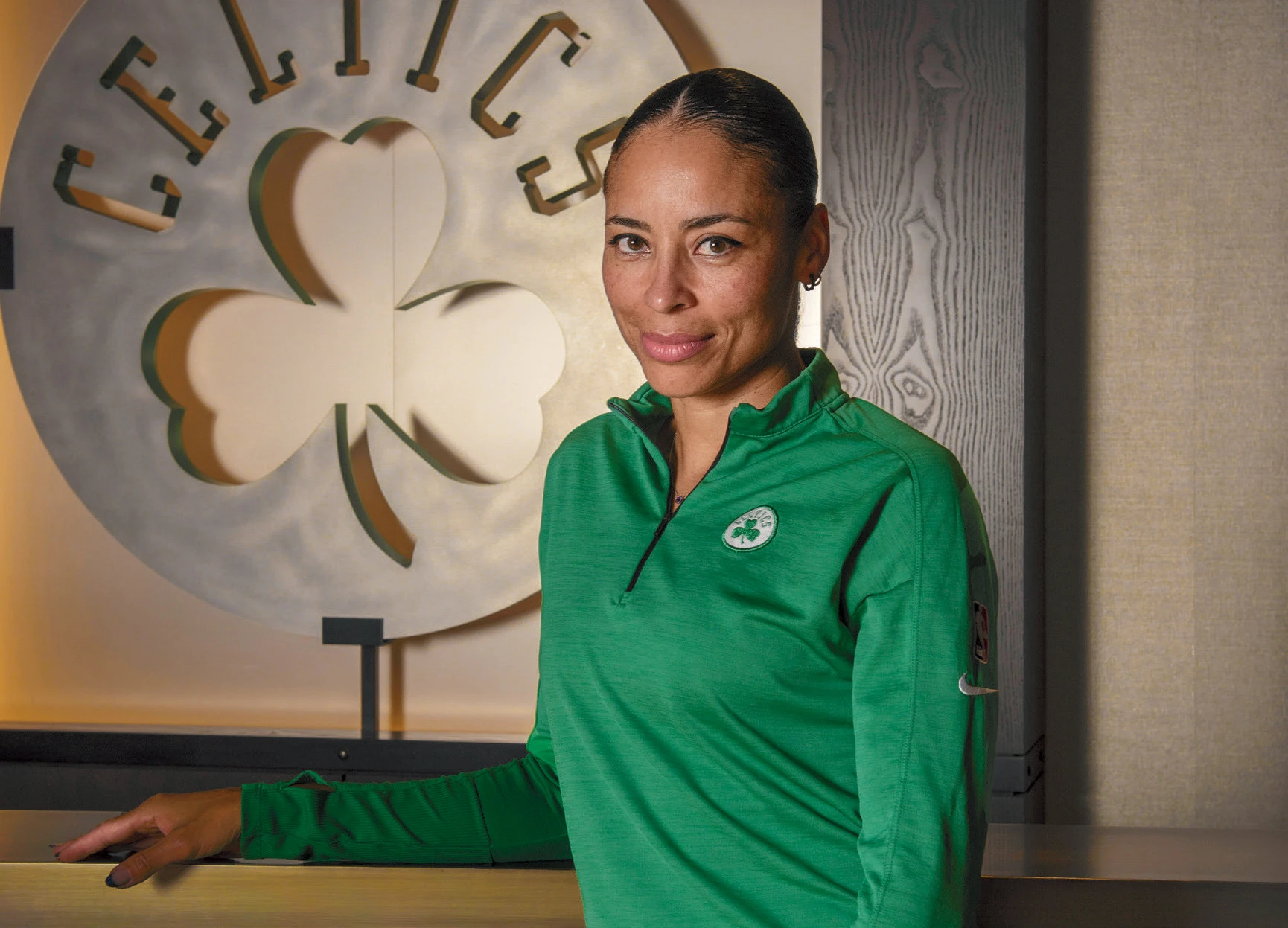
For instance, many WNBA players have supplemented their salaries by playing internationally in the offseason. Feaster played in Portugal, France, Spain, and Italy—all places from which the Celtics have recently recruited players. (She played against Celtics rookie Hugo Gonzalez’s mother in Spain and also earned an MBA from the Universidad Europea in Madrid). She can speak with many of those players in their native tongues.
Feaster believes her experience as the lone American on foreign teams equipped her to be a woman in the NBA. “It’s a beautiful, complex challenge to find common ground so that your team can win,” she says. “That’s how I approached my time abroad, and I think that’s one of the things that has helped me—and, quite frankly, helps any woman who’s had [similar] experiences—be successful in a male-dominated field.”
“It’s a beautiful, complex challenge to find common ground so that your team can win,” Feaster says.
Some women in the NBA say they’ve forged connections with players by modeling relationships from their personal lives. Indiana Pacers assistant coach Jenny Boucek, a single mother who brings her daughter on road trips, recently told the Empowering Leaders podcast: “In some ways, what I’ve heard from these guys is it’s more familiar and more comfortable to have an equipped, strong female in a leadership role in their life.”
Former Harvard player Elise Gordon ’14, an NBA agent, echoes that point. “A lot of these guys come from single-parent households where they were raised by their mom or by their auntie or by their grandma. Or they have sisters,” says Gordon, whose brother Aaron, a Denver Nuggets player, is among her clients.
Those connections can matter in challenging moments. When the COVID-19 pandemic hit in March 2020, the NBA shut down until July and then finished out the season in a restrictive bubble. “There was a lot of vulnerability in the bubble,” recalls Becky Bonner, director of pro personnel for the Orlando Magic. “Guys missed their significant others…they [felt] like they [were] trapped.” Being able to talk about that with a female staff member helped lighten the ordeal.
WOMEN IN THE NBA still face difficulties. In a 2023 interview with the podcast Sports Business Classroom, Bonner described getting stopped more often than her male colleagues by arena security guards who did not realize she was an NBA scout. So far, the league hasn’t had a female head coach or general manager, even as male coaches and general managers are routine in the WNBA.
In other ways, momentum is building. By 2030, the WNBA will add three expansion teams, bringing the total number of teams to 18 (the NBA has 30). This will make more room for talented female players and leaders, some of whom might someday bring their insights to NBA teams.
The league has also taken steps to accommodate female fans, in part due to the influence of women in front office roles. Former Harvard player Elle Hagedorn ’13, the director of global brand communications for sportswear company Under Armour—who previously worked for the National Basketball Players Association—recalls the difficulty of finding women’s basketball shoes when she was growing up. Now, she notes, brands have caught up and recognized the expanding market.
But room for growth remains. Gelman’s firm helped persuade the Denver Nuggets to lower certain ticket prices to attract younger fans, who tend to have less disposable income. “The same thing,” she says, “applies for women and who they might be attending the games with and what their experiences might be, and making it a welcoming and open environment.”
As more women work directly on the game itself—from pioneers like Feaster to analytics gurus like Evans and rising stars like Benzan—many hope that even greater opportunities will come. On a 2022 panel sponsored by the G League for Women’s History Month, Atlanta Hawks vice president Tori Miller likened the rise of women in the NBA to moments when “there’s a new player archetype” who changes the game—like Ben Wallace, who went undrafted in 1996 but became a four-time NBA defensive player of the year and was inducted into the Hall of Fame in 2021.
Scouts sometimes have trouble recognizing the value of an unconventional player, Miller said; they seek an analog where none exists. “But it only takes that one team to…see their uniqueness,” she said, “and then boom, a star is born.”