In the 2010 movie Black Swan, the creepiest moments come in close-up. When Nina, a tightly wound ballerina preparing to dance the lead in a production of Swan Lake, begins losing her grip on reality, feathers start poking through her fingernails and out of her back—the audience perspective is close enough to hear the skin breaking. There are cracking joints, blistered feet, and plenty of blood.
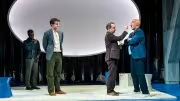
When it came to translating the movie to the stage for a new musical by the same name—premiering at the American Repertory Theater (A.R.T.) on June 3—those horror techniques weren’t going to work. The show’s creators needed to find new ways to express the visceral experience of Nina’s growing madness without claustrophobic cinematography or grisly visual effects. But they took advantage of other opportunities to sow audience discomfort.
In creating the show’s music, for example, composer Dave Malloy and music supervisor Or Matias turned Tchaikovsky’s original Swan Lake score, familiar as wallpaper, into a distressing element. They recorded an orchestra playing Swan Lake in its entirety, then deconstructed it, changing up the rhythm of certain parts, adding effects to others, and overlaying the warped samples with the show’s live pit orchestra.

“It gradually creates this very uncomfortable sensation of, ‘What is happening to this melodic content that used to feel like a safe haven?’” Matias says. “It starts feeling like our skin is itchy.”
Any adaptation of a movie to the stage is a big undertaking, and the A.R.T.’s Black Swan, in the works since 2020, presented its own unique difficulties. The film, written and directed by Darren Aronofsky ’91, follows Nina (Natalie Portman ’03, who gave an Oscar-winning performance) as she prepares to dance the lead in a high-profile production of Swan Lake. As opening night nears, the pressures facing her—from a demanding, predatory director (Vincent Cassel), an overbearing stage mother (Barbara Hershey), a rival dancer (Mila Kunis), and her own ruthless perfectionism—gradually overtake her, untethering her grip on reality.
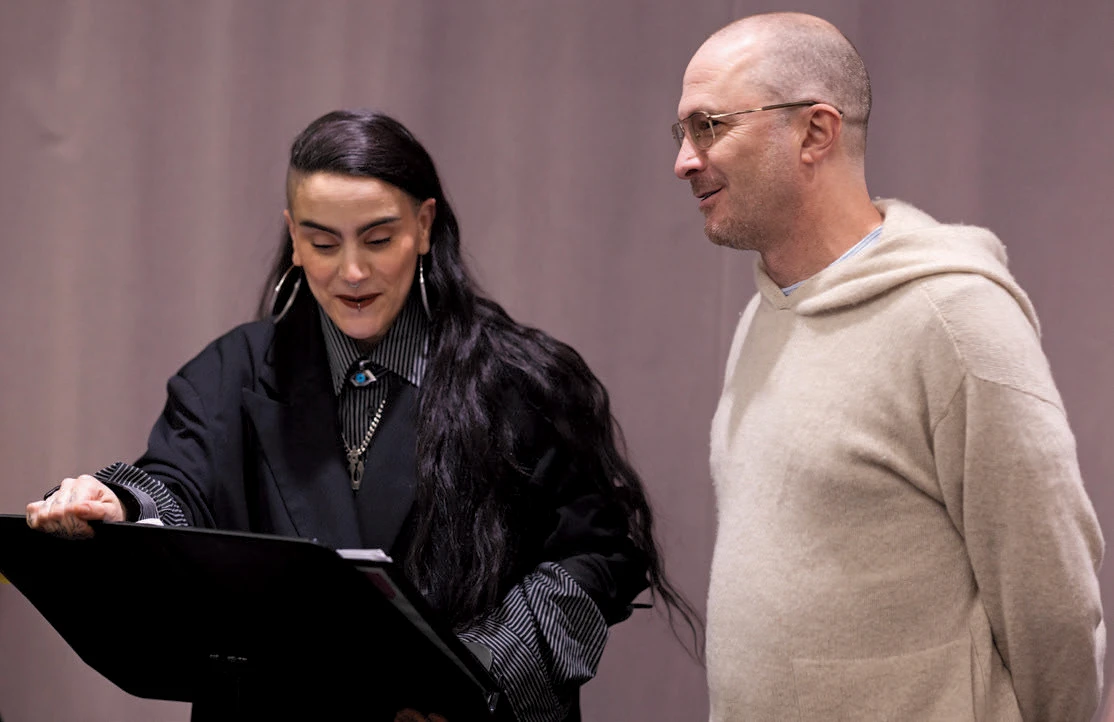
Led by director and choreographer Sonya Tayeh, with music and lyrics by Malloy (whose credits include Natasha, Pierre & the Great Comet of 1812 and the A.R.T.’s Moby-Dick), the musical’s creative team had to solve the puzzle of how to project Nina’s spiraling dread to a live audience. The show needed to effectively build tension and fear—something musicals aren’t structurally built to do.
“In a musical, the introduction of a song is an emotional release,” Matias explains. “Everything has been built up so much, and the song is the pinnacle.”
Perhaps because of that, “thriller is the last genre that you think of in terms of musical theater,” he says. There are a few prominent classics, including Sweeney Todd and Jekyll & Hyde, and a handful of adaptations of dark-comic movies like Heathers and American Psycho. But not many.
Tayeh—a Tony winner for Moulin Rouge! and a frequent choreographer for the reality competition show So You Think You Can Dance—was up for it. “I’m a humongous thriller and horror fanatic,” she says, counting Hereditary and Carrie among her favorite movies. With Black Swan, “you add dance to it, and the battle within oneself, and it’s a whole other intensity.”
The necessary adjustments to sustain the terror of the movie, and to fill up the stage with it, permeate the musical. This Black Swan has a tweaked, expanded cast of characters, a score of throbbing electronica colliding with classical harp and oboe, and an unflinching focus on dance—both by way of Tayeh’s direction and time spent narratively grappling with Swan Lake itself, the “show within the show.”
“We’re being structurally faithful to Nina’s journey,” says playwright Jen Silverman, who wrote the musical’s book. “In other elements, we went very far from the film. And the producers and Darren were like, ‘Sure, do that. Experiment.’”
Aronofsky’s initial inspiration for the movie Black Swan came from Fyodor Dostoevsky’s novella The Double, in which a man goes insane when his doppelgänger takes over his life.
“I always found that idea of losing your identity as a great basis for a horror film, and I knew I wanted to set it in the ballet world,” Aronofsky wrote in an email. “When I saw Swan Lake during that time, it was an amazing ‘aha’ moment because there’s a double in the ballet. That kind of got the ball rolling.”
Swan Lake, which premiered at Moscow’s Bolshoi Theatre in 1877, tells the story of a prince who falls for a young princess, Odette, one of a group of young girls turned into swans by an evil sorcerer—a spell the prince’s love has the power to break. The sorcerer then tricks the prince into betrothal with his own daughter, Odile (typically played by the same dancer as Odette). In the earliest stagings, Odette and the prince die together by throwing themselves into a lake.
That basic plot has changed, in various productions, for nearly the entire century and a half of Swan Lake’s existence. In some stagings, Odette dies alone in her grief. In others, such as productions for children, she gets a happy ending. In many, the evil sorcerer is a woman.
The ballet itself is a background element of Aronofsky’s film, which unfolds from Nina’s viewpoint and focuses on her interior struggle. Most of the dancing appears in rehearsal or in close-up, outside of a few wide stage shots and bits of dialogue describing it. Though Portman trained intensively in preparation for the role, the ballet serves mainly as a container for Nina’s mental and physical turmoil (including the bloody sprouting of feathers).
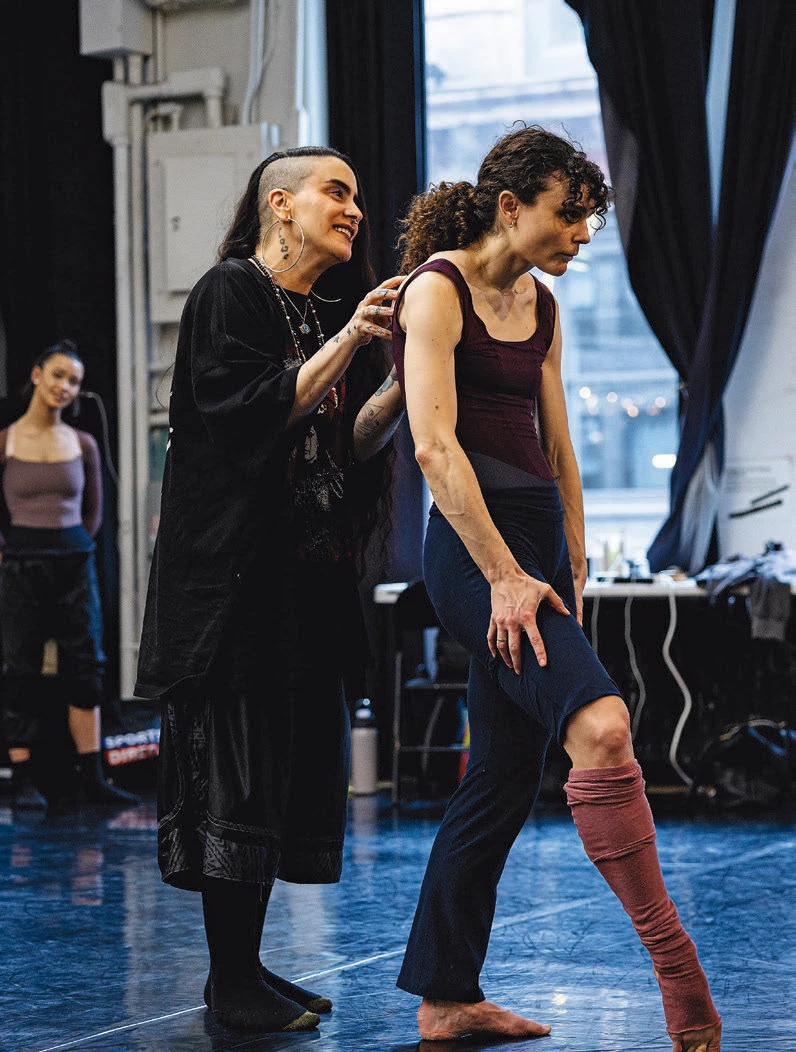
Putting the story on a literal stage demanded more time spent on the choreography—and on the company’s role. Matias says the Black Swan creative team set out to “create an epic dance musical,” with Malloy’s songs tailored to fit Tayeh’s choreography and staging.
“In a traditional musical, you have writers working by themselves, then a director comes on board, and then at some point, a choreographer builds dance to support the songs. Here, a lot of it has been the opposite,” Matias says. “Sonya would come up with an idea and say, ‘This is the kind of storytelling I’m looking to accomplish over this three-minute movement segment,’ and we would sit in a room with the dancers and build it together. Dave would sit there with his laptop and headphones while Sonya was doing movement and counts, and I would be bouncing between them.”
The musical Black Swan carries tension forward through the progression of those dance numbers, which, like Malloy’s score, start from a foundation of traditional ballet elements and become more modern, jagged, and chaotic as Nina’s story unfolds, according to the musical’s creative team.
Tayeh’s career has been built on that sort of genre-blurring. She started as a teenage freestyle house dancer and didn’t take a formal ballet class until college; now, her credits range from Broadway shows to choreography for pop stars including Kylie Minogue and Miley Cyrus.
“The body can do so much to tell a story,” she says. “So, [Black Swan] has dancing from this traditional point of view, and it morphs into another world.”
Another element Tayeh wanted to bring over from the screen was the audience’s feeling of confusion as Nina gradually loses her sense of where she ends and what Tayeh calls her “shadow self” begins.
In Aronofsky’s film, “there’s all this mirror imagery everywhere [Nina] is,” Tayeh says. Without revealing the show’s twists and surprises, she hints that a mirror motif will pervade the choreography and staging, as a way to throw perspective off balance and make audience members question what they are actually seeing.
“With Natalie [Portman], her reflection was everywhere,” Tayeh says of the movie. “It reminded me that within this story, these people are always being looked at, are always being watched. And that was a big inspiration for me, how to evoke these multiple sides, your own monster within you.”
Within the musical, bringing Swan Lake more fully to life has also meant expanding the corps of dancer characters—more of them have names and speaking roles than in the film—and fleshing out their relationships. Nina’s rival is now an old childhood friend, a change that deepens and complicates that dynamic in contrast to the film, where Mila Kunis’s character, Lily, is a stranger.
“So much of the power of theater, especially in dance, is bodies on a stage—who else is there, how people play off each other,” Silverman says. “So, it felt pretty clear to all of us that we wanted to really invest in the characters around Nina as well.”
Another significant change from Aronofsky’s script: Thomas Leroy, a male choreographer who emotionally and sexually preys on Nina, became Margaux LeRoy, a veteran female dancer turned choreographer whose continued, hard-won professional survival hangs on the success of her bold new ballet.
Silverman explains that the musical’s creative team wanted to account for changes in society in the 15 years since the movie came out—most notably the #MeToo movement, which brought stories of gender-based power imbalances and predatory behavior to the fore.
In the film, “Darren wanted to have a character who represented the overreaches that were quite common in that industry,” says Silverman, citing stories of abusive behavior by famous ballet directors, including New York City Ballet cofounder George Balanchine. “Approaching that material now, it would be hard to replicate that dynamic without Black Swan becoming a #MeToo story, and that didn’t feel like what we were trying to chase. Darren was very open to that.”
Changing LeRoy’s motivations subtly broadens the stakes and anxiety around the Swan Lake production in the musical—in a workshop version of the musical, one character complains that LeRoy’s adaptation disrespects the original ballet and risks alienating audiences. In response to the pressure around her, LeRoy pushes her dancers to the brink.
“Nina’s life is changed by meeting this person,” Silverman says. “She wants to please her. And she crumbles and twists her shape under the weight of that.”
At press time, Tayeh and the rest of Black Swan’s team were in the middle of dance workshops in New York and about to begin rehearsals at the A.R.T.’s Loeb Drama Center in Cambridge. Previews begin on May 26.
Aronofsky, who has been a sounding board throughout the creation process, wrote that he’s looking forward to seeing the “root energy” of his film brought to life in a new way: “I love how scary it is and how crazy it is, and I’m excited for audiences to experience it.”
For Silverman, who has spent so much time with the story, seeing it on a stage for the first time after years of drafts has led to a deeper understanding of what both the film and stage versions are saying about the brutal demands of making art at the highest level.
“The thing that struck me in a whole new way was the rigors that these dancers go through, what it does to their bodies and their minds,” Silverman says. “That can be both crushing and transcendent.”
Harvard Magazine Questionnaire: Art in Adaptations
Inspired by the recent Black Swan adaptation, we’re asking readers to tell us their favorite adaptation of a story from one art form to another (book to movie, movie to stage show, video game to TV show, etc.)—and why they love it. Add your voice to the conversation. Responses may be published online and in print.