In 2017, a paper titled “Attention Is All You Need” sent a jolt through the field of artificial intelligence—and through poet Sasha Stiles ’02. Published by Google researchers, it was the first to describe an approach to deep learning that now underpins ChatGPT and most other large language models.
Back then, Stiles didn’t understand terms like “transformer-based architecture” or “natural language processing,” but she grasped that new systems were being built to write like humans. “And as someone who loves language,” she says, “that just kind of lit my brain on fire.”
Nine years later, AI is a core part of Stiles’s artistic practice. She composes poetry with what she calls her AI “alter ego,” trained on her own poems, creating a voice that both is and isn’t hers. She has described this as a kind of perpetual déjà vu: lines she’s never written emerge like echoes of herself. In 2022, she published Technelegy, a collection of poems composed this way, and recently the Museum of Modern Art (MoMA) in New York exhibited Stiles’s installation, A Living Poem. On a 25-foot LED screen in the museum’s garden lobby, live-generated verses—some playful, some profound—appeared in hypnotic succession. Every hour, the poem rewrote itself, with no two versions exactly the same. “Do you believe in soft systems?” one version read. “Entangled roots, mycelial intelligence, ancestral wisdom. Code as kin.”
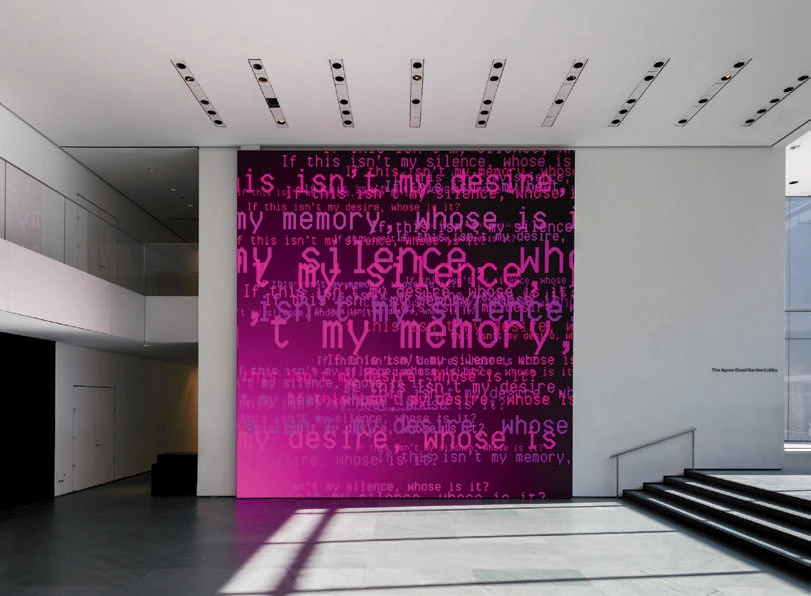
The exhibit closed in March (although it remains on the museum’s website, where the poem continues rewriting itself), and this spring, Stiles published A Living Poem: The MoMA Codex, a limited-edition book combining essays on the artwork with information about the codes, processes, and influences that made it possible.
A writer since childhood, Stiles studied literature at Harvard and has been obsessed with language for as long as she can remember, especially its power to shape human experience. But science was also ever-present. Her parents are documentary filmmakers who worked with Carl Sagan on Cosmos, and Stiles, born in 1980, came of age with the internet. Her early poems often revolved around speculative futures and technological upheavals. She became curious about ideas like transhumanism and digital immortality. “I was very intrigued,” she says, “by this question of, ‘What does it mean to be human as we’re evolving into this era of increasingly nonhuman presences?’”
Then the Google paper came out, and Stiles dove deeper into research on AI and early language bots. In 2019, when GPT-2, a precursor to today’s ChatGPT, was released, she fed it some lines of her own poetry to see what it would yield. Some of the results were beautiful, others banal or even obscene. Before long, Stiles was building fine-tuned versions of chatbots, trained on datasets of her own poetic manuscripts. (For the MoMA exhibit, she also added in publicly available data from text-based artworks in the museum’s collection—such as their titles, artists, years, and materials.)
Poetry and AI aren’t as odd a match as it may seem, says Stiles. In fact, she sees poetry itself as a form of technology. The earliest poems, she notes, began as a way to store data. “Before we had external hard drives, or archives, or even written language,” Stiles says, “humans invented poetic devices like rhyme and repetition to memorize and transmit important stories and information.”
Stiles’s work reaches back to that oral era. A Living Poem wasn’t just glowing words on a screen; it included a woman’s voiceover and an atmospheric soundscape by Stiles’s studio partner, Kris Bones. The ephemeral, ever-changing text was anchored by recurring refrains.
The metaphor of poetry as data storage speaks to Stiles on a more personal level, too. Her mother’s family are Kalmyks, a Buddhist ethnic group originally from Mongolia, whose language is now endangered. Stiles, who has written about experiencing language as “both inheritance and loss,” has used AI to preserve translations of her family members’ speech, and she also tucked a few lines from the Kalmyk Epic of Jangar—a traditional poem originally passed down through folk singing—into the dataset for A Living Poem.
She has experimented with using AI to translate her own poetic voice into Kalmyk, as a way to explore ideas of cultural transmission and ancestral knowledge. “This is something I’m really wrestling with,” she says. As her family’s language slips away, the task feels increasingly urgent. Language is a precious technology. Without it, she says, “we wouldn’t be human.”