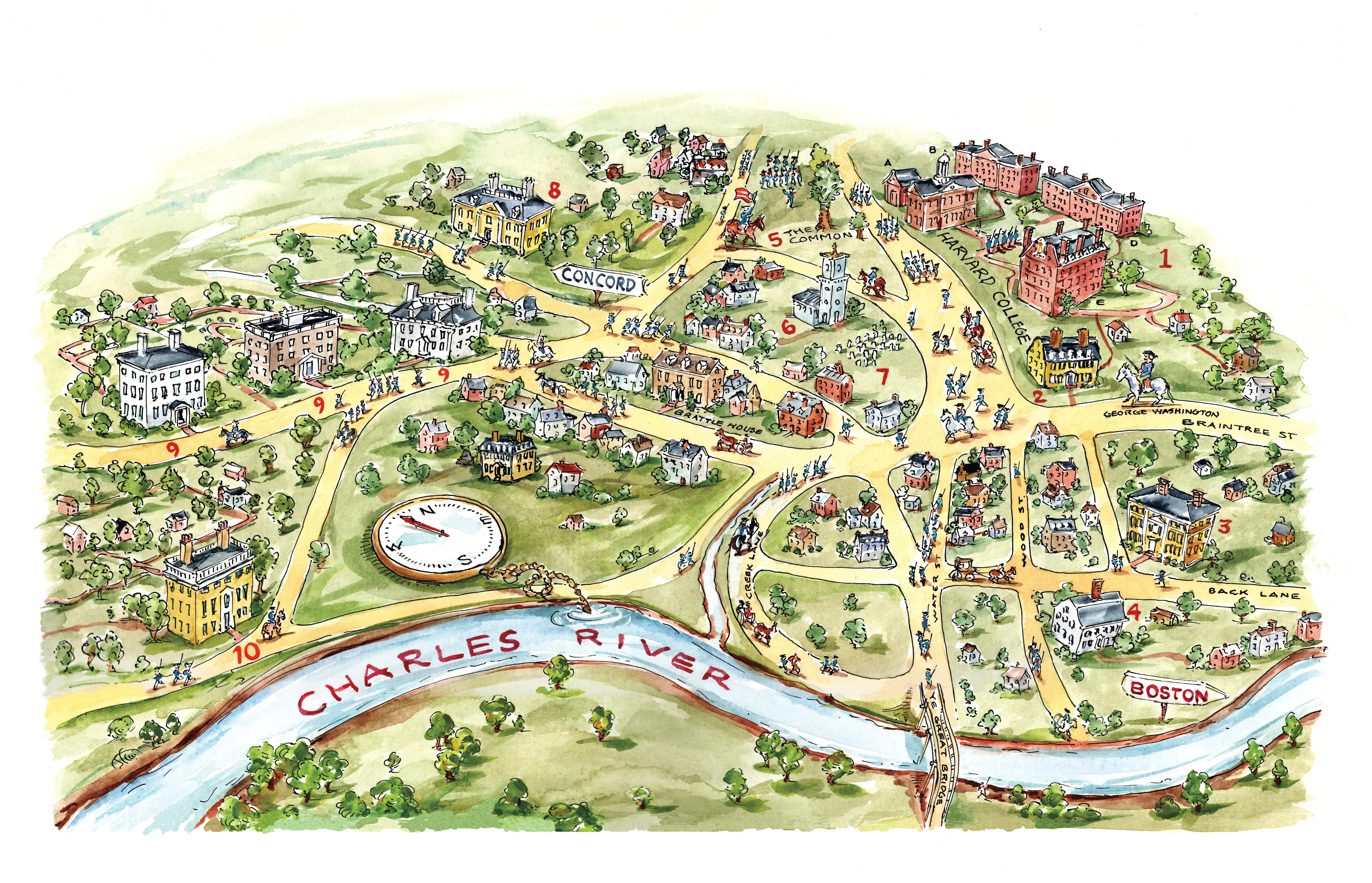
Colorful illustrated map of Colonial Cambridge and the Harvard College campus featuring buildings of the campus, houses, Cambridge Common, and the Charles River

Please see below for an interactive version. (Map is not to scale.)  | Illustration by Mark Steele

250 Years Ago, Harvard Was Home to a Revolution

A look at the sights, sounds, and characters that put the University on the frontlines of history

Editor's note: For an interactive map of Cambridge in revolutionary times, see below. 

In the years leading up to the American Revolution, Cambridge was a hub of intellectual fervor, planning, and preparation. All around Harvard Square today are reminders of those turbulent days, from the classrooms and dormitories that once housed Patriot troops to the stately homes that some Loyalists fled as Revolutionary passions grew. Certain sites are now familiar landmarks: Christ Church, the Old Burying Ground, and Cambridge Common, where George Washington first took command of the Continental Army. Many have since become part of the University’s footprint. In Apthorp House, now part of Adams House, General Israel Putnam planned the Battle of Bunker Hill. Elmwood, now the Harvard president’s official residence, became a hospital during the war. John Hicks’s residence, now the Kirkland House Library, housed officers from Washington’s army. And Washington briefly quartered at Wadsworth House before he made the Vassall mansion—now Longfellow House—his headquarters.

Interactive Charles River map with 10 annotated historical landmarks
100% Scroll · pinch · tap pins
Charles River historical map


It’s possible, with a little imagination, to conjure the atmosphere of those days and picture the characters who crossed paths in these streets—some of them etched in every history textbook, many of them lesser-known. In the following pages, you’ll find some of their stories: an inspiring doctor turned general who met a tragic end; a resourceful youth who grew to become a prominent Black abolitionist; a politician committed to advancing natural rights; a woman who wrote witty missives against tyranny; and the Harvard students who departed campus for a memorable year to make room for the war effort. These dreamers, thinkers, and fighters joined together to shape history, ensuring that Harvard’s path would always be intertwined with the nation’s.
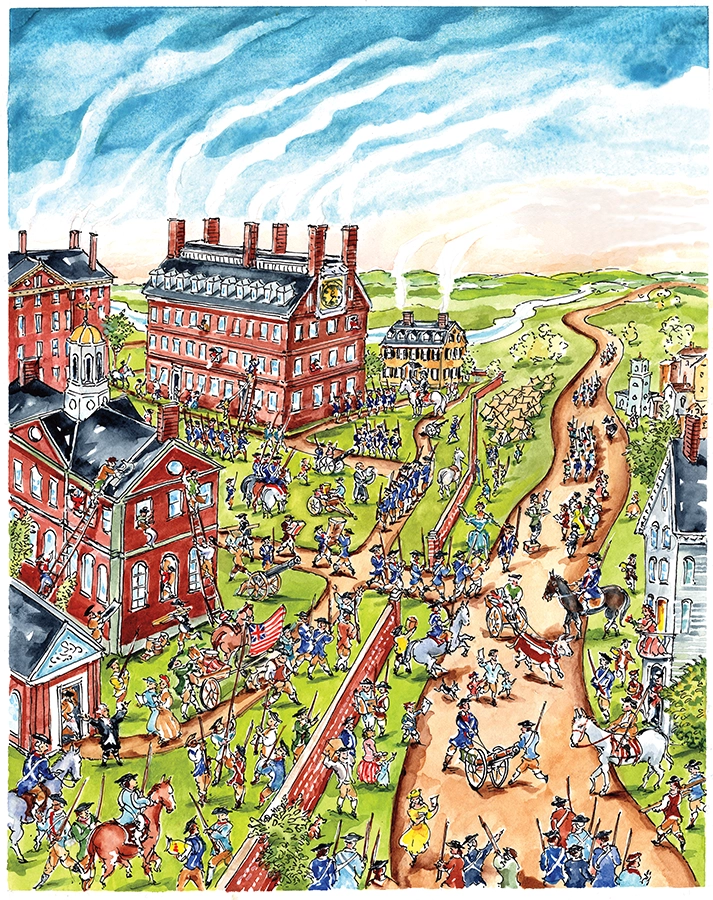



Illustrated birds-eye view of the Harvard College Campus and Cambridge during the American Revolution and the occupation of American soldiers
Illustration by mark Steele
Related topics

You might also like

How the American Revolution Freed a Future Abolitionist

Darby Vassall, an enslaved child freed after the Battle of Bunker Hill, dedicated his life to fighting for liberty.

The Costly Choice Native Americans Faced

How the Revolution reshaped indigenous New England

When the Revolution Hit Cambridge, Harvard Moved to Concord

College students broke hearts and windows during their year in exile.

Most popular

Harvard’s Class of 2029 Reflects Shifts in Racial Makeup After Affirmative Action Ends

International students continue to enroll amid political uncertainty; mandatory SATs lead to a drop in applications.

Harvard Weathers a Year of Turmoil

The federal government has launched unprecedented actions against the University. Here’s a guide.

Explore More From Current Issue

Portrait of a man with white hair, wearing a black coat, arms crossed, thoughtful expression.

The Framer Who Refused to Sign the Constitution

Harvard’s Elbridge Gerry helped draft the U.S. Constitution, but worried it might create a new monarch.

Mercy Otis Warren in period attire writes at a desk by candlelight, surrounded by books.

The Woman Who Penned the Case for War

Mercy Otis Warren’s poetry and plays incited the Patriot movement.

A woman with long hair leans on a table, looking out a large window with rain-streaked glass.

A Harvard Economist Probes the Affordable Housing Crisis

From understanding gender pay gaps to the housing crisis, Rebecca Diamond’s research aims to improve lives.