1915 Undergraduate protests against beer at class banquets prompt Bulletin editors to note that "the increase of abstinence and temperance throughout American society has become almost a commonplace observation."
Illustration by Mark Steele
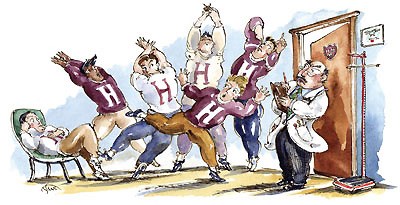
1920 A physical examination of all 700 first-years, in connection with a new system of compulsory freshman athletics, has classified each student according to "bodily mechanics" (posture). Only 7.5 percent demonstrated "good mechanical use of the human body"; 12.5 percent were "fairly good"; a full 55 percent exhibited "bad use." The 25 percent who demonstrated "very bad mechanical use" must do special exercises until they show improvement.
1925 The Crimson has been campaigning to persuade the University to buy a plot of land at the northwest corner of Mount Auburn and Holoyke streets [the present site of the University Health Services], but, the editors report, Harvard's finances "apparently do not permit it to compete with real-estate dealers" in buying land immediately south of the Yard.
1930 In the wake of "unprecedentedly light" voting for senior class officers, the editors opine that "college classes which have 500 members or more are too inchoate to inspire the feeling of kinship that animated the classes of a generation or two ago" and wonder what effect the new "House Plan" will have.
1940 In summing up a radio talk on physical fitness by Harvard's assistant director of physical education, the editors note that "the present generation of Harvard men are taller and heavier than their fathers and grandfathers. Their posture seems not to have undergone a parallel improvement...."
1950 The Faculty of Arts and Sciences petitions the governing boards of Harvard and Radcliffe to extend the "joint instruction" of male and female students (still restricted to upperclass and graduate courses) to selected freshman courses.
1955 The Overseers second the Corporation's vote to admit qualified women to the Divinity School in September. Women are already enrolled in the schools of education, public health, design, public administration, medicine, and law.
1970 Signs of the Times I: The slate of Overseer candidates includes three alumni who graduated within the past 15 years, as well as one woman. Signs of the Times II: The Committee on Houses has ruled that Radcliffe students may take breakfast in the Houses.
1980 Harvard has acquired a three-acre parking lot opposite the Harvard Square post office for $4 millionthe largest deal to date in the University's real-estate history.