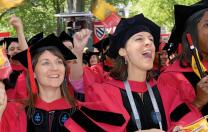
Excerpts from the Commencement address by William H. Gates III, co-founder and chairman of Microsoft Corporation and co-founder and co-chair of the Bill & Melinda Gates Foundation.
I was transformed by my years at Harvard, the friendships I made, and the ideas I worked on.
But taking a serious look back…I do have one big regret.

Photograph by Stu Rosner
William H. Gates III
I left Harvard with no real awareness of the awful inequities in the world—the appalling disparities of health, and wealth, and opportunity that condemn millions of people to lives of despair.
I learned a lot here at Harvard about new ideas in economics and politics. I got great exposure to the advances being made in the sciences.
But humanity’s greatest advances are not in its discoveries—but in how those discoveries are applied to reduce inequity. Whether through democracy, strong public education, quality healthcare, or broad economic opportunity—reducing inequity is the highest human achievement.
I left campus knowing little about the millions of young people cheated out of educational opportunities here in this country. And I knew nothing about the millions of people living in unspeakable poverty and disease in developing countries.
It took me decades to find out.…
See also: Full text
Imagine, just for the sake of discussion, that you had a few hours a week and a few dollars a month to donate to a cause—and you wanted to spend that time and money where it would have the greatest impact in saving and improving lives. Where would you spend it?…
During our discussions on this question, Melinda and I read an article about the millions of children who were dying every year in poor countries from diseases that we had long ago made harmless in this country. Measles, malaria, pneumonia, hepatitis B, yellow fever. One disease that I had never heard of, rotavirus, was killing half a million children each year—none of them in the United States.
We were shocked. We had assumed that if millions of children were dying and they could be saved, the world would make it a priority to discover and deliver the medicines to save them. But it did not. For under a dollar, there were interventions that could save lives that just weren’t being delivered.
If you believe that every life has equal value, it’s revolting to learn that some lives are seen as worth saving and others are not. We said to ourselves: “This can’t be true. But if it is true, it deserves to be the priority of our giving.”…
We asked: “How could the world let these children die?”
The answer is simple, and harsh. The market did not reward saving the lives of these children, and governments did not subsidize it. So the children died because their mothers and fathers had no power in the market and no voice in the system.
But you and I have both.
We can make market forces work better for the poor if we can develop a more creative capitalism….
If we can find approaches that meet the needs of the poor in ways that generate profits for business and votes for politicians, we will have found a sustainable way to reduce inequity in the world.
This task is open-ended. It can never be finished. But a conscious effort to answer this challenge can change the world.
I am optimistic that we can do this, but I talk to skeptics who claim there is no hope. They say: “Inequity has been with us since the beginning, and will be with us until the end—because people just…don’t…care.”
I completely disagree.
I believe we have more caring than we know what to do with.…
The barrier to change is not too little caring; it is too much complexity.
To turn caring into action, we need to see a problem, see a solution, and see the impact. But complexity blocks all three steps.…
The AIDS epidemic offers an example. The broad goal, of course, is to end the disease. The highest-leverage approach is prevention. The ideal technology would be a vaccine that gives life-long immunity with a single dose. So governments, drug companies, and foundations are funding vaccine research. But their work is likely to take more than a decade, so in the meantime, we have to work with what we have in hand—and the best prevention approach we have now is getting people to avoid risky behavior.…
The final step—after seeing the problem and finding an approach—is to measure the impact of the work and to share that success or failure so that others learn from your efforts.
You have to have the statistics, of course. You have to be able to show, for example, that a program is vaccinating millions more children. You have to be able to show, for example, a decline in the number of children dying from the diseases. This is essential not just to improve the program, but also to help draw more investment from business and government.
But if you want to inspire people to participate, you have to show more than numbers; you have to convey the human impact of the work—so people can feel what saving a life means to the families affected.…
Still, I’m optimistic. Yes, inequity has been with us forever, but the new tools we have to cut through complexity have not been with us forever. They are new—they can help us make the most of our caring—and that’s why the future can be different from the past.
The defining and ongoing innovations of this age—biotechnology, the personal computer, and the Internet—give us a chance we’ve never had before to end extreme poverty and end death from preventable disease.
Sixty years ago, George Marshall came to this commencement and he announced a plan to assist the nations of postwar Europe. He said: “I think one difficulty is that the problem is one of such enormous complexity that the very mass of facts presented to the public by press and radio make it exceedingly difficult for the man in the street to reach a clear appraisement of the situation. It is virtually impossible at this distance to grasp at all the real significance of the situation.”
Thirty years after Marshall made his address, as my class graduated without me, technology was emerging that would make the world smaller, more open, more visible, less distant.
The emergence of low-cost personal computers gave rise to a powerful network that has transformed opportunities for learning and communicating.
The magical thing about this network is not just that it collapses distance and makes everyone your neighbor. It also dramatically increases the number of brilliant minds we can bring in to work together on the same problem—and it scales up the rate of innovation to a staggering degree.…
Members of the Harvard Family: Here in the Yard is one of the great collections of intellectual talent in the world.
For what purpose?
There is no question that the faculty, the alumni, the students, and the benefactors of Harvard have used their power to improve the lives of people here and around the world. But can we do more? Can Harvard dedicate its intellect to improving the lives of people who will never even hear its name?
Let me make a request of the deans and the professors—the intellectual leaders here at Harvard: As you hire new faculty, award tenure, review curriculum, and determine degree requirements, please ask yourselves:
Should our best minds be more dedicated to solving our biggest problems?
Should Harvard encourage its faculty to take on the world’s worst inequities? Should Harvard students know about the depth of global poverty…the prevalence of world hunger…the scarcity of clean water…the girls kept out of school…the children who die from diseases we can cure?
Should the world’s most privileged learn about the lives of the world’s least privileged?
These are not rhetorical questions—you will answer with your policies.…
When you consider what those of us here in this Yard have been given—in talent, privilege, and opportunity—there is almost no limit to what the world has a right to expect from us.…
Don’t let complexity stop you. Be activists. Take on big inequities. I feel sure it will be one of the great experiences of your lives.…
You have more than we had; you must start sooner, and carry on longer.
And I hope you will come back here to Harvard 30 years from now and reflect on what you have done with your talent and your energy. I hope you will judge yourselves not on your professional accomplishments alone, but also on how well you have addressed the world’s deepest inequities…on how well you treated people a world away who have nothing in common with you but their humanity.
Good luck.


