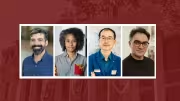
Combining forces, Henry Louis Gates Jr., the Fletcher University Professor, and Maria Tatar, Loeb professor of Germanic languages and literatures and of folklore and mythology, have jointly edited The Annotated African American Folktales (Liveright, $39.95), and contributed a foreword and an introduction, respectively. From “Recovering a Cultural Tradition,” the essay by Tatar (who was profiled in these pages in “The Horror and the Beauty,” November-December 2007):
The stories in this volume have designs on us. They take us out of our comfort zones, shaking us up in the process and sometimes even rewiring our brains. Their wizardry puts us back in touch with lived experience and reconnects us with a history that many have wanted to put behind them. Their expressive intensity enables us to explore the institution of slavery in the United States, the strategies used to survive as well as the ways of managing the complex legacy still with us today. The stories in this volume entered the bloodstream of the vernacular to become communal wisdom in an era when few had access to the instruments of writing and reading. They were meant to entertain, but also to provoke conversation and promote collective problem-solving. Their every word reminds us of the high-wattage power of stories and histories.…
How do you make something from nothing? Or from something that appears to be nothing? African American slaves may not have owned property, but no one could prevent them from storing, remembering, recounting, and, over time, creating and re-creating their own cultural property in the form of songs, stories, and belief systems. They used narratives and other forms of expressive culture not just to strategize and survive, but also to create symbolic and imaginative spaces to which they could escape, almost like an alternate universe, where they could live and breathe. “The entire sacred world of the black slaves,” American historian Lawrence Levine writes, “created the necessary space between the slaves and their owners and were the means of preventing legal slavery from becoming spiritual slavery.” These were anything but the much-heralded public spaces of freedom that are the signature of democratic societies. Instead, they were private arenas, imaginary playgrounds, secular as well as sacred, in the fields, by the fire, and in cabins. Song and story emerged, often in the form of narratives encoded with symbolic meaning—things made up for the purpose of diverting and entertaining, and also for focusing and concentrating propulsive energies that could not be contained.