L. Mahadevan on What Makes the Asiatic Lily Bloom

A Harvard professor explores the physical forces that open a flower bud.

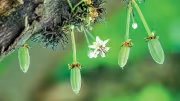
The Asiatic lily, <i>Lilium casablanca.</i>

The Asiatic lily, Lilium casablanca. | Courtesy Flickr user KingsbraeGarden

How do the petals of the white Asiatic lily form and unfurl to become a flaring trumpet? This is the sort of question most people never even think to ask—and if they did ask, might quickly abandon as either insurmountably complex or too trivial to consider. But fundamental and easily overlooked questions fascinate Valpine professor of mathematics Lakshminarayanan Mahadevan. (See his "Applied Math" laboratory website, too.)

Working with Haiyi Liang, formerly a postdoctoral fellow at the School of Engineering and Applied Sciences (SEAS) and now a professor at the University of Science and Technology of China, in Hefei, Mahadevan discovered that rapid growth in cells at the periphery of the petals leads to wrinkle-induced stress within the flower bud that forces it open and drives the subsequent development of the blossom. The discovery has connections to earlier work by Mahadevan on ruffles at the edges of kelp, and, by analogy, to crochet and to the way the brain folds during development, as described in "The Physics of the Familiar," a feature article about his work from Harvard Magazine's archives; see also the associated video of Mahadevan's discoveries.

As former SEAS dean Venkatesh Narayanamurti has said of him, “Maha is not only a tremendous applied mathematician, he truly is a kind of Renaissance thinker. Is he an applied mathematician? Is he an engineer? Is he a computational biologist? Or is he an applied physicist? He is all of the above.”
Related topics

You might also like

From competing in youth gymnastics to studying tetrapods, the Harvard curator has always chased her curiosity.

Sheila Jasanoff has spent her career studying how societies produce knowledge, evaluate expertise, and make decisions about technology.

Harvard’s Arthur Kleinman reflects on what’s lost when healthcare systems prioritize efficiency.

Most popular

The University will compensate families of those whose remains were sold and establish a scholarship to honor anatomical donors.

Harvard’s Class of 2029 Reflects Shifts in Racial Makeup After Affirmative Action Ends

International students continue to enroll amid political uncertainty; mandatory SATs lead to a drop in applications.

Harvard Weathers a Year of Turmoil

The federal government has launched unprecedented actions against the University. Here’s a guide.

Explore More From Current Issue

A woman with curly blonde hair sits casually against a stone wall, wearing a black top and jeans.

Chloe Chapin trains her Broadway costume designer’s eye on the history of men’s fashion.

A man in a suit speaks at a podium.

David Battat promotes alumni engagement.

Smiling woman stands beside a large skull in a display cabinet.

From competing in youth gymnastics to studying tetrapods, the Harvard curator has always chased her curiosity.