
The sesquicentennial of college athletics in America takes place June 8 on the Thames (rhymes with "James") River in New London, Connecticut, when the Harvard and Yale heavyweight crews line up for a race that celebrates its 150th anniversary this year. Intercollegiate sports in this country, from the bowl games to the NCAA's "Final Four," were born when crews from Harvard and Yale tested each other on Lake Winnipesaukee in New Hampshire on August 3, 1852. (Ironically, commerce played a larger part then: a publicity-minded agent for the Boston, Concord & Montreal Railroad sponsored the regatta to promote excursion trains.) Harvard's boat Oneida won the first race, about four lengths ahead of the Shawmut, the faster of two Yale entries.
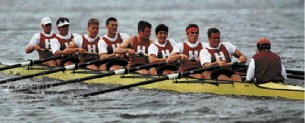 |
| Last year's heavyweight varsity finished more than 37 seconds ahead of Yale after four miles. |
| Photograph by Jon Crispin |
"Rowing was perhaps the most popular recreational activity in the United States at the time," says Harry Parker, head coach of heavyweight men's crew. "I don't think many people realize how extensive it was at Harvard and Yale, and throughout the country. There were small rowing clubs in just about every significant city in the United States and at many of the colleges then in existence."
The Harvard-Yale regatta gradually evolved into a major sporting event that even attracted heavy betting. In 1925 an estimated 100,000 spectators came to watch. Special 32-car observation trains with grandstands atop flatcars rolled along the riverbank to follow the crews. Last year, the observation trains made a comeback. It's a ride of around 20 minutes to track the four-mile varsity event, the longest race regularly rowed in the Western Hemisphere. (Worldwide, only the Oxford-Cambridge boat race, at four and one-quarter miles, is longer. But that race takes place on a tidal stretch of the "other" Thames, so it's briefer than the grueling four-milers in New London.)
All other spring crew races use 2,000-meter (circa 1.25 mile) courses, the standard international distance rowed at the Olympic Games. But in 1876, long before the modern Olympics, Harvard and Yale settled on a four-mile contest, probably modeled on the Oxford-Cambridge race. (The freshman and junior varsity crews race two and three miles respectively; there's also a special two-mile event for "combination" crews.) The downstream course record in the four-miler, set by Harvard in 1980, is 18 minutes, 22.4 seconds; in 1995, Harvard recorded the upstream record of 18 minutes, 41.9 seconds.
Due to scheduling gaps in the early years and interruptions for the Civil War and both world wars, this year's regatta will be not the 150th but merely the 137th Harvard-Yale race. Harvard leads the series, 83-53, and on June 8, Parker's oarsmen will be looking to round out the 150-year tradition in the same way it began.





