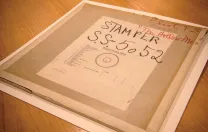

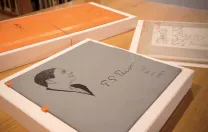
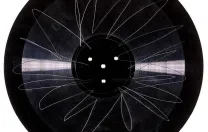
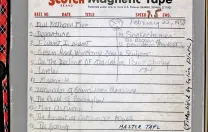
The rarest and most delicate artifacts in the Packard Collection are his original lacquer discs. During World War II, when aluminum was scarce and radio stations across the U.S. and Britain donated records to contribute material to the war effort, manufacturers switched from metal to glass for these discs’ base material; sometime over the intervening decades, some Vocarium originals have shattered. But the format is also inherently unstable. The soft lacquer coating is prone to cracking or flaking off, warping, curling—separating from the rigid base material in a process known as “delamination.” Assistant curator Mary Walker Graham uses the standard preservation term, not hyperbole, when she calls the damage “catastrophic.” It’s almost impossible to ascertain what was recorded on these discs just by playing them—an ordinary stylus would rip that outer layer right off.
A new technology capable of “playing” these discs does exist: the IRENE system. (The name officially stands for Image Reconstruct Erase Noise Etcetera, but is really a tribute to the first record its inventor reconstructed, a copy of the Weavers’ “Goodnight, Irene.”) A 3-D camera scans the audio material, and software builds maps of the groove shapes, converting those images into sound. It’s hoped scholars might browse Harvard’s holdings with the new finding aid, pointing out the most promising candidates for digitization, and that this academic interest would attract funding; the process is too expensive to apply to the collection wholesale. In 2014, the Woodberry Poetry Room successfully resurrected Ezra Pound’s 1939 recording of “The Cantos,” and a gouged recording of Robert Frost’s “The Road Not Taken,” among other objects.