On a Friday afternoon in August, the dock area at Milwaukee’s Lakeshore State Park was abuzz with hundreds of athletes in wetsuits. They had come from all over to compete in the 2026 USA Triathlon Nationals—some hoping to qualify for world championships in Germany.
Among them was Kira Bierly. She had trained for nine months for the event, her first national competition, and now had to perform: swim almost half a mile, then bike 12.4 miles and run 3.1 miles. Two minutes before the starting whistle—while all the other racers in her 25-29 age group were already in the water along the dock—she was walking alone, trying to get herself together, when she ran into her coach, Juliet Thompson Hochman ’89.
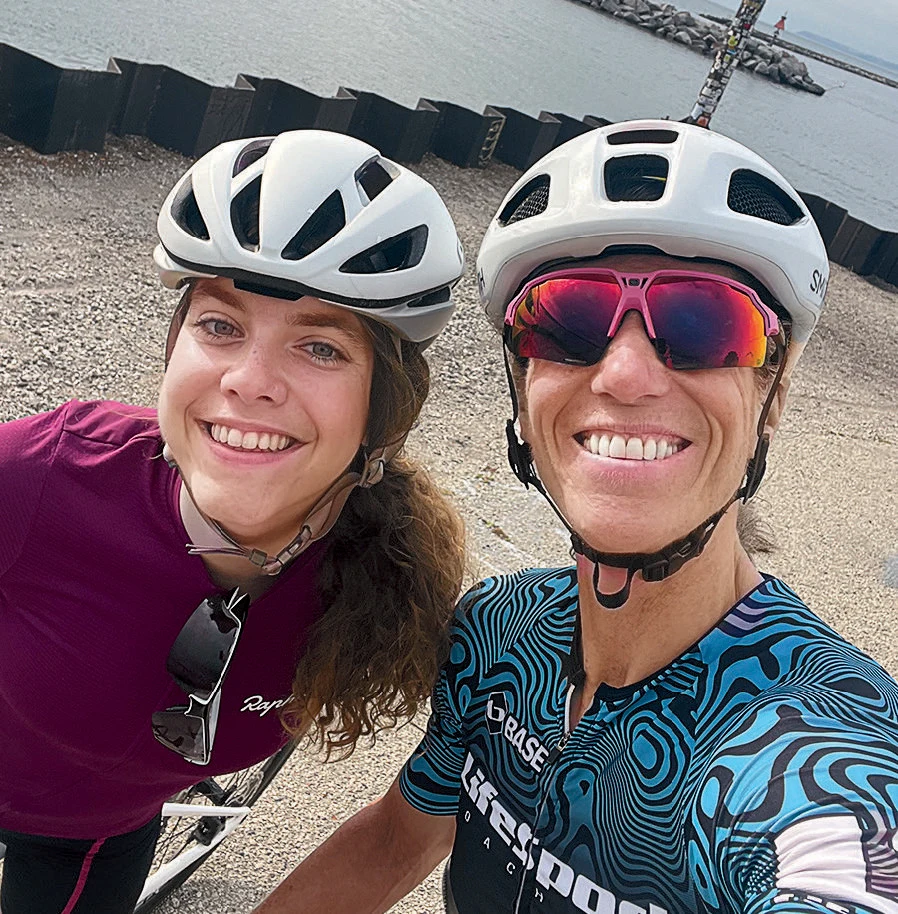
Hochman was waiting for her own age group’s race to start. The former Olympic rower had been in dozens of competitions since 2015, including grueling half-Ironman events, and hoped to win today. When Bierly suddenly appeared, Hochman recalls, she was “standing there like a deer in the headlights, in a full-blown panic.” She stuttered and shook, apologizing. Hochman grabbed her shoulders, thinking, “What do I do? Do I take the gentle approach? Do I take the ‘Get your ass in the water!’ approach?” She made Bierly look her in the eye, and then pointed outward, directing the young athlete’s gaze about 200 meters across the water.
“Look. There. All you have to do is get to that red buoy,” Hochman said. Then she hustled Bierly toward the starting position, repeating: “Just get to that buoy!”
A minute later, the whistle blew. Hochman saw her client among the wave of women splashing across the water like a school of mad fish. Race assistants in kayaks and jet skis prepared to grab anyone who floundered. But no one was pulled out. And soon Hochman had slipped into the lake herself.
This world of pressure, of combatting nerves and pushing oneself to the grinding edge of physical and mental endurance, is totally normal to Hochman. “The training is fun!” she says. “I like swimming, biking, and running as much as other people love painting.” In high school, she played three varsity sports, and at Harvard she was the first freshman to ever make the varsity heavyweight rowing team—and then became the youngest member of the 1988 U.S. Olympic team, which finished sixth at the games in Seoul, South Korea. Returning to campus as captain, she led the crew team in an unprecedented, undefeated regular season.
Now, relying heavily on what she learned at the Harvard boathouse, she has triumphed across the board as a triathlete, including earning two world championships at the 70.3 (half-Ironman) distance. Coaching seemed a natural extension of her activities. “I probably should have been a coach my entire career,” Hochman says, “but I think if you come out of Harvard and your parents have spent all this money for you to go there and everyone is becoming bankers and consultants, [it feels] hard to do something really different.” She initially gave herself a year to start earning some money at it, and since 2018 has built up a solid clientele through Life-Sport Coaching, a company founded by her own coach, Lance Watson. In addition to training for 14 to 20 hours a week from her home in Hood River, Oregon, she guides other triathletes, virtually, around the world—from beginners to seasoned competitors, aged 18 to 70. “I help create a flight path,” she says, “for normal people to do extraordinary things.”
The world of extreme sports is beyond grueling. The Olympic triathlon race is double the distances of the half-Ironman, which Bierly and Hochman raced in Milwaukee, while main Ironman events cover a total of 140.6 miles: a 2.4-mile swim, a 112-mile bike ride, and a 26.2-mile marathon run. Along with all her wins—including seven national championships in triathlon, duathlon, and aquabike—Hochman has had serious injuries over the years.
Risks run high to body and mind. Andrew Shen ’23, who raced an Ironman during his senior year at the College, wanted a coach to help him do more and found Hochman online in 2022. Impressed by her superhuman energy and athletic credentials, he also felt a kinship through their Harvard connection. Since then, they have worked together, including to prepare for Shen’s fourth Ironman, the DATEV Challenge Roth in Germany, in July 2026. There, paralyzing stomach issues—“a GI breakdown,” as Shen describes it—hit him midway through the marathon. His carbohydrate load had run dry, yet he couldn’t tolerate eating. When your body is giving out and all you have left is your mind, “you really go into some very dark places, and hope you make it out in one piece,” he says. “I know The Odyssey is going on right now, and the feeling in a race is very much like strapping yourself to the mast.” Yet he still finished in 11 hours, well within the 15 allowed.
There’s a constant debate in the Ironman sphere: how much do you force yourself to go on when every cell in your system is screeching ‘NO!’? Even professionals sometimes crawl deliriously across the finish line—or drop out. “If there’s concern that you are going to do permanent physical damage and not be able to hike with your grandchildren if you continue, then you stop,” Hochman allows. “But otherwise…you go until you drop because you have absolutely nothing to lose.”
Hochman first found sports as an oasis. At St. Paul’s School, “when I was intimidated by academics or people or the whole social scene, I would just go for a run, or shoot hoops, or practice the penalty shot,” she says. “It was almost just an escape for me and I always felt like, ‘Okay, this is a place where I can be good at something.’”
That sense of refuge carried throughout college. She switched from a pre-med concentration to East Asian studies but spent most of her time on the Charles River. “It was a women’s boathouse,” she says, “where you could be yourself, make mistakes, learn how to lead, and be powerful and outspoken. It was such a great place to grow up from 18 to 22.”
Hochman’s college coach, former Olympic rower Liz O’Leary, says she was thrilled to watch Hochman, the boat’s stroke, zealously drive herself and the team to greatness. “I think 99.9 percent of people don’t know what they are capable of doing, and are nowhere near their limit,” O’Leary says. “For Juliet, it’s, ‘I can do it. You can do it. We can do it. Let’s go!’”
After college, Hochman started a nonprofit that recruited college athletes to coach in South Africa’s townships and ran teaching programs in the country. Her mother had been a junior show-jumping champion in South Africa; her father, from England, ran marathons. In 1984, while the family was watching Olympic women’s rowing on television, Hochman remembers her father putting his arm around her and saying, “That will be you in four years.”
Hochman met her husband at the Stanford Graduate School of Business and worked over the years at entrepreneurial nonprofits and in private-sector project management, spending some time as a stay-at-home mom raising two sons. In 2012, the family moved to Amsterdam for her husband’s job; she learned Dutch and joined a group of Dutch women rowers, including other former Olympians, to race throughout Northern Europe. Back in Oregon two years later, she yearned to keep racing at something: “I love competing,” she says. “I love winning.” That’s when she learned about national and world triathlon championships—leading to races, coaching, and the “invention of me as ‘Athlete 2.0.’”
With clients, Hochman mines what she learned while rowing, when she figured out how to envision achieving “a big hairy goal,” like getting to the Olympics (which she did every night while going to sleep), and then how to break the task down into doable steps. “Execute what you have to do each day—and show up for the next,” she says.
Transcending physical obstacles and mental fear takes practice. From the start, she gives clients a few activities “that scare them a little,” raising the bar over time and staying in close contact, so that “even if they don’t think they can do something, the fact that I think they can pushes them further,” she says. “And then you introduce this exciting element of curiosity: ‘What more can I do?’”
One’s mind, as any athlete will say, is often the true opponent. Creating a mental toolkit is essential, Hochman says: self-talk, mantras, songs, prayers, inspirational quotes and people, “whatever it takes to help you break out of spiraling down the toilet.” For decades, she has listened to show tunes during workouts: Hamilton is committed to memory, and she recently rediscovered Jesus Christ Superstar.
Everyone, at times, gets stuck in looping, degrading thoughts, she says: “It’s too hard,” or “I suck.” But, she adds, you must practice turning things around to be “your own best coxswain.” She still thinks about rowing and those “horrific moments when you can’t see or hear and your heart rate is over 200,” and remembers how Harvard coxswain Leigh Weiss ’88, Ph.D. ’98, would yell at her, shouting things like: “‘JT! Prove to them that you belong here!…Show these people what you and I know you can do!’” Hochman says. “At that moment, I would have put my fist through a wall for that woman.”
At the same time, she guides athletes to be realistic about accomplishments and to immerse themselves in the daily training. “My God, you spend a lot of time and money preparing for these races,” she says, “so you better enjoy the process and not place your entire self-worth on a very specific outcome.”
In 2024, Shen made it to a pinnacle: the Ironman World Championship in Kona, Hawaii. Things started out fine. But then he was stung by jellyfish for the first time, which led to an adverse body response amid extreme heat and humidity. Soon blisters turned every footfall into an electrical bolt of pain. Shen finished, digging deep into his toolbox, which includes not wanting to disappoint family and friends “who believe in me,” he says. But he’d hoped to make better time. Hochman’s response afterward—honest, grounding, and encouraging—has stuck with him. She emphasized that he was only 24 and had just completed a race most people only dream about. It was the big-picture perspective he needed, when he tends to worry about details and focus on everything that could or does go wrong.
Hochman also helped ground her client in Milwaukee. Kira Bierly owns that she panicked before the race—which had never happened before. “I was overcome with the sheer wave of, like, ‘Holy cow, I can’t do this! It’s so scary!’” she says. Hochman steadied her enough to focus her mind on one simple goal. By the time Bierly reached the second buoy, she had kicked into high gear.
“To sprint the last three miles and cross the finish line was incredible—even though I thought I was in last place,” Bierly recalls. “Juliet found me a few minutes after she finished her race and ran over and gave me a really, really big hug and then she just screamed, ‘You got fourth!’” They spent the rest of the day together—through lunch, dinner, and the award ceremony for Hochman. Award for what? “Oh, you get an award if you’re first,” Bierly answers. “And she came in first in her age group—of course.”