A couple of years ago in an Emerson Hall classroom, Aviva Di Paolo ’27 was thinking hard about death. Di Paolo, who studies neuroscience and philosophy, is the co-president of Harvard’s Ethics Bowl team, where, as on a debate team, competitors present arguments on moral and ethical dilemmas to earn points for style and substance.
Di Paolo and the Harvard team were crunching snacks and pondering a 2024 Ethics Bowl case called “Not Your Grandparent’s Séance,” about a tech company training a chatbot on a recently deceased loved one’s personal data—including online profiles, phone records, and recordings—to create an AI replica of the dead, down to the sound of their voice.
They started with the practical applications. “It could be used as a mechanism for people who had lost a parent, maybe unexpectedly, and didn’t get that closure,” Di Paolo recalls thinking, “to then have that moment of, ‘I get to hear mom’s voice one last time.’”
But soon, they wondered: Could this mean, in a sense, that the person never has to die? That the grief that comes with losing a loved one could be effectively obliterated?
Di Paolo relishes chewing on those types of endless, meaty questions with her friends; that’s why she’s a philosophy concentrator. At Harvard, she has a lot of company.
In the popular imagination, college philosophy departments tend to be tiny and rumpled—dominated by future academics holding court over phenomenology and aesthetics. The stereotype paints the environment as insular and esoteric, with lots of tweed. But Harvard’s, which counts famed thinkers like Ralph Waldo Emerson, A.B. 1821, A.M. ’27, LL.D. ’66, and Thomas Nagel, Ph.D. ’63, LL.D. ’10, among its graduates, feels markedly different today.
For one thing, it’s growing—at a time when humanities have been in well-documented decline at Harvard and across higher education. Since the 2005-2006 academic year, the number of Arts and Humanities concentrators of all kinds at Harvard has decreased by 12.6 percent overall, according to data from the Faculty of Arts and Sciences (FAS), and some of the biggest concentrations have shrunk by more than half. Students studying English have dwindled from 276 to 117 in that period, with course enrollments down by 60 percent. History and Literature concentrators are down by 38 percent, Comparative Religion by 60 percent.
Philosophy, though, has more than doubled in size during that time. It is now the largest of Harvard’s Arts and Humanities fields, with 150 primary and joint philosophy concentrators as of 2025. That’s much smaller than Economics (953) and Government (589), the most popular University concentrations, but proportional to student body size, it’s about 10 times the national average.
“Universities with much larger undergraduate populations are often very happy to have 30 or 40 [philosophy] majors,” says philosophy lecturer Seth Robertson, the department’s assistant director of undergraduate studies. “I’ve thought for a while that something special is going on here.”
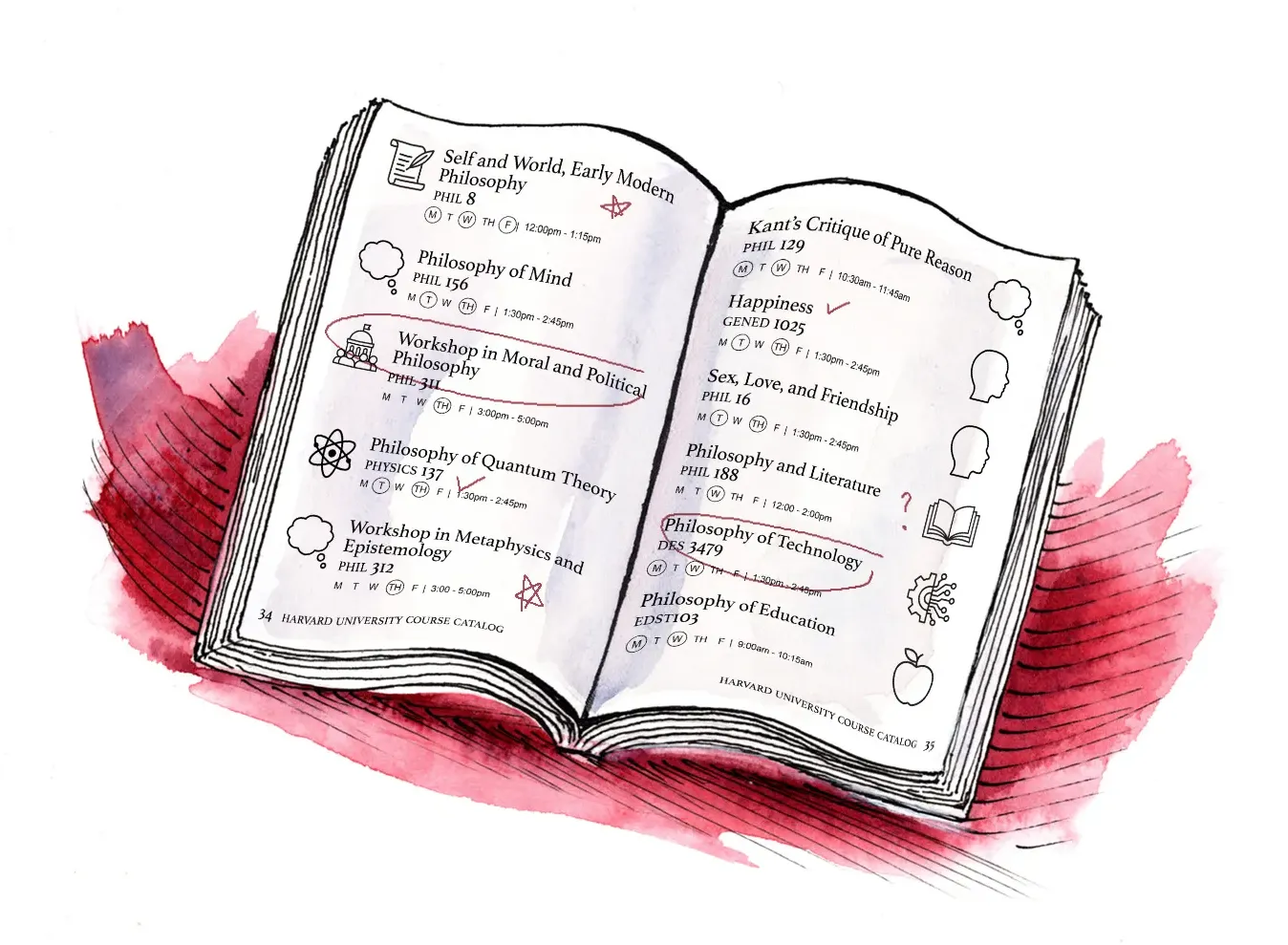
The program has also cultivated a broad appeal with the general undergraduate population, supercharged by big introductory seminars with irresistible names such as “Happiness” and “Sex, Love, and Friendship.” Even classes digging deep into René Descartes and Immanuel Kant draw bigger crowds than you probably think. At the start of the fall 2026 semester, close to 600 students, from all concentrations, were enrolled in undergraduate-level philosophy courses—triple the number from 2007. Within the humanities, only classes in the creative and performing arts have grown at a similar pace.
The department has benefited from a College-wide emphasis on interdisciplinary learning and the arrival of double concentrations in 2022: it’s common to find philosophy concentrators doubling with government, mathematics, and history. Philosophy faculty pop up frequently outside the department: Susanna Rinard’s “Happiness” course, which enrolled 370 students this fall, is housed in the broader General Education program.
But students and faculty also note that Harvard’s philosophy program, through circumstance and by design, is meeting a historic moment—both in higher education and the culture writ large. As AI raises new questions about ethics and morality, philosophy feels suddenly more pressing, not to mention marketable. And by designing courses with broad appeal that also serve as on-ramps to more rigorous study, the department’s faculty and administrators have managed to use today’s ethics questions as gateways to the discipline, leading students who might never have dreamed of a philosophy degree to discover that Martin Heidegger is timely and Aristotle is a must-read.
“Universities with much larger undergraduate populations are often happy to have 30 or 40 [philosophy] majors.”
—Seth Robertson
“Almost always,” Robertson says of philosophy concentrators, “they happened to take a class, and they fell in love.”
For decades, Harvard has been wrestling with how best to incorporate the humanities into its general education requirements, with the goal of producing well-rounded students equipped to step into whatever world they will enter after graduation. Efforts have ranged from the “Harvard Redbook,” the University’s 1945 report calling for students to share a common intellectual foundation, to the 1990s-era Core Curriculum that emphasized “approaches to knowledge.” An early-2000s overhaul introduced a requirement for each student to take a mix of courses organized into eight broad frameworks, including “culture and belief,” “empirical and mathematical reasoning,” and “ethical reasoning.”
These days, much of the emphasis has been on interdisciplinary thinking. Under its dean, Martignetti professor of philosophy Sean Kelly, the Arts and Humanities division has consolidated some introductory coursework into interdisciplinary seminars, which take the form of large lectures taught by teams of faculty from different fields. Last year, Harvard launched nine such courses, organized around themes rather than departments. The initial offerings included “Introduction to the Medical and Health Humanities,” “Bob Dylan the Classic,” and “Language.”
This blurring of disciplinary boundaries is a natural fit for philosophy, which offers training in tools such as formal logic and reasoning to work through problems in any field. “We’ve always been the ‘and’ in ‘arts and sciences,’” says Alison Simmons, the Wolcott professor of philosophy and a regular instructor for Humanities 10, a popular, yearlong General Education survey course. “If you look at the catalog, there’s ‘Philosophy of Mind,’ ‘Philosophy of Biology,’ ‘Philosophy of Language,’ ‘Philosophy of Hip Hop,’” she adds. “I came through graduate school with the view that you can’t do philosophy if you don’t know something else.”
A lot of philosophy students and faculty at Harvard, in fact, planned to study something else before stumbling onto the discipline. Di Paolo says that “Phil 16: Sex, Love, and Friendship” and Gina Schouten, the professor who designed it, are in part responsible for her decision to pursue a philosophy degree.
Schouten herself has a similar story. As an undergraduate at Ball State University in the early 2000s, she started out majoring in social work and took her first philosophy class “probably to torture my parents, honestly,” she says. “But I really loved it. I got a little hooked, and I just kept taking more classes.”
She found that she was picking up tangible skills to help her tackle big questions that came up in her social work courses, where she was interested in topics such as legal rights and access to representation for immigrants. There was a dissonance, she discovered, “between my preconceived notions about philosophy’s infamous impracticality and the experience I was having.”
“It was applicable everywhere,” Schouten adds, “including to the things I cared about the most.”
Years later, that idea—of exposing students to philosophy through issues and questions in which they were personally invested—drove the conception of her Phil 16 class, which she first taught in the spring of 2024.
“What’s a good way to invite students into philosophical conversations?” Schouten asks. “One thought is, let them see that they already have an expertise on the subject matter. They’ve already been asking philosophical questions.”
The class touches on concepts including consent, the “sex recession,” and the difference between romance and love, with a syllabus that ranges from Aristotle’s Nicomachean Ethics (which examines the concept, and purpose, of friendship) to the 2018 book American Hookup, about sexual politics and feminism on college campuses. The class also watches Casablanca together, deconstructing the central romance of the film and contending with the idea that patriotism (as exemplified by the scene of the bar patrons singing the French national anthem) can be its own form of romance.
“I love it when the conversation goes in that direction,” Schouten says, “about under what circumstances patriotism is a force for good, and whether it can stir us in a way that is similar to romance stirring [us]. This is the kind of question that captivates my philosophical excitement.”
The class was an instant hit. “No introductory course when it’s first taught gets an enrollment above about 12,” Kelly notes, because students often look at course evaluation scores online to decide what to take. Phil 16’s debut semester had 101 students.
“Every undergraduate wants to know about those topics, and she used that,” Kelly says.
Schouten says that when she built “Sex, Love, and Friendship,” she was thinking about what an undergraduate who only takes one philosophy class should get from the experience. But many students have come away with an appetite for more.
“This was my first ever philosophy class, and I was so nervous coming in because I thought philosophy was an unapproachable room of old people discussing the meaning [of] life in terms too difficult for most to understand,” reads one anonymous review on the Q Guide, the University’s student course evaluation platform. “But now I’m actually considering concentrating in Phil!”
Schouten stresses that it isn’t an easy course, and several faculty members interviewed for this story floated the idea that philosophy’s reputation as rigorous may, at least at Harvard, be its own draw.
“We’re viewed as a difficult major,” Simmons says, “and Harvard students actually like a challenge.”
Indeed, more straightforward Philosophy-with-a-capital-P classes are increasingly filling lecture halls. Simmons has taught “Self and World: Early Modern Philosophy,” a survey of the Western canon from the 1500s to the 1700s, since she joined Harvard’s faculty in 1994. Her first class had eight students. Now, she regularly has 70 or 80.
Samantha Matherne draws a similar number of students for her course on Kant’s Critique of Pure Reason, widely considered one of the most difficult philosophy texts in existence. (Kelly says he once mentioned that course enrollment number to a preeminent Kant scholar at Brown, who retorted: “Impossible. Kant didn’t have 80 students in his Critique course.”)
Harvard students and graduates often describe the challenge of working through such dense, difficult texts as an exhilarating, addictive endeavor, akin to climbing a mountain or completing a marathon.
“The first time I read Critique of Pure Reason, I thought, ‘Oh my God, this is idiotic,’” says David Lehn ’99, a philosophy concentrator who now works as a litigator in Washington, D.C. “Why did this guy write a 900-page book about these things? Why can’t he say it more simply? I hated it. Then at some point the coin drops, almost, and you realize, this is the most beautiful, complex set of ideas. It’s extraordinary that somebody could build this. People will read it the first time, the first five times, the first 10 times, and not really understand what’s going on. And you have to just keep working through it to really get it.”
Yael Goldstein ’26, a Harvard philosophy concentrator who is now studying at Oxford on a Rhodes Scholarship, describes that feeling of hard-won joy as a common feature of the discipline. “I’m a philosophy junkie,” she says. “I don’t believe in a runner’s high, because I’ve never felt it, but I believe in a philosophy high, where you’re chewing a sentence over and over and over again, and then you finally think, ‘Wow! This is what this person is saying.’”
She thinks that type of hard mental work has the potential to become more vital as AI creeps into our thinking and communication. “Writing emails or looking at a blank page, these are all really important tasks for exercising [cognitive] muscles,” she says. “Sometimes I worry that, just like when we developed gyms to walk on treadmills because we’re not moving around as much anymore, we’re going to have to have the equivalent for thinking. That’s a really frightening prospect.”
Increasingly, it’s hard to talk about philosophy without also talking about generative AI, which is not only upending the process of teaching and learning but also calling into question the very purpose of a formal education. It’s not foreign philosophical territory; as Simmons points out, Descartes was teasing out concepts of consciousness and what separates man from machine 400 years ago. Still, AI has contributed to making philosophy suddenly topical, even marketable. Goldstein says at least five adults in her life sent her a last summer about how AI companies are hiring academics trained in logic, ethics, and theory of mind. “Like, ‘Yay, you have a future ahead of you!’” she laughs.
Meanwhile, as technical skills suddenly seem more precarious, students’ anxiety over job prospects is reflected, sometimes dramatically, in their choice of what to study. According to FAS data, the number of computer science concentrators plummeted 25 percent at Harvard between 2025 and 2026. Dean of undergraduate education Amanda Claybaugh thinks that shift represents an opportunity for all of the humanities.
“We’re going to see a revaluing of different forms of knowledge,” Claybaugh, who is also the Stone professor of English, says. “Career paths that seemed very certain for students are no longer seeming certain. The humanities were suffering from enrollments when other paths looked more likely to lead directly to a job, and things are really up for grabs now. What do English scholars have to offer the world of computing? What would we like the world of consulting and finance to know about the world of texts? Probably a lot, if we thought about it.”
“I’m a philosophy junkie. I don’t believe in a runner’s high, because I’ve never felt it, but I believe in a philosophy high.” —Yael Goldstein
Even beyond the tech world, the department’s graduates fly in the face of the stereotype that studying philosophy is a career dead end. It’s a misconception all humanities disciplines have long fought to shake off; a wide range of research shows that while STEM graduates make more than their liberal arts counterparts just out of college, earnings tend to even out over time.
After Harvard, where she remembers being one of “maybe a dozen” philosophy concentrators in her class, Molly Faulkner-Bond ’06 went on to earn a Ph.D. in psychometrics and educational measurement. Since then, she has spent her career helping build more effective standardized tests for education organizations, including medical boards and state K-12 school systems.
Her philosophy training as an undergraduate provided a clear foundation for the work she does now. Her senior thesis was focused on the differences between subjectivity and objectivity—how we know something if nobody else can perceive or confirm it.
“Building a test is a concrete manifestation of that same kind of inquiry,” Faulkner-Bond explains. “How do I know if a third grader learned the things a third grader [should] learn over the course of the year? How do I know if this person knows enough to be called a lawyer in the state of Louisiana? It’s a very similar question.”
Likewise, Goldstein’s philosophy coursework at Harvard helped steer her life both in and out of the classroom. In “Inequality,” a class taught by associate professor of philosophy Lucas Stanczyk, she read essays about homelessness that argued that stable housing is a form of freedom, compelling her to volunteer, for years, at the Harvard Square Homeless Shelter. “It totally changed the course of my extracurricular life,” she says.
Goldstein also wrote her undergraduate thesis on homelessness, using her training in analytic philosophy and phenomenology to recast it as a form of political disenfranchisement, rather than as a personal or societal failing. The paper argues that “certain commitments we have to ‘negative freedom,’ or to political inclusion, demand that people have a private place to be,” she explains. “That was the arc of the thesis, and then I spent a little time trying to think about a realistic implementation of that commitment. I pulled one or two readings from almost every single class I took.”
That type of grounded engagement with real-world questions and worries marks an evolution for the department. Simmons says that when she first arrived at Harvard 32 years ago, philosophy was small and insular, with a curriculum geared toward preparing students for their eventual Ph.D.s. Now, an internal department report shows that students’ interests range from “global governance to animal ethics.”
And the training those students are getting, rooted in texts dating as far back as Socrates, are, in many ways, helping them grapple with an immediate future that can seem straight out of science fiction. Back in Emerson Hall, debating whether resurrecting the dead via chatbot is a good idea, Di Paolo and her Ethics Bowl teammates drew on tenets of existentialism and metaphysics to dig deep into the purpose of grief.
“Death, for one, is inevitable, [and] there’s something about death that gives life meaning,” Di Paolo says, recalling the discussion. Working through grief, the group decided, is a necessary step for the people who are left to keep living—one that can’t, or shouldn’t, be replaced by a ghost in the machine.
“We ultimately said that this is not something that people should be using as a form of therapy,” Di Paolo says.
She could see herself making a career out of wrestling with such questions, possibly helping to shape regulations and ethical frameworks for AI companies. But the joy she gets out of it goes beyond job considerations.
“In a perfect world I would be sitting down doing ethics somewhere with a bottle of wine,” she says, describing her future. “I just really love it.”