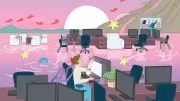
The conveyor belts are the most disconcerting part. Every dining hall has them, sometimes in plain sight, sometimes hidden bashfully in a wood-paneled corner. When you’re done hacking away at your rotisserie-style block of tofu, you can push your seat back and deposit your tray on the nearest conveyor belt. The tray will be whisked out of sight.
Life in a Harvard House has an oddly frictionless quality. Well into our college careers, most students don’t have to cook, commute, or argue with a landlord. We can get anything from ibuprofen to emergency contraception at a University-run vending machine. For a steep fee, students can pay other students to pick up their dirty laundry, clean it, and deliver it back to their door in a neat bag. So many of the demands of everyday life—the scrubbing, the scrounging, the waiting around—are either eliminated or outsourced to other people.
What replaces these responsibilities, apart from studying, is a perpetual carnival of recreation. Just look through a Harvard College inbox: you’ll find hundreds of advertisements for random enticements. The librarians at Lamont host cookie-decorating afternoons to promote their archival services. Dunster House occasionally turns its courtyard into apetting zoo. Harvard’s undergraduates have few responsibilities and many unearned delights. We are living through an extended adolescence.
It isn’t an accident that the structure of the College can feel a little paternalistic. The House system, established in the 1930s under President A. LawrenceLowell, was explicitly designed to provide a moral and social education.
Part of the impetus was that students were highly segregated by social class prior to the creation of the Houses. “A college…to be successful must be a democracy,” Lowell wrote in a 1904 essay. “A democracy cannot continue to exist if rich men live apart by themselves in expensive private dormitories, and the poorer men by themselves in other places.” Most notorious of these luxury residencies was the Gold Coast, a group of buildings along Mt. Auburn Street that housed wealthy undergraduates.
The simpler, less-cited reason for the House system’s creation was that undergraduates—at that point, all men—were lonely. As Harvard’s enrollment increased, University officials struggled to provide personalized support to students. Shortly before his death in 1894, University secretary Frank Bolles wrote an influential essay suggesting that Harvard create four divisions with separate deans who would live alongside students. “There is something very ugly in the possibility of a young man’s coming to Cambridge and while here sleeping and studying alone in a cheerless lodging, eating alone in a dismal restaurant, feeling himself unknown,” Bolles wrote. Small residential communities would allow for greater supervision of students’ health and morals and might “break the barrack-like monotony of the dormitory.”
Did the House system succeed? On one hand, it helped create orbs of connection within a student body that is ambitious, competitive, and unbelievably neurotic. And, within the University, the House system has succeeded in reducing the sense of inequality. Students from different backgrounds eat in the same dining halls, use the same College-provided toilet paper, climb onto the same rickety fire escapes at sunset. In an alternative world, students might have to fend for themselves in finding a place to live—and Lowell would roll over in his grave at the sight of Cambridge’s real estate market.
On the other hand, residential houses have an unnerving quality of artifice, like a zoo exhibit that is contrived to meet the animal’s everyday needs but bears limited resemblance to its original habitat. House life is materially excessive. It is sustained on the labor of people who are often paid poorly. (Dining hall workers—members of the UNITE HERE Local 26 union—are, at print time, demanding better salary and benefits during contentious contract negotiations.) The more we engineer college life to reproduce a specific set of social and intellectual values, the more distant students grow from what happens outside of the University.
That detachment is not unique to Harvard, but it is more discernible because so few of us live off campus. About 98 percent of Harvard’s undergraduates reside in University-provided housing, compared to 66 percent at Boston University and 59 percent at Tufts. Here, the House is the gravitational center of undergraduate life. Dinners, parties, and academic advising typically take place through the House, and students who live off campus risk missing out. The upcoming closure of the Dudley Co-Op will leave even fewer options for students hoping to live independently.
Here, an uncertain trade-off emerges. House life is comfortable and enriching, but it also breeds a strange dissociation from the outside world. The question is, which aspects of reality are worth impressing upon students through experience? And which can we afford to suspend?
In Neil Gaiman’s The Graveyard Book (2008), an infant named Nobody “Bod” Owens is adopted by ghosts. Bod grows up in a tomb, learning to read from the letters on the gravestones. It is a warm, nostalgic childhood, but also a childhood that runs parallel to reality. Bod knows nothing of the world outside the graveyard. When he meets his first human companion—a girl named Scarlett—she tells him about “the world outside, about cars and buses and television and aeroplanes.” He, in turn, tells her about dead Romans and Celts.
Only when Bod turns 15 do these two worlds collide. He leaves the cemetery with a small suitcase, a forged passport, and some cash. When he tries to hug his ghostly, adoptive mother goodbye, he finds that he can no longer see her. “He might as well have been trying to hold mist,” Gaiman writes. For Bod, coming of age means forgoing fantasy. It means living amid the roughness of the world and experiencing uncurated discomforts and joys.
My mother and I read The Graveyard Book together when I was in elementary school. Halfway through my first year at Harvard, I told her how much I missed home, and she mailed a copy of the book to my dorm. Each time I sit down to study its familiar pages, I wonder if I have yet to leave the graveyard. I have learned a lot over my three years at Harvard, but I often don’t feel like I am growing up.
Part of this outlook is rooted in comparison. I grew up in Vancouver, and most of my childhood friends go to college in major Canadian cities. Some of them lived on campus for the first year, but by this point, almost all of them are renting apartments with friends. When I visit them, we make homemade pasta sauce in their charming Montreal kitchens. I sit in the cafes where they work as baristas, typing away at my Canvas discussion posts. When they visit me, they sleep on a mattress next to a noisy radiator on the fourth floor of Kirkland House. I take them to the dining hall, where they can drink from our chocolate milk machine. It’s hard not to feel a little bashful.
My friends like to invent terminology, and they started talking recently about the “blight mindset.” Like many Gen-Z colloquialisms, the blight mindset defies precise definition, but it is best described as a cultivated enthusiasm for difficulty. The challenging part is figuring out what could be done, institutionally and personally, to foster a blight mindset at Harvard. Deliberately making students’ lives harder to facilitate vicarious class empathy would be, well, a little weird. Should we make ibuprofen more expensive so that Harvard students have to see what “the real world” is like for average Americans? Should we make freshmen commute from Ashmont instead of Mass Hall? Probably not.
One small but feasible step would be to encourage students to take on more of the labor that sustains us. College housing could offer a limited number of meals per week, and have students cook their remaining meals in communal kitchens. The College could require that students take out the compost, mow the lawns, mop the floors. These changes would require a shift in House culture. The crocodile in the zoo isn’t used to cleaning the safety glass himself, after all. Students would sacrifice some of our free time and some of that feeling of weightless adolescent freedom. But we might also gain a larger stake in the physical and social communities that most of us cherish.
A few weeks ago, I returned to Kirkland House and started my final year at Harvard. I had spent my summer living alone in Singapore, and it was calming to be back in a place I knew well. The ceilings sloped the same way, the radiator clinked the same way, the hallways were just as long and tendrilly.
I am growing conscious that this feeling is transient. Come May, I’ll leave for an unknown place. My familiar House, soon slated for its turn in the Undergraduate House Renewal Program, will be gutted after I’m gone—conveyor belts and dysfunctional radiators and all—and eventually rebuilt. Occasionally I worry about what is waiting for me on the outside.