In 1901, during excavations in Egypt, a mummy case was unearthed on the West Bank at Thebes (modern Luxor). Witnesses described the opening of the ornate container, so colorful it was as if it had just been buried. While unwrapping the mummy, several objects were found, including a green scarab and small wax ibis inscribed with texts from the Book of the Dead. Then a hush fell over the room, American diplomat and author Thomas Nelson Page wrote in his diary, as “our eyes fell on that figure still concealed in its yellow cocoon that had not seen the light of day in something like 3,000 years.” It was the body of Padimut. He’d been a metal engraver and wab-priest—someone who oversaw purification rites—in the Temple of Amun-Re at Thebes during the 22nd Dynasty (945-712 BCE). Not much else is known about the man, except that he ranked high enough to merit a beautifully crafted cartonnage case, on which the illustrations were atypically carved in the plaster before being painted, says Bell professor of Egyptology Peter Der Manuelian: “It’s a very cool piece.”
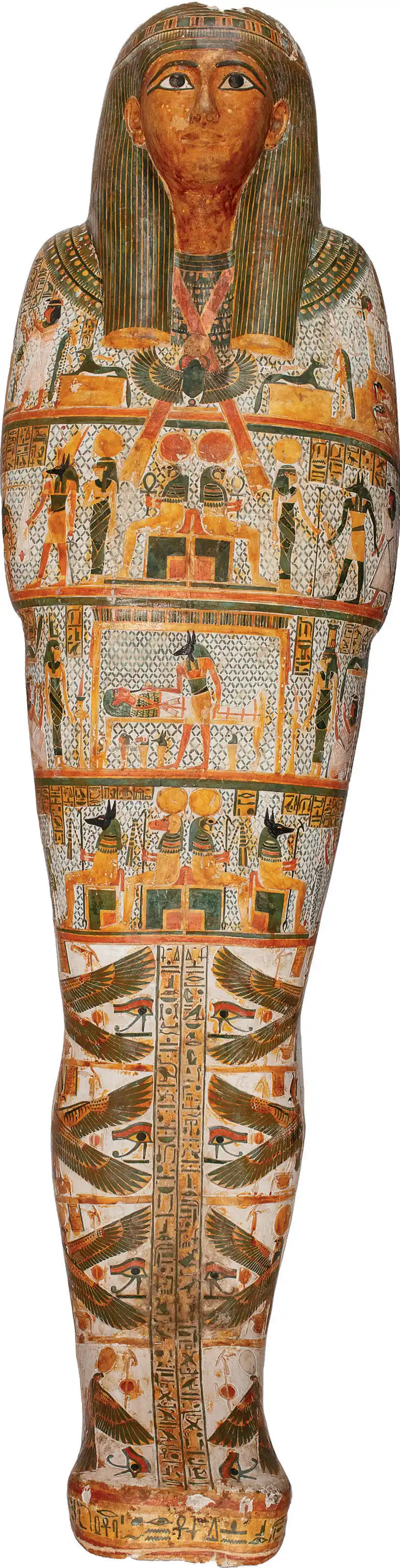
Manuelian also directs the Harvard Museum of the Ancient Near East, where the conserved mummy case of Padimut is now on display in the exhibit Egypt Eternal: 4,000 Years of Fascination. Iconography and funerary scenes cover every inch. There’s the “weighing of the heart” against an ostrich feather of “maat” (an ancient Egyptian concept of truth, justice, and harmony), and the resulting triumphant journey to the afterlife. Depictions of Padimut’s burial show the supervisory jackal-headed god of mummification, Anubis. There are also images of a deified pharaoh, Amenhotep, from early 1,500 BCE—more than 600 years earlier. It’s not clear why exactly he’s there, Manuelian says, except to participate in the engraver’s afterlife odyssey. “Dynasty 22 was a really important time for decorated coffins, as opposed to tombs with multiple rooms, wall paintings, and carvings,” Manuelian adds. Most likely, there were workshops where people chose decorations for their future caskets, or those of others.
Separate Egyptian excavations, conducted between 1902 and 1913, uncovered about 30 mummy cases and associated artifacts. The digs had no affiliation with Harvard; they were funded by Newport, R.I., financier and Egyptophile Theodore M. Davis, who donated most of the findings to the Metropolitan Museum of Art and other institutions. He watched the opening of Padimut’s case and then bought it, along with two others, and gave them to Harvard. The cases have since seen several phases of restoration work. “One of the most enjoyable weeks in all of my Harvard career,” Manuelian says, was in January 2020 when he and a team of “crack specialists” holed up in a room “and did every type of analysis you can imagine.”
The fruits of that collaborative effort are clear in the exhibit, and on the museum’s website, which provides an animated three-dimensional rendering of the Padimut case, along with voice recordings based on diaries of the time. Witnesses chronicled the unorthodox opening of the case in Thebes—on the dining table of the chief excavator with a knife—and the fact that the mummy itself was reburied in the Egyptian sand.
The museum’s website also offers a virtual tour of the gallery exhibit with a video clip highlighting the case. Padimut would have been happy to know of his present-day fame, Manuelian notes, since the Egyptians believed that “a man is revived when his name is pronounced.”