As the strike by the Harvard Graduate Students Union-United Auto Workers (HGSU-UAW) entered its second week, events on campus were cancelled, at least one midterm exam was disrupted, and some faculty members expressed frustration with both the union and the Harvard negotiating team.
Union members appealed to luminaries scheduled to speak at Harvard to cancel or move their events in solidarity with the strike. Early on Thursday morning, the union posted an Instagram video asking comedian Stephen Colbert and cellist Yo-Yo Ma ’76, D.Mus. ’91, who were scheduled to appear at Sanders Theatre that night for an Office for the Arts event, to change their plans and join the picket line. (The event went as planned, but was interrupted by a fire alarm that evacuated the theater. Union leaders said they were not responsible for the alarm.)
One similar appeal worked: author John Green, who had been scheduled to deliver the annual George W. Gay Lecture at the Harvard Center for Bioethics on Wednesday, announced that he would move his event to a closed livestream and donate his honorarium to the union’s strike fund.
The union has also appealed to faculty to adjust their classes to account for picket lines, a move that rankled some professors and administrators who said the disruptions were hurting students. At a meeting of the Faculty of Arts and Sciences on Tuesday, one professor asked whether the administration was sufficiently committed to negotiations.
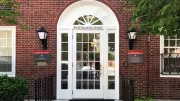
At the same meeting, Ackerman professor of the culture of medicine David S. Jones told colleagues that the union had emailed him the previous week, demanding that he honor a picket line outside Emerson Hall by cancelling or relocating his Gen Ed class on the history of science. Moving the large class proved impossible, Jones said, so he proceeded with a long-planned midterm exam.
Once the exam began, Jones said, union members outside the building began to make noise. He had purchased 100 pairs of ear plugs and allowed students to use noise-cancelling headphones, he said, but “nothing worked.”
“This was not the usual picket,” Jones said. “This was a sonic assault.” He played audio recordings for the assembled faculty—one of an air horn, and another of a voice wordlessly screaming.
“This is an unprecedented event in the 380-year history of our college,” Jones said. “One group of students orchestrated a deliberate attack on another group of students taking an exam. If the protesters thought they were punishing me, they only harmed my students.”
At the meeting, Danoff Dean of Harvard College David Deming appealed to union leaders to end the disruptions to classrooms. “Students are innocent bystanders to this. They don’t have a seat at the table; many of them actually support the HGSU,” he said. “I’m actually begging you, please leave students alone and let them continue their studies.”
Asked about the midterm incident, HGSU-UAW president Denish Jaswal said in a statement: “HGSU remains committed to communicating our picketing plans with faculty. The sooner our workers receive a fair contract, the sooner we can return to work and to our educational mission. We hope the university will be just as committed to ending the disruption in education caused by having to go into medical debt, apply for food stamps, or by getting denied entry into the United States.”
The union, which represents more than 4,000 student employees, walked off the job for six weeks last spring, the longest strike in the organization’s history. The work stoppage upended late-semester grading, and picketers disrupted Commencement events (including a Harvard Law School Class Day address by Boston Mayor Michelle Wu ’07, J.D. ’12, who withdrew as a speaker under union pressure).
HGSU-UAW called off the strike and returned to the bargaining table in late May without a contract agreement in place. After negotiations with the University stalled again, the union launched a strike on October 27, demanding higher pay, an independent grievance process for harassment and bullying complaints, and stronger protections for noncitizen members.
Harvard leaders have called the strike “unwarranted,” pointing to tentative agreements with the union on key issues, and they also contend that the new walkout is an “intermittent strike,” which is not protected by federal labor law. Union leaders strongly dispute that argument.
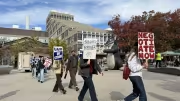
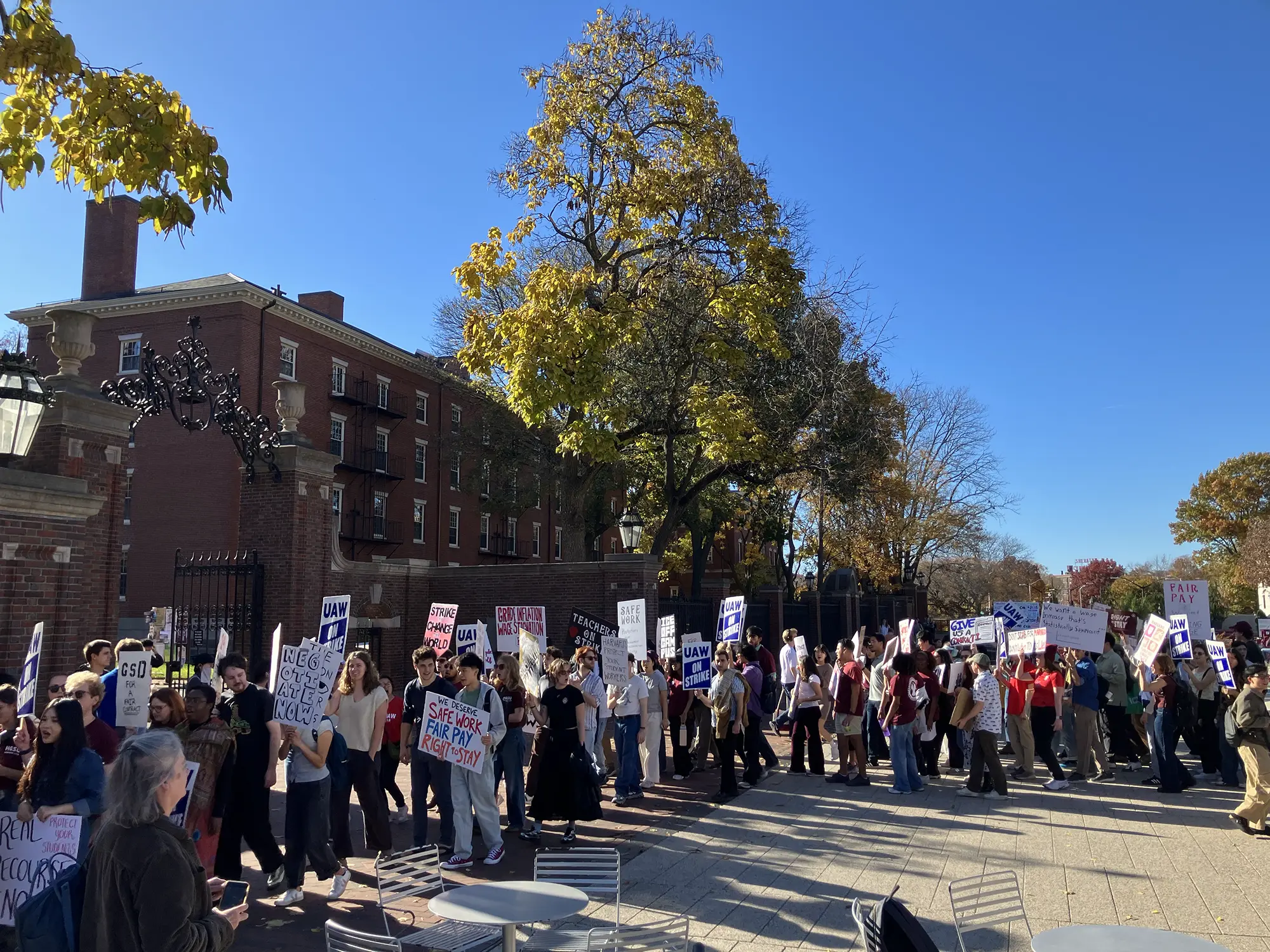
On Wednesday, hundreds of union members rallied outside Zimmer Hall before marching through Harvard Yard, carrying signs with slogans like, “Negotiate Now” and “Safe Work, Fair Pay.” Accompanied by the Good Trouble Brass Band, a Cambridge street band, and led by a megaphone-wielding Reuben Owusu, a member of HGSU-UAW’s executive board, protesters chanted, “We walked out once, we walked out twice. We got tired of playing nice!”
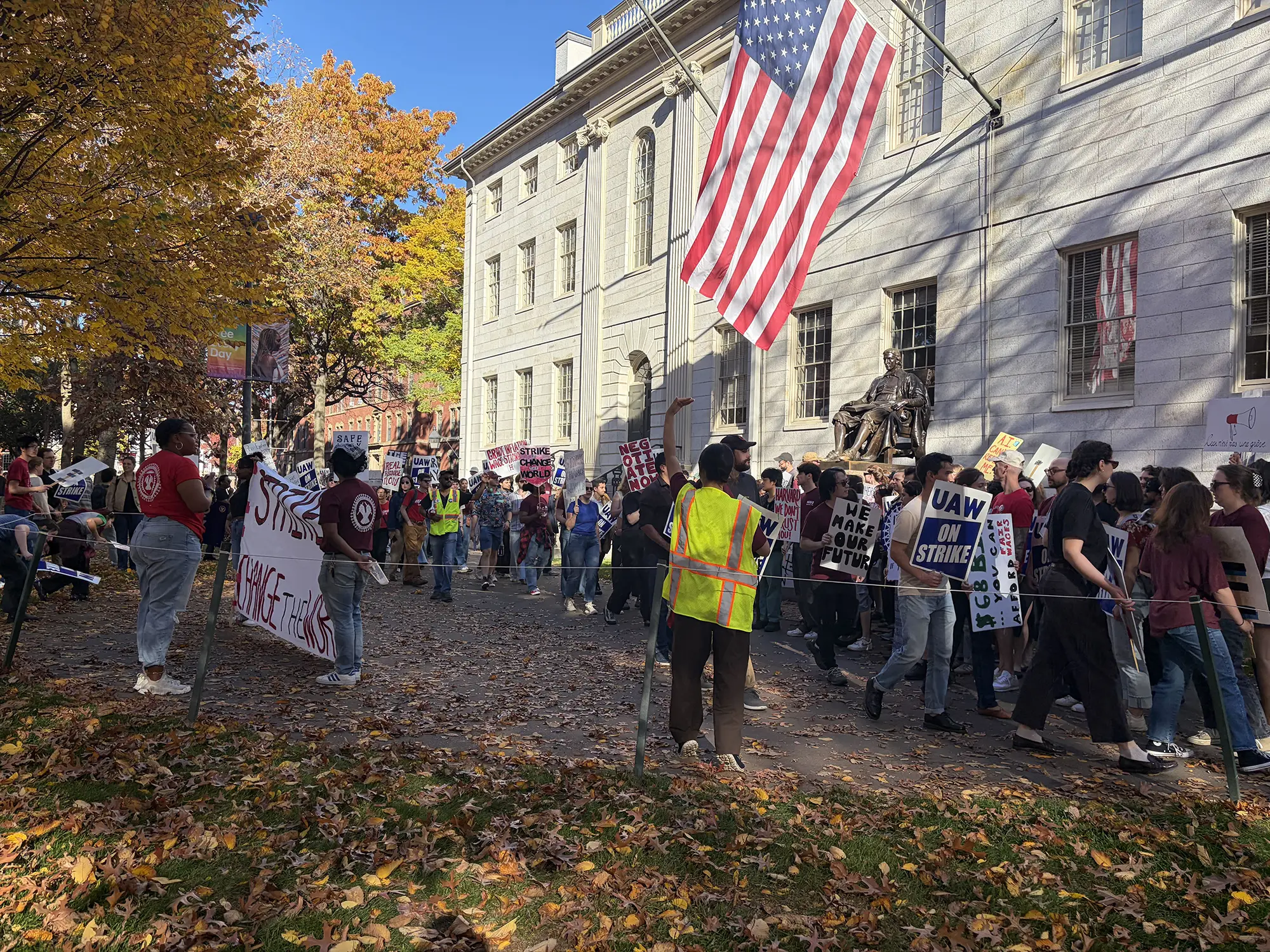
At the rally, Brandeis professor of law Nikolas Bowie also disputed the University’s assertion that the strike is unprotected by law. Speaking to the crowd, he said, “The question for Harvard right now is not whether it can win a bargaining round; it’s whether the people who do its work and serve its mission will be treated with respect.”
He called on University leaders to take seriously the union’s demands. “Harvard has a duty to ask what it owes you,” he said. “Faculty, we know the answer. We know who teaches our students; we know who runs our experiments. We know who serves the public on our behalf, and we will not hire your replacements, and we will not do your work.”
The union—whose membership includes graduate research assistants and instructors, along with graduate and undergraduate teaching fellows and course assistants—has asked faculty members not to step in to cover the teaching, grading, and research duties that striking workers would otherwise perform.
Another speaker at the rally, Ben Ewen-Campen, Ph.D. ’14, hinted at a broader problem the University is facing: two other campus unions are also poised to strike. A local politician who won a seat in the Massachusetts legislature during this Tuesday’s elections, Ewen-Campen is also a postdoctoral fellow in biology and a member of the Harvard Academic Workers-United Auto Workers (HAW-UAW), which represents non-tenure-track faculty. Formed in 2024, the union is still seeking its first contract, and last month it announced that it will strike on November 10 unless an agreement with the University can be reached before then.
“We are going to join you on the picket line next week,” Ewen-Campen said at the rally. “I do not want to go on strike,” he added. “It sucks…But make no mistake, it will be an easy, easy decision.”
A bargaining session between the HGSU-UAW and the University, the first since the walkout began, was set to take place on Thursday afternoon.