After last-ditch negotiations with the University failed, thousands of Harvard graduate workers from the Harvard Graduate Students Union-United Auto Workers (HGSU-UAW) walked off the job on Tuesday. For union members, who have been working without a contract since 2025, this is the second strike in less than six months.
Last spring, the same union picketed for six weeks—a massive work stoppage that disrupted Commencement and upended late-semester grading. It was called off in late May without an agreement in place.
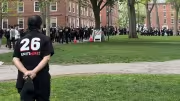
After a noon rally in front of Zimmer Hall, union members marched through Harvard Yard to Massachusetts Hall to deliver a petition addressed to President Alan M. Garber and Provost John Manning.
The new strike—one of three potential union walkouts this fall—seemed increasingly likely as the semester wore on. The HGSU-UAW represents more than 4,000 employees, including graduate research assistants and instructors, along with graduate and undergraduate teaching fellows and course assistants. Among the union’s central demands are higher pay and benefits, a stronger grievance process for harassment and discrimination complaints, and more protections for non-citizen workers.
In recent weeks, union leaders have said that after relatively productive negotiations with the University over the summer, talks stalled again this fall. In a statement Tuesday morning, Denish Jaswal, the HGSU-UAW president, placed the blame on Harvard. The University, she said “has refused to offer meaningful proposals or schedule additional, on-the-record bargaining sessions. We are ready to bargain at any time. We would rather be teaching and doing research. But we need a contract we can live and work under. We are prepared to stay on strike until Harvard moves.”
The University has insisted that the strike is not justified. In an email to the Harvard community on Monday afternoon, Manning and Harvard Executive Vice President Meredith Weenick called the walkout “unwarranted, particularly considering the agreement that exists between the two parties on key issues the union continues to cite as the reason for their potential strike action. Through both formal and informal engagements, the University has shown an unwavering commitment to reaching an agreement.”
The University’s most recent offer, made during an October 22 bargaining session, included a 6.1 percent compensation increase, with a 3 percent increase each year afterward, Manning and Weenick wrote. That amounts to a 16 percent increase over the life of the contract, they said.
HGSU-UAW leaders have said that these raises will not keep up with inflation.
The University has also made proposals that would address the pay disparity between research assistants and teaching fellows (the former earn much more per hour than the latter), as well as support for international workers, Manning and Weenick wrote. In both cases, union leaders say that the proposed measures do not go far enough.
On other key issues, the two sides still seem far apart. One longstanding union demand is for an independent grievance process to adjudicate complaints of bullying, harassment, and discrimination. The union is also asking for legal support for Title IX cases and guaranteed funding to leave “unsafe” labs without losing their income.
But Harvard has argued that creating a separate grievance process for union members would be unfair. In their email, Manning and Weenick wrote, “The University believes that all community members should have access to the same policies and procedures provided through the University’s Policies and Procedures for Non-Discrimination, Anti-Bullying, Sexual Harassment, and Other Sexual Misconduct.” (Italics were included.) Union leaders contend that those policies have often not worked for union members.
In response to union demands for increased benefit funds, the University announced last spring that Ph.D. students, regardless of whether they are graduate workers, will have access to the same package of student benefits. That package includes tuition grants, subsidized health and dental insurance, living expense support, and a parental benefit stipend. Altogether, Manning and Weenick wrote, “The University provides over $425,000 in financial support to all Ph.D. students over a five-year period.”
Union leaders say that Harvard’s proposals would eliminate nearly $3 million in existing benefit funds that help workers pay expenses related to healthcare, dental, childcare, and immigration requirements.
Harvard has also challenged the new strike’s legality, arguing that it is an “intermittent” strike, in which union members coordinate to stop work multiple times in pursuit of the same goals. Such strikes are not protected by federal labor law, and in an October 2 letter to HGSU-UAW, Paul Curran, the managing director of Harvard’s Office of Labor and Employee Relations, warned that the University would consider a new strike to be unprotected, meaning that union members would be subject to disciplinary action or dismissal for not performing their work.
Union members have strongly rejected this characterization, arguing that the new work stoppage constitutes a separate, protected strike. In an interview earlier this month, Jaswal pointed to a 2019 ruling by the National Labor Relations Board (NLRB) that explicitly allows unions to strike a second time for the same demands, when “circumstances warrant going on another strike.”
In a statement released Tuesday, Evan Lemire, the HGSU-UAW vice president said, “Harvard is forcing us to withhold the work we love to secure the conditions we need to do it. The University can end this strike by negotiating a fair contract.”
Two other Harvard unions have also threatened strikes in recent weeks. Last Tuesday, UNITE HERE Local 26, which represents nearly 900 campus dining workers, voted to authorize a strike, although no start date has been set. Meanwhile, Harvard Academic Workers-United Auto Workers (HAW-UAW), which represents roughly 2,500 non-tenure-track instructors, announced that its members would strike beginning on November 11, unless the union can reach a contract agreement with the University before then.