In 1785, the Marquis de Lafayette sent George Washington a few special gifts. A new jack (known today as a donkey) and two jennets (the female of the species) arrived at Mount Vernon, as per the former general’s request. The shipment also included a partridge and several Chinese pheasants, which came from French King Louis XVI’s aviary. There’s no record of why Lafayette threw in the birds, and they didn’t last too long in Virginia.
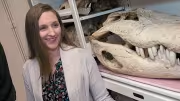
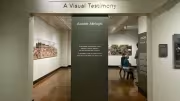
But two of the pheasants were preserved and will be on display at the Harvard Museum of Natural History starting on June 27 as part of Harvard’s celebration of the 250th anniversary of the American Revolution. The exhibit “Collecting Wonders—Tomorrow’s Discoveries” features the elegantly tailed birds, technically golden pheasants (Chrysolophus pictus), among other specimens from the Museum of Comparative Zoology’s vast collection. Also of note is a woodpecker, Melanerpes lewis, that is the only extant complete specimen from the Lewis and Clark Expedition commissioned by U.S. President Thomas Jefferson.
The pheasants were exotic creatures in eighteenth-century America. Having heard tale of them, artist and naturalist Charles Willson Peale, Washington’s portraitist, wrote to Washington asking if, when the birds died, he could have their bodies for display. “I cannot say that I shall be happy to have it in my power to comply with your request,” Washington replied in January 1787, “but expect that it will not be long before they will compose a part of your Museum, as they all appear to be drooping.” Upon receipt of one pheasant, Peale was clearly pleased. He wrote back that, until he had a bird in hand, he had believed their appearance in Chinese paintings to be merely “works of fancy.”
The birds were displayed at Peale’s Philadelphia museum, founded “to instruct the mind and sow the seeds of Virtue” in the emerging republic. It began with art and expanded into natural curiosities in 1786 (among them a nearly complete skeleton of a mastodon). Other Peale museums were opened elsewhere, but all eventually closed. In 1849, Peale’s collection was sold and much of it, including the blue silk sash Washington wore to distinguish himself when he took command of the Continental Army, was ultimately donated to Harvard, where they offer a glimpse into bygone curiosities. (The sash will be on display at the Harvard's Peabody Museum of Archaeology and Ethnology starting May 25.)