George Washington’s Sash on Display at Peabody Museum Starting May 25

A famous American fashion statement helps bring Revolutionary history to life.

A long, patterned fabric ribbon in shades of blue and green, draped on a white background.

George Washington’s Sash | Photograph by Hillel S. Burger/ ©President and Fellows of Harvard College, Peabody Museum of Archaeology and Ethnology, Harvard University

George Washington was a smart dresser. High-quality fabrics. Fitted suits. He was aware of how clothing made a statement. So, it’s not surprising that after arriving in Cambridge in 1775 to take charge of the Continental Army—an unkempt crowd of “provincials under very little command, discipline, or order,” as he wrote to his brother—he sought to differentiate himself.

His individual style came in the form of an elegant, bright blue, taffeta silk sash worn boldly across his chest. “When he first wore it is unknown,” says Horace D. Ballard, the Stebbins Jr. curator of American art at the Harvard Art Museums, who authored the forthcoming book George Washington, Slavery, and the New Politics of Style, 1743-1789. But documents show, Ballard says, that on July 10, 1775, eight days after his arrival, Washington bought a ribbon for three-quarters of a pound sterling, noting that it would “distinguish myself.”
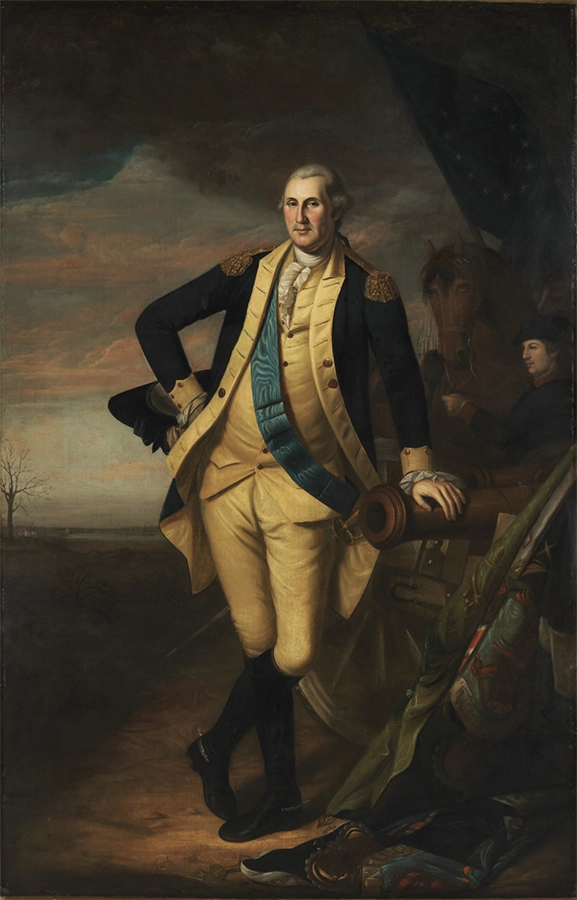
Painting of George Washington wearing formal military attire and a blue silk sash and leaning on a cannon, with horse and soldiers in the background.
George Washington at Princeton, Charles Willson Peale (1779). | Courtesy of the Pennsylvania Academy of the Fine Arts, Philadelphia. Gift of Maria McKean Allen and Phoebe Warren Downes through the bequest of their mother, Elizabeth Wharton McKean.

The sash appears in the 1779 commemorative battle portrait Washington at Princeton, among Charles Willson Peale’s famous paintings of the leader, but it is absent in paintings created after that year. Ballard suggests that Washington had stopped wearing the sash by 1779-1780, based on a letter from a French soldier that says the general had worn it on formal, solemn occasions, but “has given up that unrepublican distinction.”

Perhaps the leader of the burgeoning nation was recognizable enough by then? Perhaps the sash was too close to the blue color associated with chivalric British orders and emblems of the peerage or the British crown? Whatever the case, Peale, who later opened a Philadelphia museum of natural artifacts and other objects, ended up with the garment. It passed from his collection to the Boston Museum and, when that closed in 1899, to Harvard’s Peabody Museum of Archaeology and Ethnology.

There, the sash will be on display at the Peabody museum from May 25 through October 18, as part of the University’s celebration of the American Revolution’s 250th anniversary. (Also on display at the Harvard Museum of Natural History are two pheasants once owned by Washington at Mount Vernon.) “When we see something associated with such a notable character from the past,” says Diana Loren, the Peabody deputy director for curatorial affairs and senior curator, “it brings that history to life in a different way. History becomes more personal to us.”


Read more articles by Nell Porter-Brown

You might also like

Lafayette’s Unexpected Gift to George Washington: Pheasants

The two birds will be on display at Harvard this summer.

250 Years Ago, Harvard Was Home to a Revolution

A look at the sights, sounds, and characters that put the University on the frontlines of history

The Costly Choice Native Americans Faced

How the Revolution reshaped indigenous New England

Most popular

Harvard Discloses Top Earners’ Compensation

The University files its annual report for tax-exempt organizations.

Social Media Use and Adult Depression

A survey reveals suprising links between social media use and depression in adults.

AI Outperforms Doctors in Emergency Room Tasks, New Harvard Study Shows

Researchers say the technology could help physicians with triage, diagnosis.

Explore More From Current Issue

A man holding a revolver and lantern, wearing a hat and coat, appears to be walking cautiously.

Scoundrels, Then and Now

On con men, Mark Twain, and the powers of the Harvard name

Brick archway with a sandy base, surrounded by wooden planks and boxes in a dim space.

How the American Revolution Freed a Future Abolitionist

Darby Vassall, an enslaved child freed after the Battle of Bunker Hill, dedicated his life to fighting for liberty.

Colorful illustrated map of Colonial Cambridge and the Harvard College campus featuring buildings of the campus, houses, Cambridge Common, and the Charles River

250 Years Ago, Harvard Was Home to a Revolution

A look at the sights, sounds, and characters that put the University on the frontlines of history