If any real person could pass for a comic book superhero, it might be Jonny Kim MD ’16: he’s a Harvard-educated physician, a decorated Navy SEAL and combat veteran, and a NASA astronaut who spent eight months aboard the International Space Station last year.
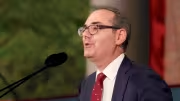
But in a raw, moving speech for Harvard’s Alumni Day festivities on Friday, Kim warned that the “solo superhero” ideal—pervasive in his childhood imagination—has dangerous limitations.
Growing up, “I wanted to be like the incorruptible self-reliant Batman fighting injustice,” Kim told a crowd of over 9,000 Harvard graduates ranging from William “Bill” Dubey ’46, age 101, to members of the Class of 2026. “But in the extreme environments [where] I’ve spent my life as an adult, I learned that the solo hero myth is dangerous.”
He continued: “Whether you’re relying on the marine next to you in a firefight, the nurse during a Code Blue, or your crewmates in the vacuum of space, survival demands absolute trust in others. True strength is found in recognizing you cannot do this alone.”
Kim pointed to examples both globally transcendent and intimately, deeply personal. The ISS, where he logged 245 days in orbit as an Expedition 72/73 flight engineer, is “a triumph of international collaboration,” he said. “Alliances across 15 countries have kept a sustained human presence in low Earth orbit for over 25 years, and this collaboration continues.”
In space, he added, our shared humanity is hard to dismiss. Orbiting Earth at 17,000 miles per hour, “I witnessed our planet’s raw majesty, epic storms, volcanic eruptions, vast oceans, and cities glowing like the constellations, all crowned by the vibrant auroras that paint the sky in colors beyond imagination,” he said. “Yet through it all I never saw distinct borders.”
On a personal level, Kim said, he couldn’t begin to heal from the traumas of his time in combat—including a battlefield decision resulting in a death that still haunts him— without people around him, at Harvard and elsewhere, allowing him to be vulnerable.
“The greatest gift this amazing institution has given me is not my medical education or the prestige that follows,” he said. “It is that the people at Harvard helped pull me out of the darkness and into the light and did it through something I had long considered a weakness: empathy.”
But empathy and vulnerability, he said, are “superpowers that can heal.”
“To my classmates and professors, who took time to understand how I got in the dark hole I was in, and sometimes sit with me in it… thank you for extending grace I may not have always deserved.”
Kim urged the crowd to “be the superhero you wish to be” by treating others with respect and kindness. “Service shows itself in the quiet unseen acts of kindness and everyday grace.”
He closed his remarks with a tearful tribute to his mother, who recently died from cancer and exemplified those ideals.
“Despite having many reasons to be cold to a world that was sometimes unkind to her, she remained compassionate, generous, and above all, morally courageous,” he said. “My whole life I’ve looked to characters, or out into the world, for heroes to emulate, when my biggest superhero was always right there by my side. Mom, I love you, and I wish I had told you that you were my superhero.”