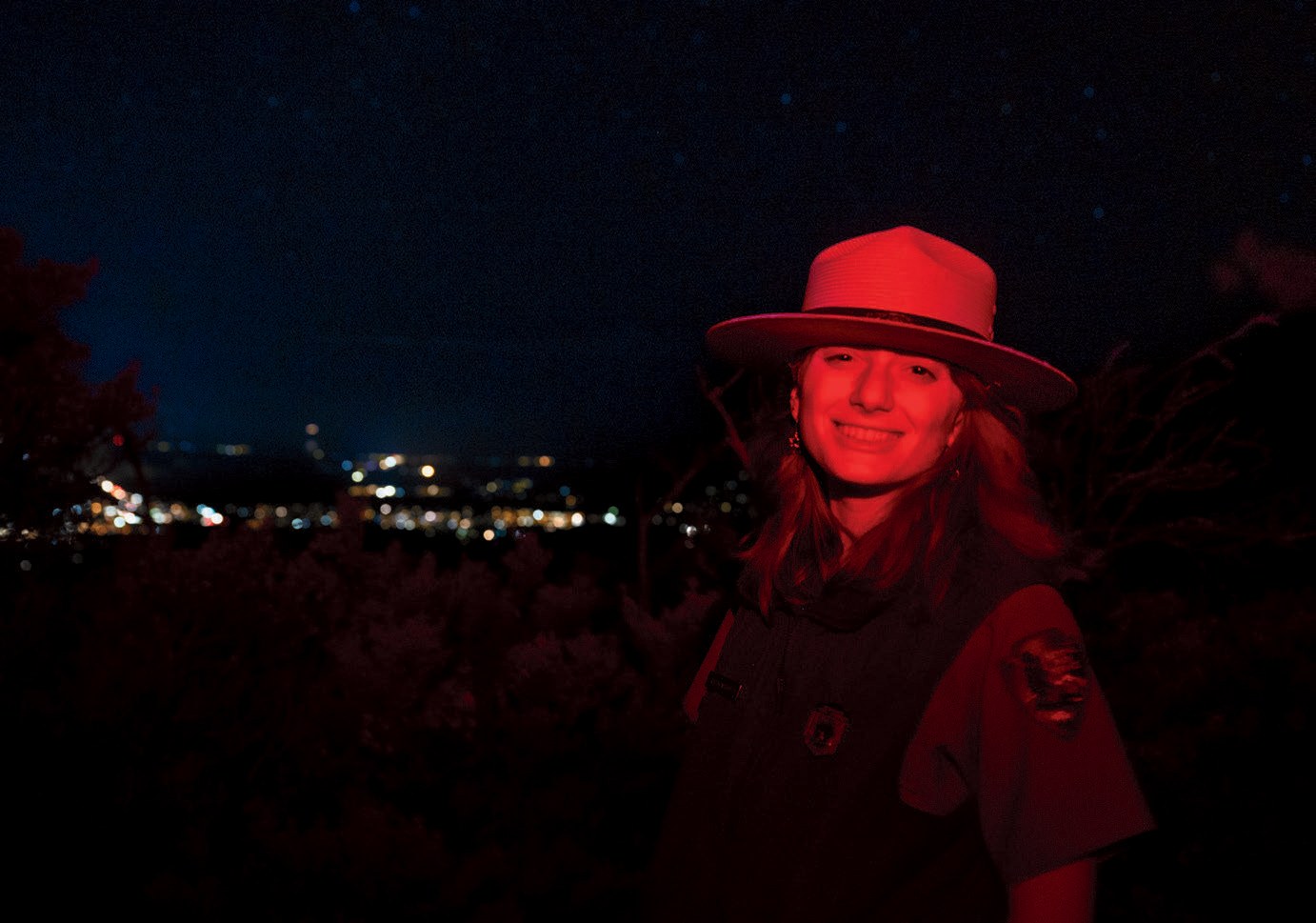
The dormant volcano Haleakalā climbs 10,023 feet into the sky, high above Maui and the Pacific Ocean. As it stretches through the clouds, the summit emerges as one of the darkest and clearest places on earth. That makes Haleakalā National Park an ideal setting for Serena Wurmser ’23 to lead astronomy tours.
Wurmser’s love for the stars runs deep. She wrote her Harvard admissions essay about the Big Dipper and now spends hours crafting her nighttime talks, mixing science and stories, history and legends. As the end of her tour draws near, she lets quiet drape over her guests, lets them lose themselves in the infinity above Puʻuʻulaʻula—Red Hill—as the summit is known.
Finally, she speaks again. “Think about someone you miss,” she tells them. Someone you wish were here. Wherever that person lives or lived, they once looked up at these same stars. “The stars connect us all,” she says.
But outside of rarefied locations like the top of a volcano, we are losing that connection. Ninety-nine percent of Americans live under skies dimmed by light pollution. The spread of light is like suburban sprawl, only worse because the light keeps going—up and out—when the suburbs stop. The eastern seaboard from Boston to Washington, D.C., seen from space, is a ribbon of light. On the ground, thousands of lights collectively shine so bright that it never gets truly dark. Sharp stars are fading and dull stars are disappearing. One study published in the journal Science, based on thousands of reports from citizen scientists, suggests the sky is getting 10 percent brighter every year.
And light pollution travels far beyond city borders. Las Vegas lights “are the dominant cause of light pollution in Death Valley National Park, 93 miles from the city,” according to DarkSky, an international organization whose mission is “to restore the nighttime environment and protect communities and wildlife from light pollution.”
Man-made light reaches even Puʻuʻulaʻula—though admittedly not very much, it is measurable. “It’s pervading natural areas that we would think are undisturbed,” says Avalon Owens ’13, a research fellow at Harvard’s Rowland Institute who has studied the effect of light pollution on fireflies and other bugs.
Light has always and forever been a metaphor for good. The Bible says God’s first spoken command created light. The Enlightenment redeemed the Dark Ages. Light stands for knowledge, for clarity, for purity. We can never have too much of any of those.
But when light is a real thing and not a metaphor, too much of it is just that: too much. And light pollution does far more than just make it hard to see stars. There are long-term and wide-ranging health consequences up and down the food chain.
Dark is good. Dark works. We need more of it, not less. On top of Haleakalā, in urban parks, in state capitols, in architectural designs of urban landscapes, and in astronomy conferences across the country, Harvard professors, scientists, and graduates are working to make that happen.
The dangers of light
Light pollution is still a relatively new field of study. Researchers trace the term to an article in Science in 1973, and for years it seemed that only astronomers cared about it. To the extent the public paid attention, the reaction was to shrug and say the astronomers just need to go where it’s darker.
Dark sky advocates have a name for this problem or, rather, an acronym: ALAN, which stands for “artificial light at night.” It’s increasingly clear, they say, that many places we think are dark actually aren’t, with far-reaching health consequences for humans and animals.
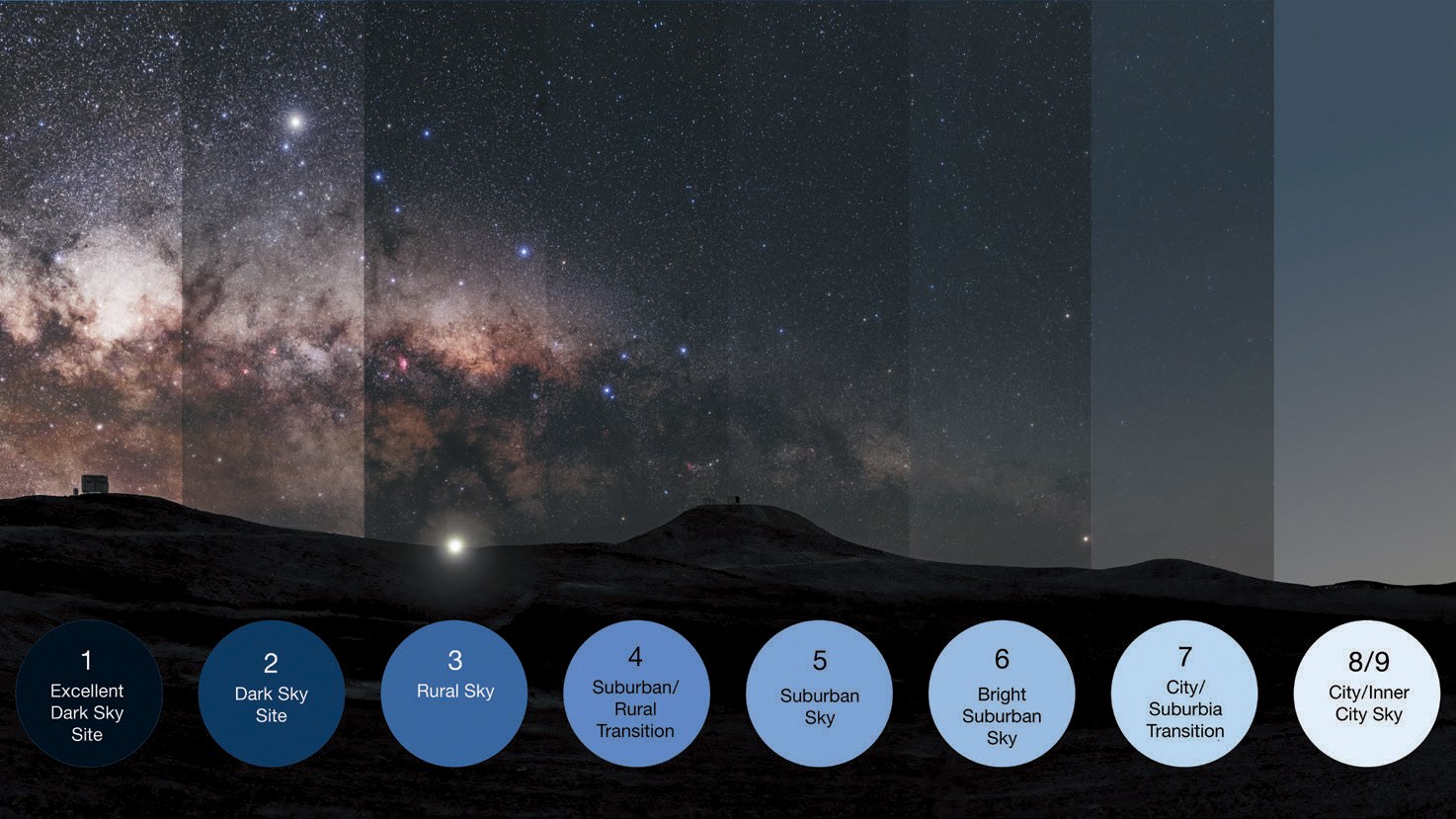
Road glare causes thousands of car accidents every year. A 2024 story in the AMA Journal of Ethics, “We’re All Healthier Under a Starry Sky,” says artificial light at night has “been associated with sleep disturbances, depression, psychiatric disorders, and obesity, with a subsequent increased risk of diabetes.”
In 2017, researchers from Harvard and several other institutions released a landmark study that followed 109,672 nurses for 24 years. They separated the women into five groups based on lighting in their home ZIP codes. Women who lived in areas with the highest levels of exposure to ALAN had a 14 percent increased risk of breast cancer compared to women who lived in areas with the lowest level of ALAN.
Early this century, scientists began asking what light pollution was doing to animals—and found challenges “impossible to ignore,” Owens says. The key problem is what scientists call “an evolutionary trap”: behavior that has worked forever to help an animal survive suddenly kills the animal, instead.
For most of history, nocturnal animals saw only the lights of the moon and the stars, which are, for all practical purposes, infinitely far away. Animals drawn to that light would never get there. But now lights are right there on the side of that building or on the top of that pole, and animals seemingly don’t know the difference between a light bulb and a light in the sky.
Before artificial light at night, for instance, a sea turtle fled from predators by scooting toward the brightest light, which was the moon and stars reflecting off the sea. Now, the sea turtle sees a hotel sign, thinks it’s the moon, and runs toward it. He steps off the beach, puts his little reptilian flippers on the highway…and finds out cars exist when one runs him over.
Credit goes to Serena Wurmser for the setup and nightmare ending of that story. She tells it during stargazing tours, slowly teasing out the details before dropping the hammer of the poor squished turtle at the end.
Not all ALAN-related animal problems end in heartbreak. Some are just weird. Consider dung beetles, or Scarabaeidae. They make balls out of poop and roll them like they’re building the world’s grossest snowman.
And that’s not the weird part. At night, these dung beetles navigate by the stars (humans call this wayfinding, and it’s one more thing we lose when we lose darkness). With no stars to follow, the dung beetles roll their poop willy-nilly, as if they’re following bad GPS. In addition to not going where they should, they sometimes run into each other and get into fights.
Scientists file these nighttime brawls between poop-rolling Scarabaeidae under the heading of “temporal disorientation”: not knowing where you are in space and time. That’s part of why some scientists theorize that light pollution contributes to an ongoing bug apocalypse—massive recorded drops in the volume of insects.
Repeating the same mistakes
Tucson, Arizona, is widely considered the astronomy capital of the world. High elevation and light pollution ordinances make for dark skies, and the region has a handful of astronomy sites and attractions.
In 2013, Tom Reinert ’75, J.D. ’80, visited Kitt Peak National Observatory, 50 miles southwest of Tucson. There he gaped at “the darkest sky [he]’d ever seen.” That visit rekindled Reinert’s boyhood love of astronomy, and ever since, he’s been casting his eyes to the heavens.
And also at legal documents.
A lawyer for 40 years, Reinert worked with DarkSky on policy and law issues and eventually became the president of its board of directors. Still a board member today, Reinert speaks often about astronomy and light pollution issues. It’s a common misconception, he says, that light pollution is the inevitable result of a growing population—as if more people equals more light and less dark, and there’s nothing else to talk about.
The truth, Reinert says, is that we have far brighter light than we need, in places we don’t need it and at times we don’t need it, and the growth in light pollution far outpaces the growth in population.
But it’s not as if the pro-darkness forces are battling Big Light, an evil corporate cabal bent on ruining the night for everyone. In fact, the opposite might be the problem. Outdoor lights are installed with no plan at all, whether they are streetlights, park lights, stadium lights, or house lights. The enemy is a million points of light in a million locations all over the industrialized world, put there by a million decision makers, all repeating the same mistakes.
Owens puts it this way: “The people installing lights aren’t lighting experts.”
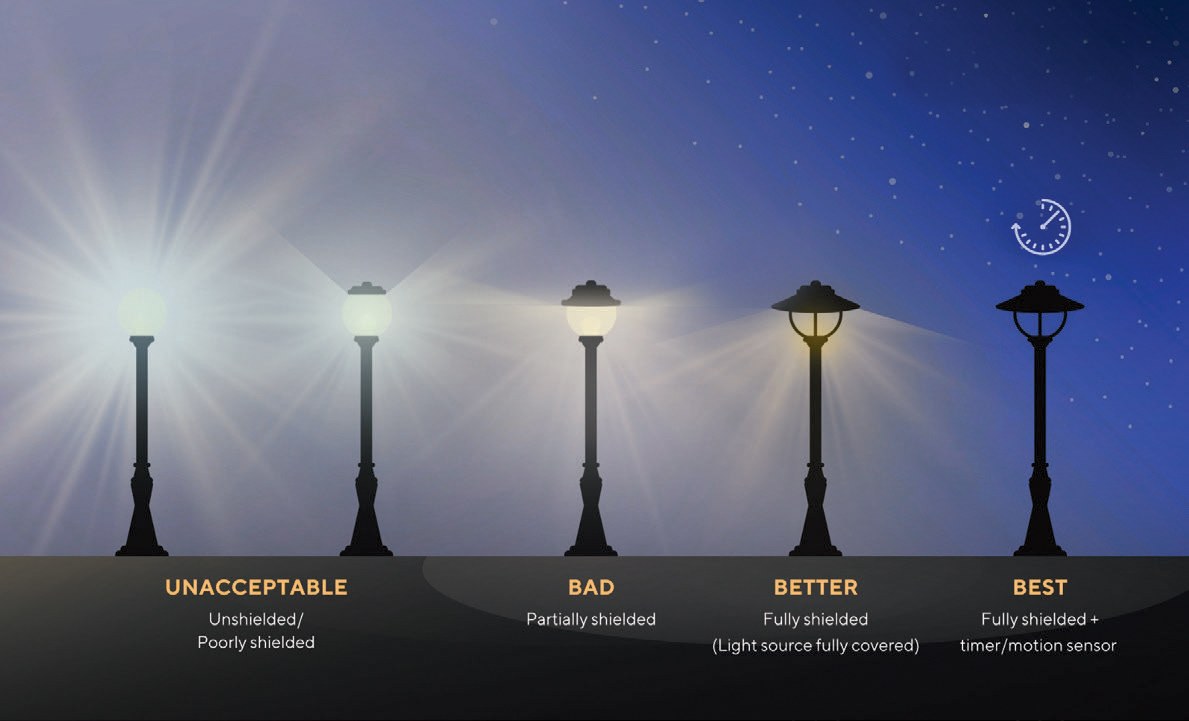
If you can see a light bulb from anywhere except directly below it, that light is inefficient, says Dan Green, an astronomer and solar system researcher in Harvard’s Department of Earth and Planetary Sciences. Unshielded lamps shoot light all over, like an unattended kitchen hose shoots water.
And the problem isn’t just bright lights; it’s also bright lights that are on at the wrong times and in the wrong places. (Not everything is worth seeing, and certainly not all night long when no one is there to see that which is not worth seeing.)
When Green first started making the case against light pollution in the 1990s, he wanted to understand the origin of the problem and amassed a library on the history of lighting. He read and read and dug and dug and couldn’t find any reason why outdoor lighting is the way it is.
“In the late 1800s and early 1900s, if you had a light bulb on your street, you were civilized, right? It was a big deal. Nobody cared whether it was shielded or not,” he says. “But if you go into a house, people have lamp shades. Why do they have lamp shades? Because they don’t want a bare bulb, right? And for some reason, historically, there’s been this huge disconnect in the general public between shielding a light in your house and not shielding a light outside the house.”
Even now, massive changes in the practice of lighting take place without much thought about the consequences. The most obvious example is the transition from incandescent light bulbs to LED bulbs earlier this century. We replaced 60-watt incandescent bulbs with 60-watt LED bulbs. But LED bulbs are 10 times as bright as incandescent bulbs.
And if you really want to get a dark sky advocate fired up, bring up “wall packs.” They’re the square-shaped fixtures attached to the exterior of hundreds of buildings, shooting far too much light toward nowhere in particular. Lighting experts derisively call them “glare bombs,” says Dan Weissman, the associate principal and director at the design firm Lam Partners.
To be clear, nobody is suggesting that we turn off all the lights—or try to turn New York, L.A., or any other city into a stargazing hotspot. But advocates say there are ways to reduce light pollution and slow down its spread. DarkSky offers five principles for proper outdoor lighting:
Useful. Lights should have a clear purpose.
Targeted. Lights should be shielded and pointed toward where they are needed.
Low level. More is not better.
Controlled. Motion sensors and timers should be used to trigger lights.
Warm-colored. Too many lights are on the blue end of the spectrum. Blue light suppresses melatonin, and lack of melatonin has been tied to increased cancer rates.
Weissman, who teaches lighting design at the Harvard Graduate School of Design, recently won approval for a spring 2027 course called “After Dark: Ecology, Justice, and Joy in the Nocturnal Luminous Environment.” He has already put some of his ideas into effect: lighting the façade of a building in Lowell, Massachusetts, with indoor lights; getting rid of all the outdoor lights at his condo; and inventing a device that renders all wall packs powerless while also covering them in black tar. (OK, that last one is a running joke between Weissman and a friend, expressing what they really want to do to end light pollution.)
Weissman is also active in the Illuminating Engineering Society of North America (IES), founded in 1906. Last year, after years of publishing guidelines for minimum levels of brightness, the IES for the first time published guidance for maximum levels of brightness, too.
Weissman says this new policy has the chance to make an enormous impact. “The best thing that can happen is municipalities adopt that,” he says.
Some countries in Europe, along with assorted states, cities, and towns, have adopted lighting ordinances. But that’s been a slow slog. Green got so fed up with his yearslong attempts to get Massachusetts to adopt a light pollution law that he walked away from the issue before it drove him crazy.
Still, if problem No. 1 of light pollution is ignorance, as Green, Owens, Reinert, and Weissman describe, dark sky advocates can counter that with education and lobbying.
But even as they fight that battle, they face another that is more primal: fear of the dark.
Myths and anxieties
On her Haleakalā tours, before she talks about sea turtles or how stars connect all of humanity, Wurmser first makes her guests feel safe in the darkness that swallows them atop the volcano. She has compassion for those who fear the dark because she once feared it herself. She grew up in New York City, where it’s never dark, and she had to learn not to be afraid of it. Otherwise, she couldn’t be an astronomer, or at least not the kind who leads tours on top of volcanoes.
She overcame her fear by immersing herself in darkness. She confesses, almost sheepishly, that when she worked at Glacier National Park in Montana, she had to steel herself for the nighttime walk from the office to her car. Who could blame her? Bears and mountain lions live there. “It was a 20-foot walk,” she says. “And I had my bear spray ready.”
Humankind has wrestled with fear of the dark since we realized that animals want to eat us, and they hunt at night. “Walking out in the dark is not something that made a lot of sense for survival,” says Kerry Ressler, a Harvard professor of psychiatry who has focused on the pathophysiology of fear-related disorders.
Today, when we arrive at a place that feels pitch-black, Ressler says, our amygdala, the part of our brain sensitive to novelty and threat, turns on. We fear being robbed or mugged or worse. The amygdala’s fight-or-flight response drowns out our ability to discern real danger from unlikely nightmares.
Many parks, college campuses, and other public places glow all night long, all year long, because we think light keeps us safe.
But it isn’t true.
In his book The End of Night: Searching for Natural Darkness in an Age of Artificial Light—considered a classic among dark sky proponents—science writer Paul Bogard cites numerous public and private studies conducted all over the world, none of which found a causal relationship between lighting and a decrease in crime. He quotes Australian astronomer Barry Clark, who reviewed the existing research on the topic: “Advocating lighting for crime prevention is like advocating use of a flammable liquid to try to put out a fire.”
That’s because too much light might have the opposite effect of what is intended. “Studies bear this out,” Bogard writes. “Light allows criminals to choose their victims, locate escape routes, and see their surroundings.”
To illustrate that point, Reinert has given speeches dressed as Batman. “Batman said criminals are a cowardly and superstitious lot,” he says. “And his thing is, he used to jump out of the shadows and get them, right? And now, criminals can see Batman coming three blocks away because the city’s overlit.”
The beauty of darkness
Wurmser likens the loss of the night sky to draping cloth over items in a museum. Owens says light pollution needs its Silent Spring moment, a reference to the 1962 book by Rachel Carson that ignited the environmental movement. Maybe scientists will find the light pollution equivalent of DDT, the pesticide Carson wrote about that caused widespread damage to animals, agriculture, and humans. Maybe the public will start to care more when enough people venture out to see the stars, only to find they can’t.
Until then, dark sky advocates will lament the ever-shrinking and dimming celestial show.
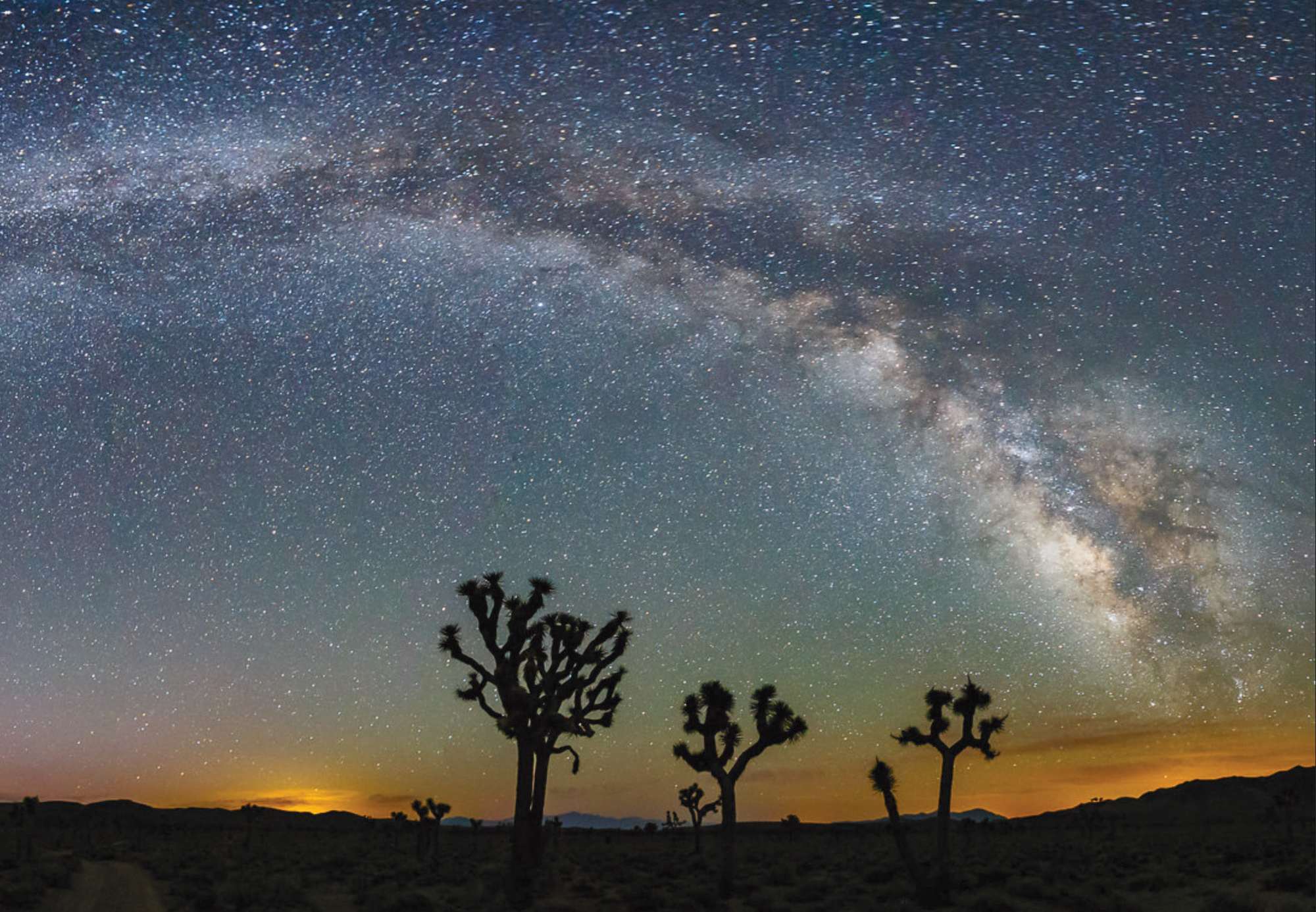
Even as scientists and advocates involved in the issue report frustration about the lack of improvement, there has been growing interest in dark skies in recent years. “Astrotourism” has soared in popularity. Travelers appear to be realizing anew that a dark and clear night is art, pure and unadulterated, unedited, the source of endless myths and stories. They are willing to spend money to go see that, and DarkSky works with local governments to make sure that where they go is indeed dark—and to make the case that there is beauty there worth saving.
“As we lose access to the night sky, we’re losing access to quite a few pieces of what makes us human,” Wurmser says. “More than anything else, we’re losing access to a piece of beauty and joy. I love the night sky, mostly because I think it’s beautiful.”