Kevin Davis ’98 remembers walking into Harvard’s Science Center one winter morning and taking the stairs down to the computer lab, a large, windowless room in the basement where about 100 terminals were arranged in neat rows, separated by glass dividers, each with its own rolling office-style chair. The chairs were filled with undergraduates, and out of the corner of his eye, Davis noticed that nearly half of their screens were casting the same blue and white flickering lights. He thought to himself, “That’s weird, because all these students are usually doing their assignments, checking their email.” When Davis reached the student help desk, which he managed as the University’s supervisor of student and residential computing, he realized that the members of the tech support team were no different. Everyone was looking at the same website at the same time.
“I was like, ‘What on earth is going on?’” he recalls. “And they said, ‘Oh, Thefacebook launched.’”
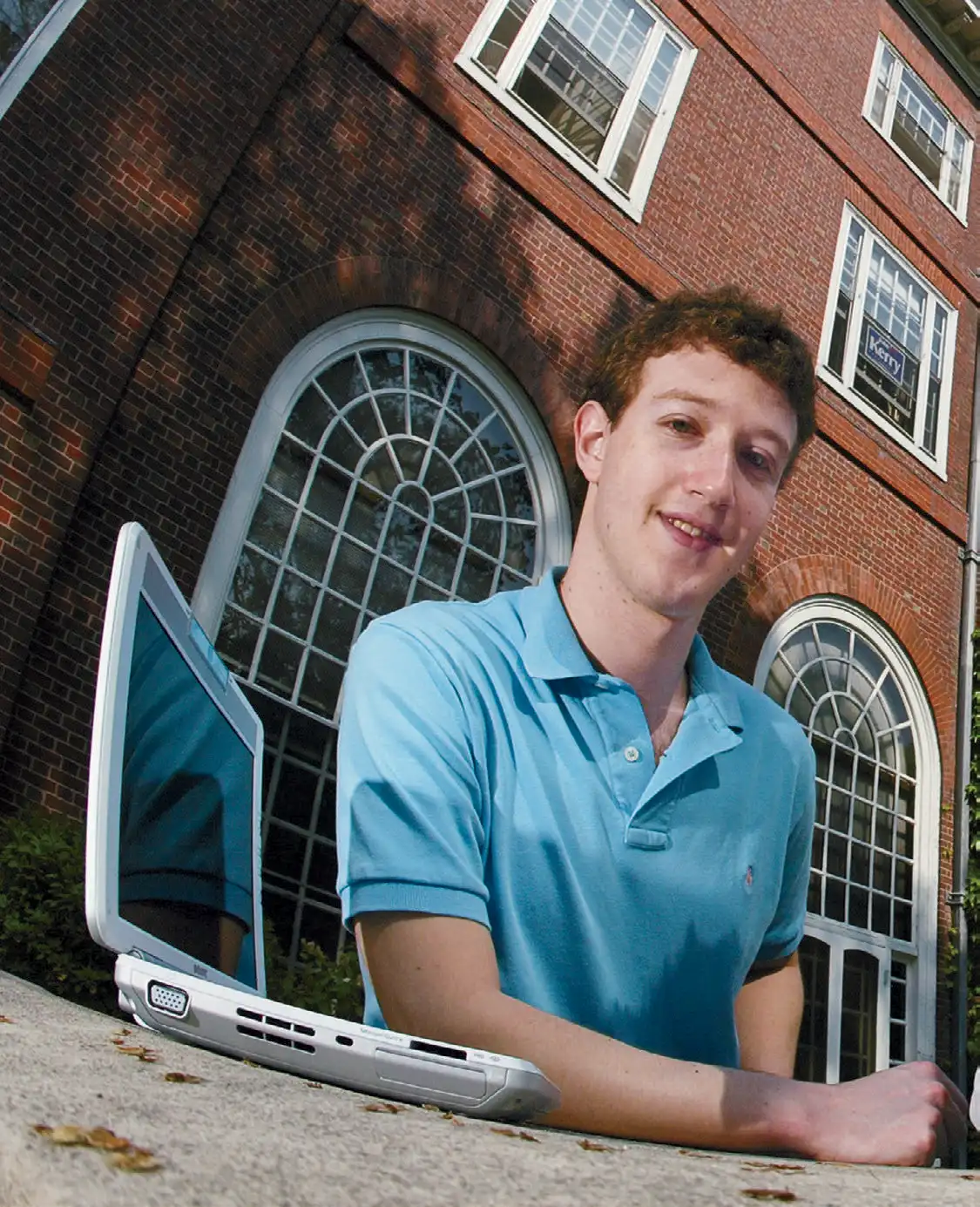
As he’s telling this story, Davis knows how quaint it all sounds, how it ages him—and me, his interviewer, for that matter—as someone who remembers a time when we weren’t all entertaining ourselves by staring at a computer screen. When we’d go visit the computer instead of carrying one with us in our pockets. But that’s the point, of course. We are a radically different society today, attached to the screens on our phones, which are, in turn, attached to the same handful of dominant platforms, where we buy our stuff, get our news and entertainment, and connect with our friends. And arguably this all traces back to the time of Davis’s astounding discovery in the Science Center basement, to February 4, 2004, the day Thefacebook.com, a platform designed in a matter of a week or so by a Kirkland House sophomore named Mark Zuckerberg, blew off the doors at Harvard.
The invention of Facebook has been sliced and diced, in books, in movies, in essays, in investigative journalism, in memoirs, in commencement addresses, and in podcasts. Many of the early stories tap into dark emotions—jealousy, betrayal, greed, misogyny, elitism, and vengeance—tied to singular, driven characters who saw Thefacebook as a way to make a mark in the world. Zuckerberg, of course, is famously the antihero of the celebrated 2010 film The Social Network, portrayed as a condescending, brilliant coder motivated by his desire for acceptance. Then, there are his nemeses, the Winklevosses, identical twin crew stars who believe Zuckerberg stole their idea, and his friend, Eduardo Saverin, Facebook’s first investor and business manager, who later took Zuckerberg to court over how large his stake in the company should be.
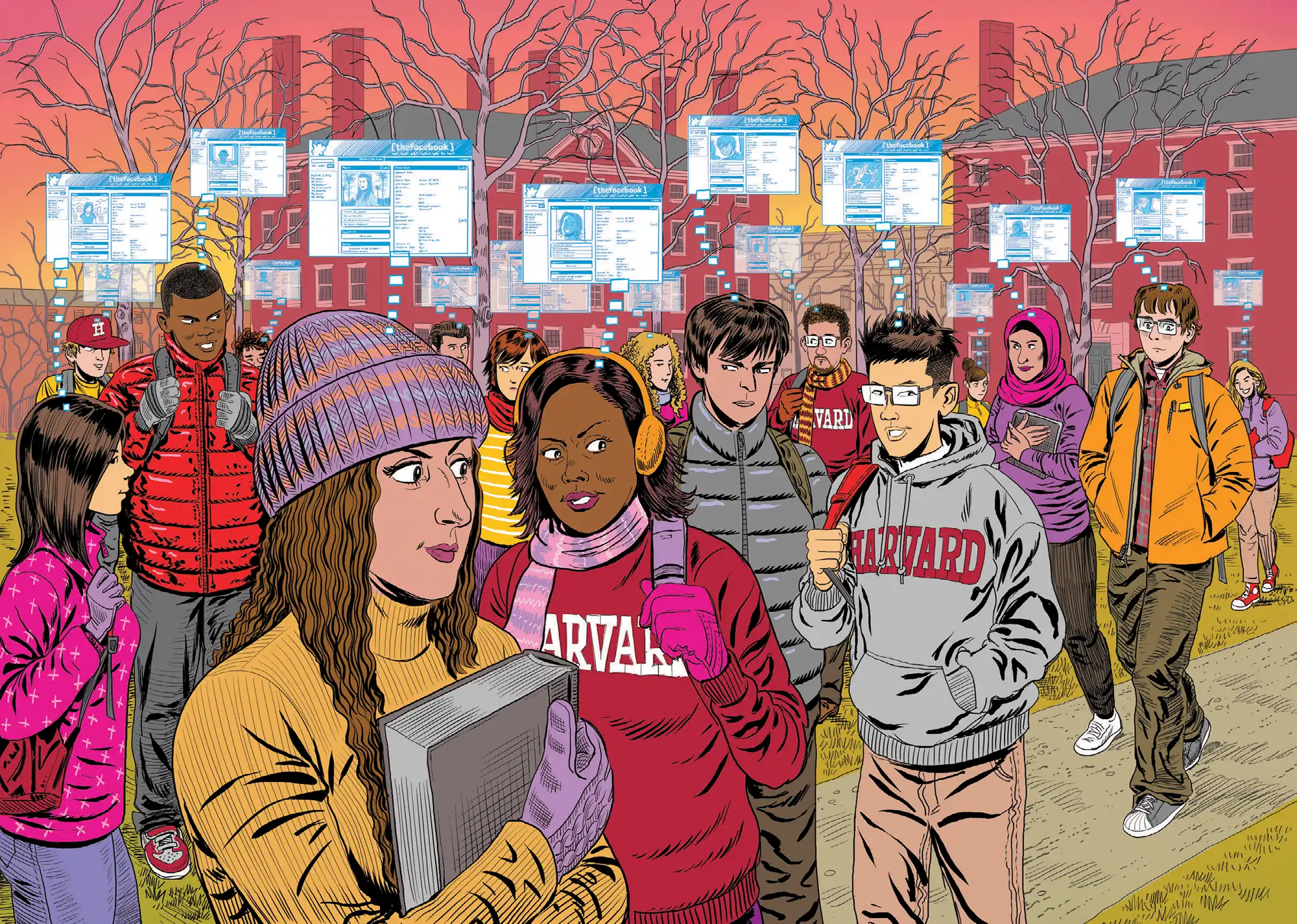
But two decades out, the story of Facebook, and Silicon Valley more generally, is no longer viewed as an unmitigated success, to put it mildly. (The sequel to The Social Network, to be released this October, is fittingly called The Social Reckoning.) Today, Meta, the company Facebook has become, is valued at more than a trillion dollars and wields an astounding influence on the tech sector and the global economy as a whole through its nearly four billion users—spread across platforms like Instagram and WhatsApp, in addition to Facebook itself. The mode of communication it launched has helped erase borders, both political and social, distorted our notions of privacy and how we pass the time, and coarsened how we communicate. These days, society is wrestling with another potentially cataclysmic technology in the form of artificial intelligence and pondering how to control it before it gets out of hand. So perhaps there is something to be learned from the days when Facebook felt like just another social experiment on an elite college campus, like the distribution of LSD to undergraduates at Harvard in the early 1960s, or the Stanford study conducted in the 1970s that dressed students up as prison guards and inmates. In this case, it was a social experiment that managed to jump over the ivy-covered walls and escape containment.
Facebook arrived on the Harvard campus fully baked: It was, and would be, a social network led by an ambitious, even roguish, coder. It aspired to fantastic growth and complete ubiquity through a strategy of keeping its audience engaged, amused, and at times enraged by who and what they could find there. It discovered an ideal incubator in Harvard College, with its population of young people who were frustrated by how few real-world social opportunities they could find, as well as excited by the new, new thing—the internet.
Simon Rich ’06 described those first days: “You look out the window like in a zombie movie and you’re like, ‘It’s spreading to everybody.’”
The people who were present on Harvard’s campus in those early days can precisely recall the thrall they were under from this new way to self-identify, communicate, and connect; only in retrospect did most of them recognize the dangers that were lurking. A few sensitive souls were turned off immediately, of course, and feared for the future. One of them, the writer Simon Rich ’06, who never joined Facebook even in the years since, described those first days on comedian Neal Brennan’s Blocks podcast: “You look out the window like in a zombie movie and you’re like, ‘It’s spreading to everybody.’”
To start, it must be said that Facebook wasn’t a revolutionary new technology like the silicon chip or the internal combustion engine. There already were social networks that people used to promote themselves to the world and make connections—Friendster and MySpace being the major ones. Harvard itself had planned to publish a college-wide digital version of a student registry along the lines of The Freshman Register, the physical book handed out to all first-year students, who traditionally used it to scour each other’s high school photos for the purposes of icebreaking and dating potential. (“The facebook” was the informal name for that book on campus.) The official version would have already happened but for last-minute concerns about student privacy. Even the uber-confident Zuckerberg conceded the ordinariness of Thefacebook in an instant-message conversation with another student: “Apparently the winklevoss twins are spreading that i took the idea for thefacebook from them, as if there was an idea haha.”
What was striking, though, was how quickly this new form of communication spread: on the first day, 650 users logged on; two weeks later, it was 4,300, including a few alumni and even fewer faculty members. A month later, Thefacebook had spread to other, carefully chosen, colleges—Columbia, Stanford, and Yale—and had signed up 10,000 people. Harvard’s users alone had viewed individual profiles 1.5 million times in less than a month, at a time when profile viewing was still the main activity.
The social impact of Thefacebook was immense and immediate, too, visible throughout the Harvard ecosystem. A piece of art in the Spring 2004 issue of The Advocate, Harvard’s student literary magazine, shows two people in hazmat suits with the ironic caption, “We Are Friends, Right?” In his Ivy Address that spring, Colin Jost ’04, with September 11, 2001, fresh on the mind, described three challenges during his class’s years at Harvard: the war in Iraq, the threat of terrorism, “and that time when the Harvard server went down and we couldn’t check facebook.com for more than an hour.” And the op-eds in the Crimson arrived almost instantaneously. One, titled “Cyberfrauds,” warned that online networks threatened genuine connection: “After all, do we really want to live in a community where 17-to-23-year-olds feel more comfortable ‘poking’ friends of friends online, than approaching them in a dining hall and striking up a conversation? I certainly hope not.” In a piece for Harvard Magazine mocking Thefacebook as a place where friends are defined as “people who do not hate you,” the Undergraduate columnist Nathan Heller ’06 described the feeling on campus: “Nineteenth-century essayist Thomas De Quincey might have been onto something perspicacious when he remarked of his opium usage, ‘I could not have done otherwise.’”
In other words, the platform was humming along as no platform had ever hummed: students were using it to make friends, to find people of similar tastes and interests, to organize their classes and their social lives. But in the back of students’ minds—if not in the front—were fundamental questions that seem strikingly prescient today: Are we being manipulated? By some website? Do we even have control of our actions anymore?
Aaron Chadbourne ’06, J.D. ’10, M.B.A. ’10, who was active in student politics, told me he resisted Thefacebook initially because of privacy concerns. “I think it was two weeks,” he said. “It could have been two days. I don’t remember. I just remember my attitude at the time was, ‘I would never join this. Who’s ever going to do this?’ And then everyone was on it. I was like, ‘Well, I can’t get left behind. I’ve got to be where people are. I’ve got to be interacting. I’ve got to be doing it.’ And then you get on the hamster wheel.” Chadbourne soon had that wheel spinning big time: 159 friends before the month was out.
Brock Read, a reporter at The Chronicle of Higher Education who was among the first national reporters to write about Thefacebook—soon to lose its “the” as it sought outside investors—remembers being intrigued by how fast it was spreading, but also doubting its long-term relevance. “I was less immediately clear on, OK, what concrete and existing problem is this solving?” he said, adding, “I talked with a few students about their usage of it and I asked them, ‘Well, what do you use this for? What do you do on this?’ They said pretty candidly, ‘Yeah, for the time being, I mostly just kill time on it. I’m mostly just procrastinating.’ And I think at the time I thought, well, that’s a sign that when the novelty of this thing wears off, what does it have to offer?”
Only later, he said, did he recognize that his thinking was backwards. “This is not just going to be a kind of adjunct to certain real-world encounters or services that you need provided,” he said. “It’s going to create an attention economy of its own.”
In other words, Facebook, as well as the social networks that followed, became the answer to its own question—people would use it because other people were using it. The principal tasks for the young team were twofold: to add users quickly and to generate inexhaustible amounts of material for those users to pore over. Elissa Poorman ’06, now a doctor in Chicago, remembers a brief, brief moment at the start when “you would get to the bottom of it. You know what I mean? There was no more content to see.” That quickly changed. She adds, “They manipulated the dials and it wasn’t just your friends, and then it was your friends of friends, and then it was like anything that was popular was being shown to you. And then there was no end to the content.”
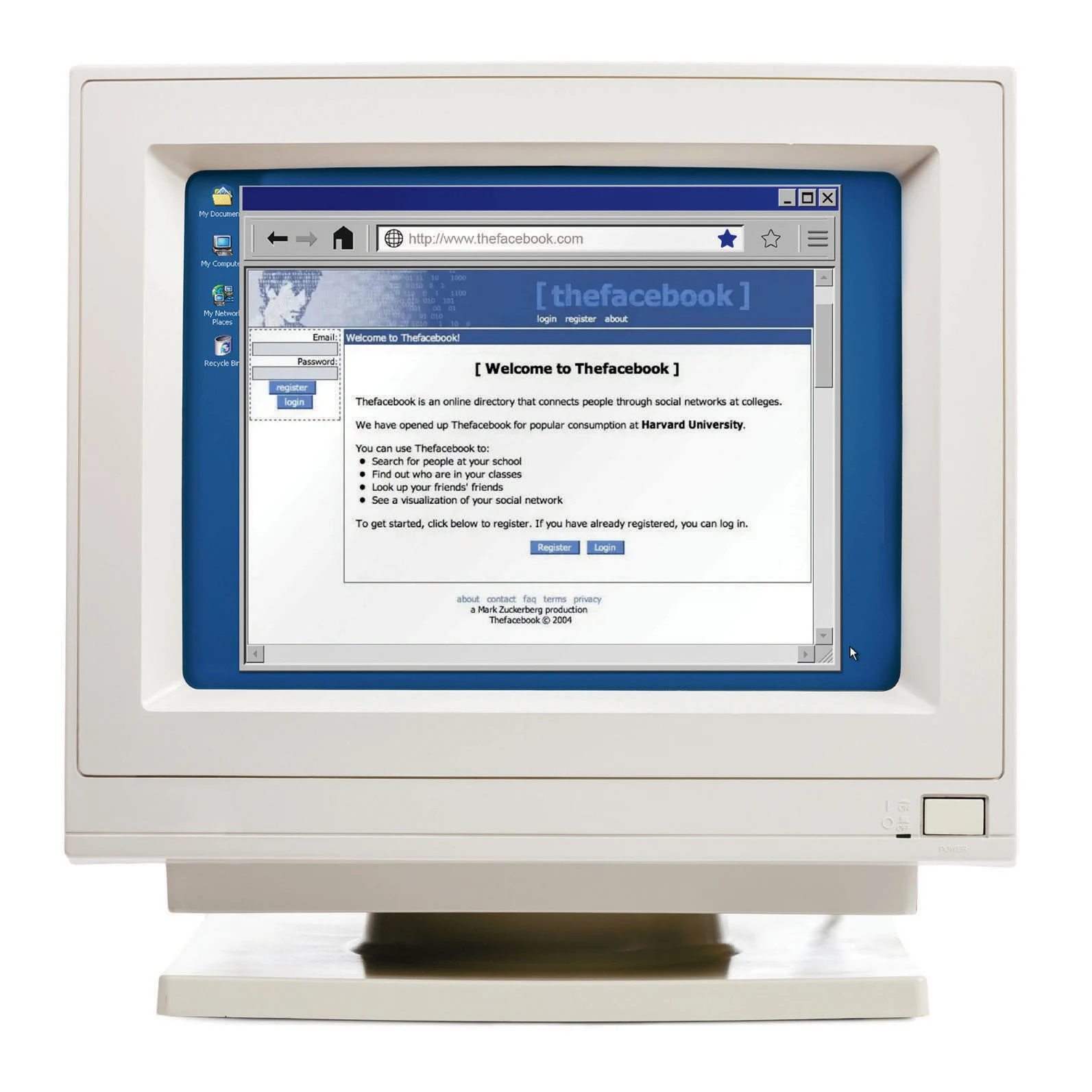
This was all by design, starting with the idea of organizing the new site around a user’s “social network”—that is, the totality of friends plus friends of friends. From this tweak, the number of pages to scroll through would grow exponentially. At the same time, Thefacebook introduced a series of automated features that would make each page more scrollable, such as where on campus you last logged in from, or what was written about you in the Crimson; there were statistics to review, too, such as how many friends you had or who most frequently looked at your profile. That last item, Poorman recalls, led to discoveries of secret crushes and awkward conversations.
Facebook, as well as the social media networks that followed, became the answer to its own question—people would use it because other people were using it.
“I think they got rid of that pretty quickly because people were really upset about it,” she says. “But there was just the idea that I wish I had thought about more deeply…these people have a lot of data on me, and they can do whatever they want with it.” Early on, of course, “these people” largely meant Zuckerberg himself. “I think there was this false sense of security,” Poorman says, “because it was another Harvard student and you’re like, ‘Oh, he responds to feedback, he cares what his peers think about him.’ And then very quickly, this guy had no peers.”
If in those first months the entire project felt like it was “among friends,” that’s because it kind of was. When the Undergraduate Council was on the hook for a campus performance by the comedian Jim Breuer that wasn’t selling well, Thefacebook came to the rescue. The council was able to take advantage of the platform’s targeted advertising, speaking precisely to students in Boston who listed Breuer in their profile. Disaster was averted. After a campus tragedy, a Winthrop House student’s apparent suicide only weeks after the launch of Thefacebook, Zuckerberg personally took down his profile out of respect.
In those few weeks when Thefacebook lived at Harvard, and only Harvard, there was a culture of trust and accountability, as Poorman described. Significantly, each potential user had a Harvard-assigned email address that made possible what Zuckerberg has called “a culture of real identity,” as opposed to the anonymous or pseudonymous identities that had been common on social networks. On Thefacebook, there would be real connections between real people. And real connections meant real stakes that drove real obsessive online behavior.
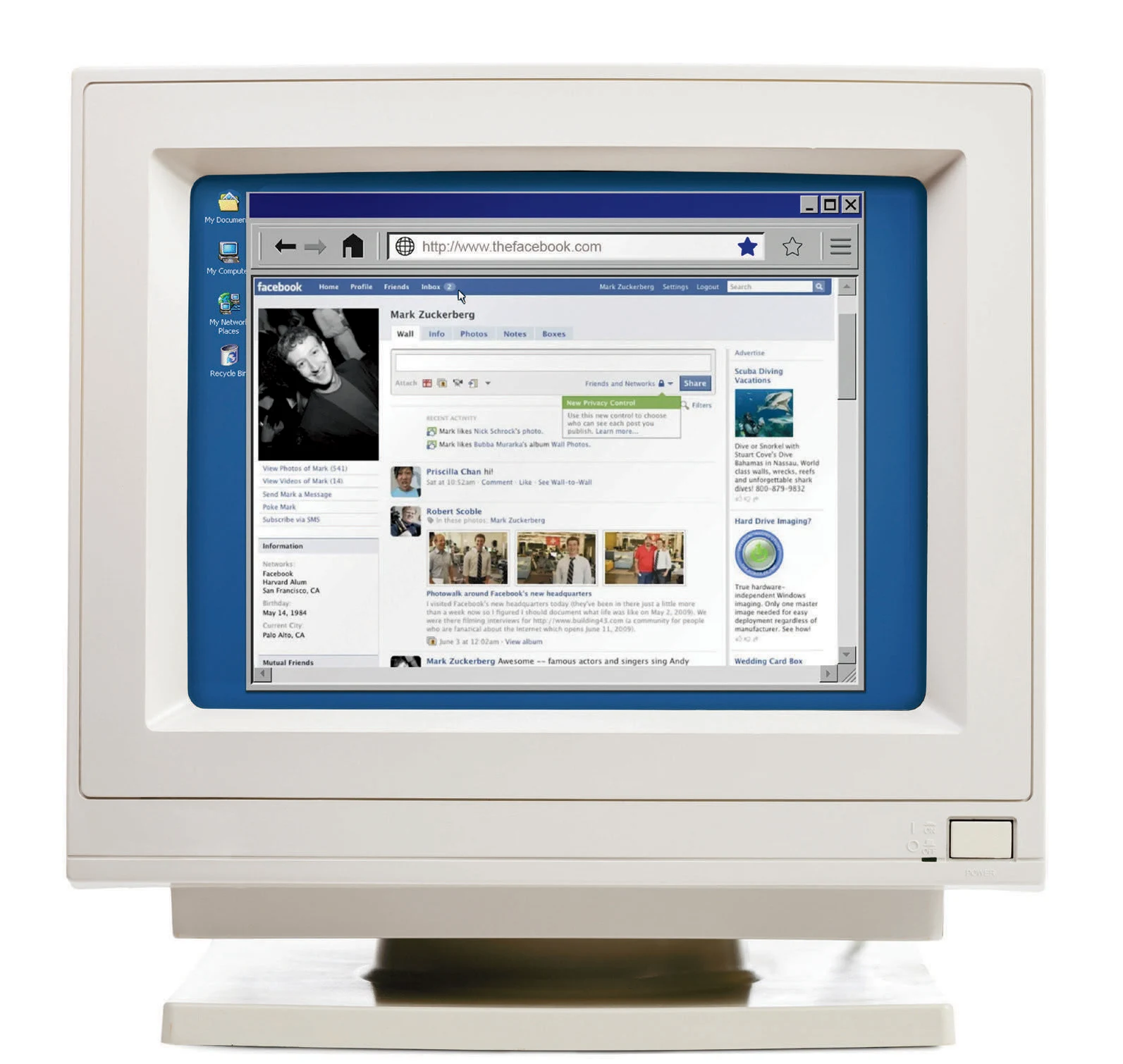
“The thing that Facebook did very, very well was first limiting it to Harvard students,” says Michael Kearns, a professor at the University of Pennsylvania, who was already teaching a course on networked communities when Thefacebook launched. (Later, during Facebook’s expansion, Harvard’s global cachet undoubtedly helped in convincing college students to join a social network created on another campus.)
“Because it was such an insular environment, there’s a very good chance that people would choose to friend other people at Harvard that they actually knew and that the network, even though it was restricted to this very small insular world, might actually reflect offline reality in some sense,” Kearns says. And this was crucial, ultimately, because if people were relaxed enough to share online their real identities, real friendships, and real interests, there would be a fortune to be made by selling to advertisers what users had revealed about themselves.
Heller, in his 2004 essay for Harvard Magazine, explained how this dynamic played out: “I expose myself in order to see others exposed. Thefacebook legitimates this shady-sounding arrangement because the site, to use Zuckerberg’s phrase, acts ‘as a mirror of the real-life social network.’ I can actually meet the people I’ve befriended on-line. Some of them might even live down the hall.” Of course, the exposure remained even as Facebook expanded and you were sharing information about yourself with relative strangers; later came parasocial relationships, where you think you are friends with people who are, in fact, strangers.
Zuckerberg proved to be an ideal candidate to accomplish the mission of quickly building a Harvard audience and then leveraging that audience to go global. He had been designing internet-based projects since he was a preteen setting up an instant-messaging system for his father’s dental office in Dobbs Ferry, N.Y., and that drive continued during his time at Harvard. Months before Thefacebook launched, Zuckerberg created a site, FaceMash, by hacking into the Houses’ computer systems to extract students’ photos so they could be paired against each other in “hot or not” fashion. This was just a prank, Zuckerberg would later say, “kind of funny, but also was a little bit in poor taste.” What it was, undeniably, was a smash, drawing 450 visitors in a few hours, with those visitors voting a total of 22,000 times before the administration shut down the site.
Interested in both computer science and psychology, Zuckerberg arguably learned more about people than website construction from the FaceMash episode. He learned what gets an audience’s attention online (people you know, images, status anxiety) and what motivates them to act (envy, gossip, feeling superior). “I saw the website and I was really upset by it,” Poorman recalls. “I found Harvard to be a pretty sexist place and that was pretty upsetting. Then of course I was like, ‘Am I on here? What was my rating?’”
The episode also offered valuable lessons for the next Zuckerberg project, which inevitably would follow:
• Keep your website far from Harvard’s computer servers, which can be turned off by administrators with a flick of a switch.
• Don’t steal what people will gladly give away, which, as it turns out, is basically everything: their photos, relationship status, political views, favorite books, medical histories…
• On the internet, it’s best to “move fast and break things,” which became Facebook’s credo. Hacking into a secured site and taking away copies of the photos stored there may resemble burglary, but for some reason most people didn’t see it that way, and certainly the Harvard administration didn’t. Despite the FaceMash controversy, Zuckerberg would be free to start his next project as a Harvard student in good standing.
• And there’s the eternal lesson: there’s no such thing as bad publicity.
The internet at that time was still a great leveler, assuming you had the advantages of a Harvard student. The initial web hosting fees were $85 a month, and in Saverin, born to a wealthy family, Zuckerberg had a friend who could pay the expenses for maintaining a complex, interconnected site even as it grew to tens of thousands of registered users. He had access to young, talented coders not just among classmates studying computer science but within his own rooming suite. And, ultimately, he had the self-confidence to keep growing. Speaking to a group of young start-up founders in 2012, Zuckerberg recounted his initial disbelief that Thefacebook would be able to connect the world. “I thought that over time someone would definitely go build this version of this for the world, but it wasn’t going to be us, it was going to be, you know, Microsoft or, you know, someone who builds software for hundreds of millions of people,” he said. “It’s like, who were we? We’re college students, right? We’re not qualified in any way to build this. And now I think a lot of my takeaway from that was that we just kind of cared more than those other companies about making it exist.”
There was one final bit of perfect timing for Thefacebook team: the social life at Harvard in 2004 was in decline. For a variety of reasons, the familiar ways undergraduates would meet in real life—at their Houses, at a bar, in shared public spaces—were no longer up to the challenge. In this way, Harvard was a good proxy for the rest of America, where social institutions were dwindling and people spent more and more time online, a trend that accelerated with the arrival of the iPhone in 2007. Perhaps this explains why Facebook had similarly rapid growth once it expanded to the general population in 2006.
In this way, Harvard was a good proxy for the rest of America, where social institutions were dwindling and people spent more and more time online.
Harvard’s House system had recently turned away from a collection of self-selecting, socially cohesive communities—the jock house, the artsy house, the geek house, the preppy house, the people of color house. To break down these divisions, the administration began assigning housing randomly, though you could still choose your roommates. What remained were a bunch of individuals with weak to nonexistent ties. The administration tried to build a sense of community on campus: there were rivalries between the Houses, but students from that time remember that it all felt forced; in the fall of 2004, the College actually created a position, “fun czar,” hiring a recent graduate known for his campus parties. The new czar’s suggestions for making the campus more social included ending random housing and limiting final clubs to seniors, though he told the Crimson those actions “were not really in [his] job description.”
And Cambridge bars couldn’t pick up the slack—in fact, the opposite was true. After an MIT freshman died from alcohol poisoning during a fraternity hazing event in 1998, the city suddenly began to strictly enforce the drinking age of 21. The only social institutions left standing were the final clubs, which were elitist by design and left the bulk of students on the outside looking in.
With nowhere else to turn, students leapt at the idea of an eros ex machina. Even a stripped-down site called Crimsonhookups, which launched within a week of Thefacebook, was gaining traction. The site prompted students to provide lists of emails of 10 students they’d want to hook up with and connected any pairs that listed each other; in a month, the site announced there had been more than 200 “hookup matches.” A writer in The Independent explored campus-focused online dating in light of these new websites and had the least patience for Crimsonhookups and its “time for just some good old fun” message: “Imagine how awkward it would be. ‘Hi, so I want to hook up with you, and you want to hook up with me, so…let’s hook up?’ Relationships don’t work like that! It takes away all the suspense and tension and drama of not knowing for sure.” Facebook offered a more natural way of connecting, the article concluded.
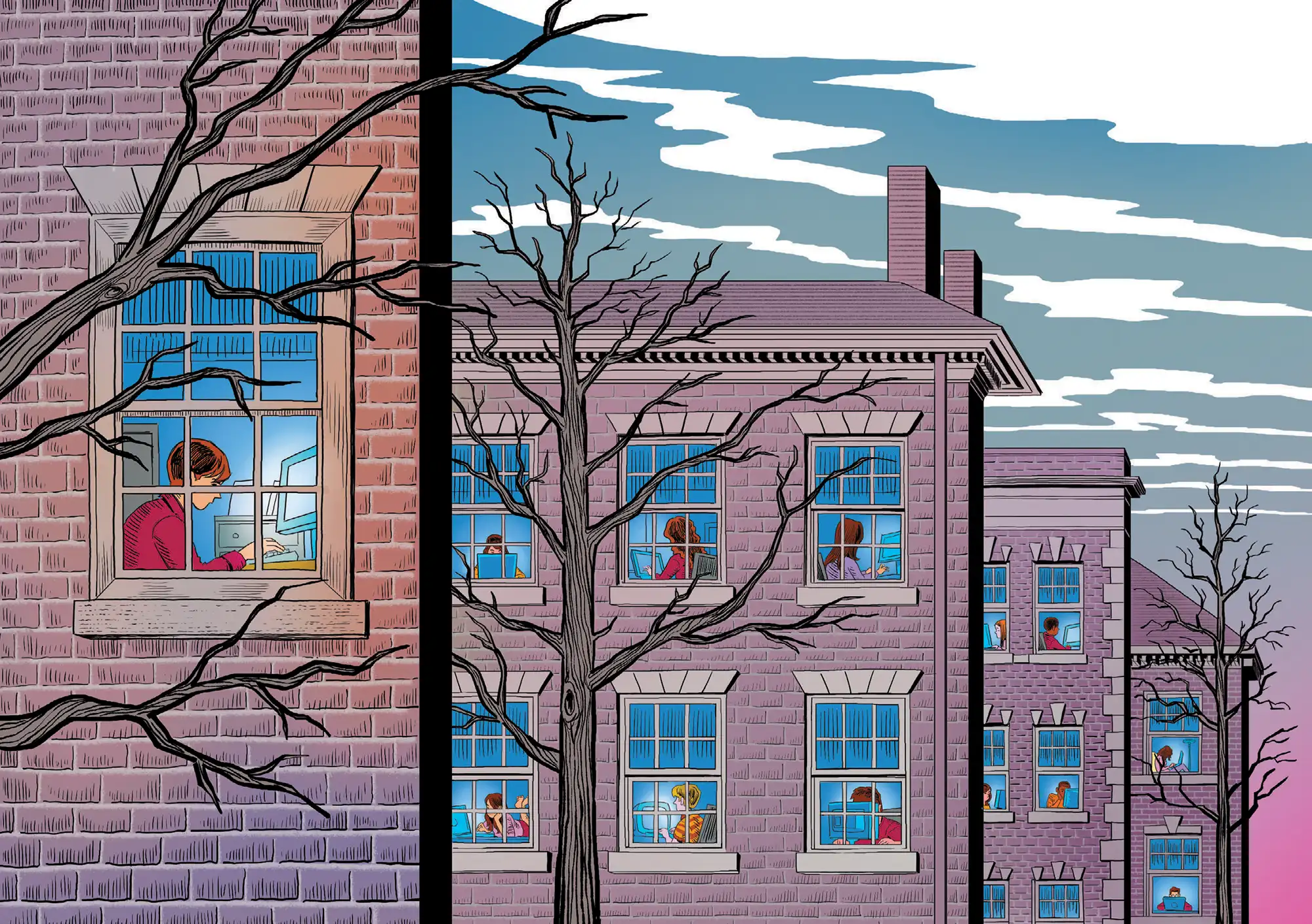
Right around this time, there was a meeting between the University’s president, Larry Summers, and a group of undergraduates in Kirkland House’s junior common room, not far from room H33, where Thefacebook was conceived. Summers was there to talk about academics—specifically about allowing more electives—but the subject quickly turned to what the Crimson called “the grinding unhappiness of the student body.” There were no good on-campus places to socialize, they said; final clubs and other clubs had become social centers, which wasn’t right or fair. When the students told Summers that they saw great potential in the arrival of Thefacebook and Crimsonhookups, they discovered that despite all the hype, not everyone on campus had been swept up in the frenzy. Thefacebook hype was news to him, Summers told the students. In an exchange captured by the Crimson, he then offered the paternal advice that while the internet can be used to “make positive connections,” it “can encourage people’s tendencies to isolate themselves and spend more time in front of a screen.”
The students’ answer was clear—spending more time in front of a screen was better than being alone.
Geraldine Grimm, who has long taught German at Harvard and other universities, has the distinction of being perhaps the first faculty member to join Thefacebook. She says she was asked personally by Zuckerberg, who had a friend in her class. She worried that it might seem weird, and she asked her students, who were enthusiastic. So she joined. Her number, as best she can recall, was 1,852. Her students immediately became her “friends,” and she used Facebook as a forum for the class. She recalls that time vividly, right around Valentine’s Day. “What started happening as the weeks went by [was] people started creating groups, and they had the weirdest groups…The ‘cinnamon flavored group,’ people who love cinnamon. It was just very niche, very strange. And I think it did foster a sense of community initially, it really did.”
Today, Grimm teaches German at Boston College, as well as writing at the Harvard Extension School, and before our scheduled interview, she asked her class of 12 undergraduates if any of them were on Facebook. She was greeted with laughter. Not one of them had ever had an account. The typical response, she said, was, “‘Yeah, my mom is on,’ or my dad or my uncle.” Then she asked how much time the students spent online on sites like YouTube, TikTok, and Instagram. The average, she said, was five hours a day, some as much as 12.
“A lot of the guys were just watching tons and tons of sports videos on YouTube,” she said. “It’s like the legacy is that Facebook learned how to keep people on the computer—and that’s something that all of them do.”
Noam Cohen ’89 is a technology journalist and the author of The Know-It-Alls: The Rise of Silicon Valley as a Political Powerhouse and Social Wrecking Ball (2017).