In her own telling, Ruth J. Simmons doesn’t keep her thoughts to herself—a frankness that earned her the nickname “Ruth the Truth” from students at Prairie View A&M University in Texas during her tenure as the school’s president. That frankness has informed key moments of Simmons’s barrier-breaking career in education, from reshaping African American studies at Princeton University to pushing Ivy League institutions, including Brown and Harvard, to reckon with their historical ties to slavery.
“I thought I would never go very far in higher education because of my mouth,” Simmons said, in conversation with former President Drew Gilpin Faust during Harvard’s Radcliffe Day. Her parents, she said, raised her and her 11 siblings to be quiet and deferential—necessary survival traits for Black children growing up in the Jim Crow South.
“They gave us a lesson in subservience, which, of course, I didn't learn very well,” Simmons joked.
On Friday, Simmons received the 2026 Radcliffe Medal, marking the culmination of the annual Radcliffe Day celebration. Events also included “Leading with Vision and Purpose,” a morning panel discussion with leaders in sports, finance, higher education, and the arts.
Bestowing the Radcliffe Medal, Tomiko Brown-Nagin, dean of Radcliffe Institute, praised Simmons as “a visionary who reimagines what is possible and has the courage and the tenacity to do what is needed.”
In a video tribute, Michelle Obama, J.D. ’88, noted that Simmons, the first Black woman to serve as president of an Ivy League university, “spent most of her career in rooms with few, if any, others who look like her.”
“It would have been safer to play nice and not rock the boat, but that’s just not who Dr. Simmons is,” Obama said. “She refused to be content with just earning her place within these institutions. She wanted to challenge them to be better, too.”
As Brown’s president, Simmons established the Committee on Slavery and Justice, which investigated Brown’s past ties to slavery. It became a model for other institutions, including Harvard.
At Princeton, she led the creation of the African American studies program and recruited celebrated Black writers and thinkers to the faculty, including Toni Morrison, Nell Painter, and Cornell West. Later, as chair of the Visiting Committee for African American Studies at Harvard, she pushed for the University to recruit Fletcher University Professor Henry Louis Gates, then at Duke.
Toward the end of the conversation, Simmons and Faust discussed the threats facing universities today. In Simmons’s view, reforms and policies that have undercut the equitable promise of higher education, including a Supreme Court decision that outlawed the use of affirmative action in college admissions, gained popularity in part because universities themselves lost sight of that promise.
“We focused on particular groups to the detriment of the little poor white kids in a trailer park,” she said. “What about them? We made a mistake…we were not inclusive enough.”
“For a while we were so enamored of the elite status that we built up resentment that made it possible for demagogues to come after higher education with success,” she continued. “Because there are enough people out there who feel wounded by what we’ve done.”
She ended with a call for universities to band together and fight back in the face of that threat. “It’s not about protecting your own institution right now,” she said.
Before Faust and Simmons took the stage, a panel of leaders in various arenas—economics, academia, sports, and the arts—spoke about their own journeys, and what they’d learned about leadership, innovation, and the inevitable curveballs of life, career, and societal change. The group also argued for the importance of protecting institutions and offered a stout defense of diversity efforts in large organizations, which have come under fierce political attack in recent years.
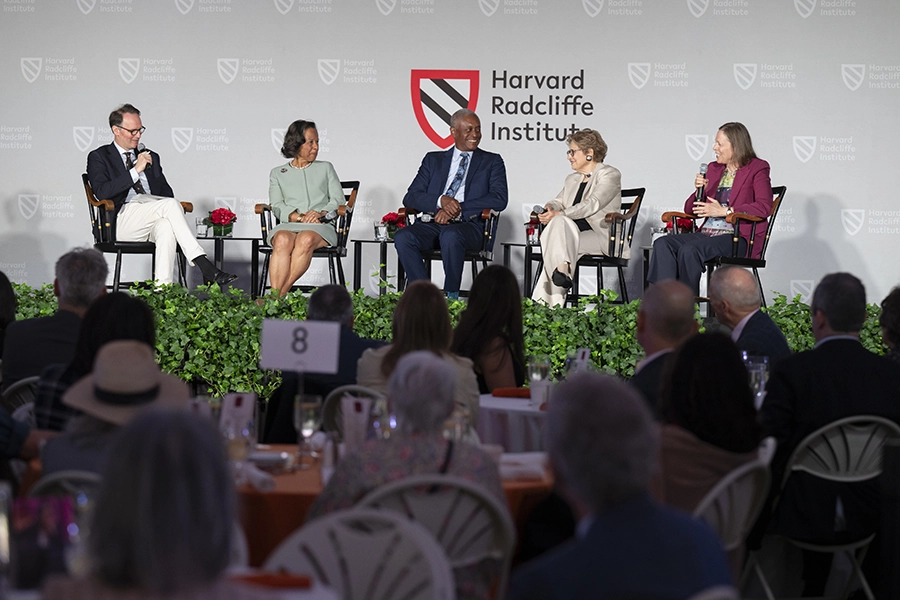
“The strongest work I’ve ever done has been inclusive work,” said Raphael Bostic ’87, who retired this year as president of the Federal Reserve Bank of Atlanta and was previously a public policy professor at the University of California and an assistant secretary for the U.S. Department of Housing and Urban Development.
Citing a economic data that shows that diverse communities are more innovative, resilient, and productive, Bostic argued that more women and people of color are needed in economics, finance, and public policy—both to inform organizations’ understanding of the world and to challenge some conventional but erroneous beliefs that shape American policy.
“There are so many questions that we need to be asking that are not being asked,” he said, “because the people who understand the nature of those questions best are not there. And that’s a problem.”
“The assault on DEI [diversity, equity, and inclusion] is something that is quite dangerous,” said Wellesley College president Paula A. Johnson ’80, M.D. ’84, M.P.H. ’85. A cardiologist, Johnson said that in the last 10 years, the number of Wellesley students from underrepresented backgrounds in STEM and other quantitative fields has doubled thanks to efforts to make higher education more equitable.
“At the end of the day, we are institutions of hope and opportunity for every last student that we bring into our walls,” she said, including students from different racial, ethnic, and socioeconomic backgrounds, as well as students from other countries. “We need to create the conditions for them to succeed,” she said. “That’s our responsibility.”
Recently, DEI efforts at some organizations, including Harvard, have been rebranded with less politicized terms like “community” and “belonging,” a change that Johnson acknowledged may be necessary but argued shouldn’t alter the underlying effort. “We might have to use slightly different language, and that’s fine,” she said, “but the essence, the mission, the purpose remains unchanged.”
Deborah Borda, the former president and CEO of both the New York and Los Angeles Philharmonic Orchestras, emphasized class background and age, two types of diversity that are less often emphasized in discussions that often focus on race and gender. “We need to listen to younger people,” she said. “I have learned so much from people in their 20s who have so much more knowledge and so much of a broader vision, and I think when we talk about inclusion we don’t talk about this.”
Val Ackerman, a former professional basketball player who was the founding president of the Women’s National Basketball Association and is retiring this year as commissioner of the Big East Conference, said that the reasons for supporting more women in sports go beyond sports themselves.
“The role of women in sports has been a metaphor for women in society,” she said, “and there’s an important correlation between women who play organized sports and then go on and become successful in other walks of life.”
The panelists praised Harvard for its efforts to push back against attacks from the Trump administration over the past year. Moderator John Palfrey ’94, J.D. ’01, the president of the MacArthur Foundation, said he was “incredibly proud” of what he viewed as Harvard’s leadership in this moment.