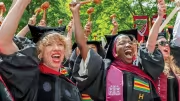
In his remarks during the University’s Baccalaureate ceremony on Tuesday, President Alan M. Garber told the College Class of 2026 about a backlash over a revolutionary technology that, its detractors feared, would usher in a new “age of little effort.”
The twist: it was the hot air balloon.
In 1903, Garber recounted, a tethered balloon appeared as a tourist attraction in the French Alps; a critic for the Pittsburgh Gazette bemoaned that riders could get a summit view of Mont Blanc without facing the same dangers or exertion as the mountaineers toiling below. Along with elevators, railroads, and telegraphs, the critic wrote, the balloons represented “a mania for simplification,” poised to leave “the indelible stamp of melancholy” on a brand-new century.
To Garber, the parallels to the present debate around artificial intelligence are clear—and particularly meaningful for the Class of 2026.
“Just a few months after your first year began, ChatGPT was released,” he told the crowd of graduating seniors in Tercentenary Theater, spurring a rapid advance of AI usage that “has been, for better and worse, the backdrop of your Harvard experience.”
For Garber, the hot air balloon is both a telling precedent and an apt metaphor for AI’s possibilities. When it comes to scientific progress and discovery, he argued, there are some horizons that can’t be explored without the aid of new technologies.
Artificial intelligence, he said, “can accelerate the pace of discovery and innovation, revolutionizing how we undertake research and lifting humanity to new heights”—and rendering some other tools and skills obsolete.
“There are the landscapes you just don’t need to explore anymore,” he said. “I may still be able to read a slide rule, and I can use a paper map, but those skills long ago lost most of their value thanks to calculators and GPS. That is what it is to live as progress is being made.”
But in the face of that progress, Garber reminded the crowd, humans have choices—about where to exert our efforts and struggle, and where to seek and embrace the unexpected.
“There will always be value in ‘toiling laboriously,’ to reach new levels of understanding,” he said. “When you do so, you do more than celebrate the exquisite potential of human beings; you elevate the meaning of your singular existence.”
AI has been a common subject at commencement ceremonies across the U.S. this season, and critics of the technology have sometimes been a vocal presence. Speakers lauding the use of artificial intelligence were booed by graduates at the University of Central Florida, the University of Arizona, and elsewhere.
At the start of his address, Garber acknowledged the risks of praising AI, while joking that he considered using the large language model Claude to write his speech. “Claude and I have been working on my remarks for many days,” he quipped. “But—given how Commencement season has been unfolding—we decided it would be better for me to go it alone.”
He also warned against passivity in the face of AI-driven algorithms that increasingly control what people read and encounter. “You will not chance upon something that truly delights and surprises you if comfortable curation becomes your way of being,” he said. “You must be open to the possibility of being wowed by something that you did not expect to find.”
In closing, Garber offered wishes to the class that “the journeys you take, regardless of the balloons at your disposal, bring you happiness and satisfaction.”
At times, Garber’s speech was drowned out by protesters outside the Science Center, picketing as part of an ongoing strike by the Harvard Graduate Student Union. Graduate workers have been on strike since late April, when contract negotiations between Harvard and union leaders broke down.
Though there were no picketers inside of Harvard’s gates, Garber’s speech was interrupted by demands from several students in the audience to “pay your workers.” As students and families filtered out of the Baccalaureate ceremony, more than 70 members of the union also marched through the Yard.
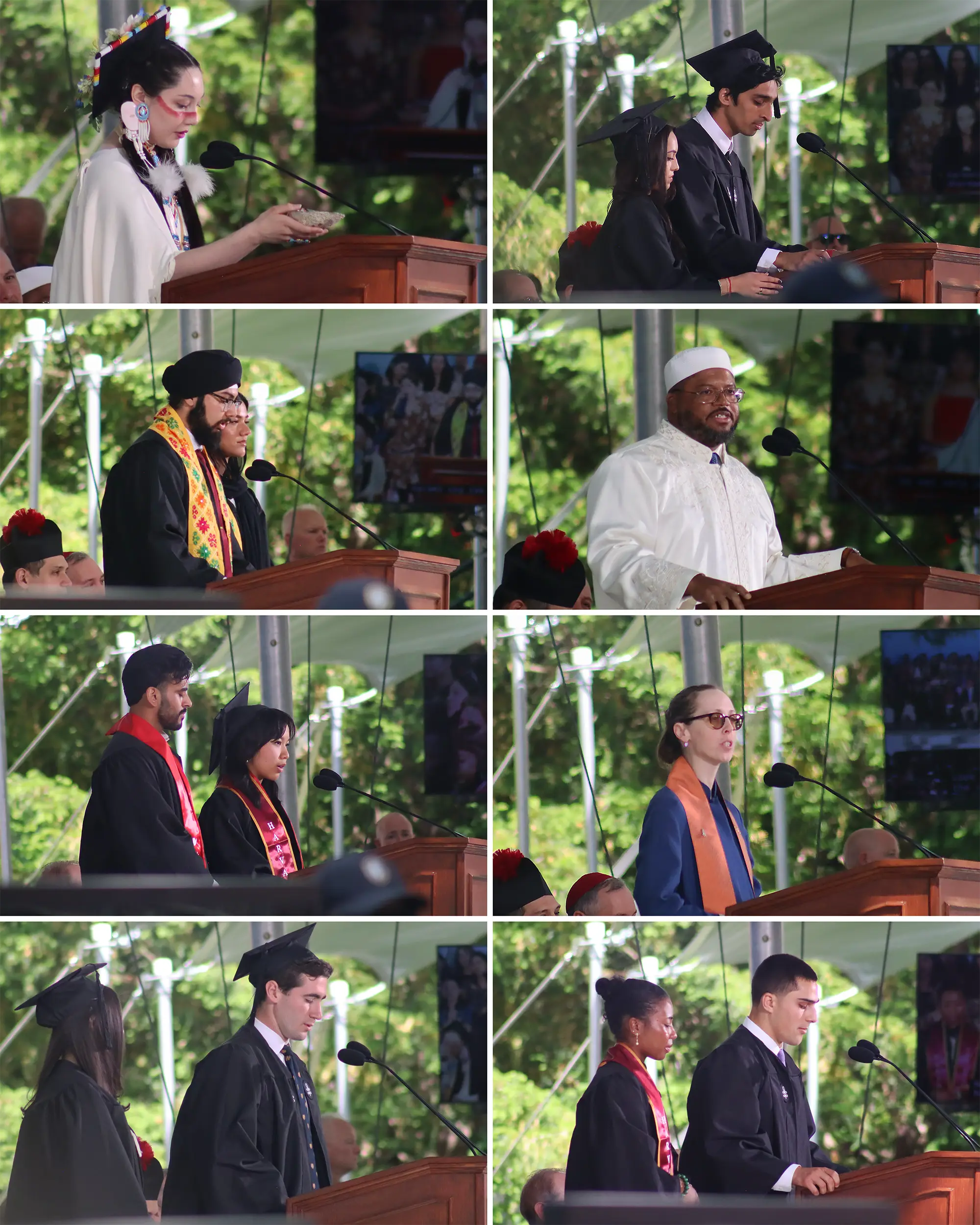
Harvard’s Baccalaureate Service, which dates back to 1642, is a mainstay of Commencement week—a bridge between the present-day, largely secular University and its religious origins. Since the 1800s, Harvard College seniors have traditionally invited the president to address them, as well. Tuesday’s service included readings and blessings from Christian, Jewish, Muslim, Sikh, and Salish traditions.
The Commencement Choir also performed hymns, including “Give Ear, Ye Children, to My Law” to open the ceremony and “Deus Omnium Creator” at the end. The choir also sang two anthems composed by graduating seniors — “Lines and Particles” by Anika Liv Christensen ’26 and “Prelude” by Emma Miao ’26 and Jerry Li ’26.
Following the program, the senior class posed for a group photo on the steps of Widener Library.
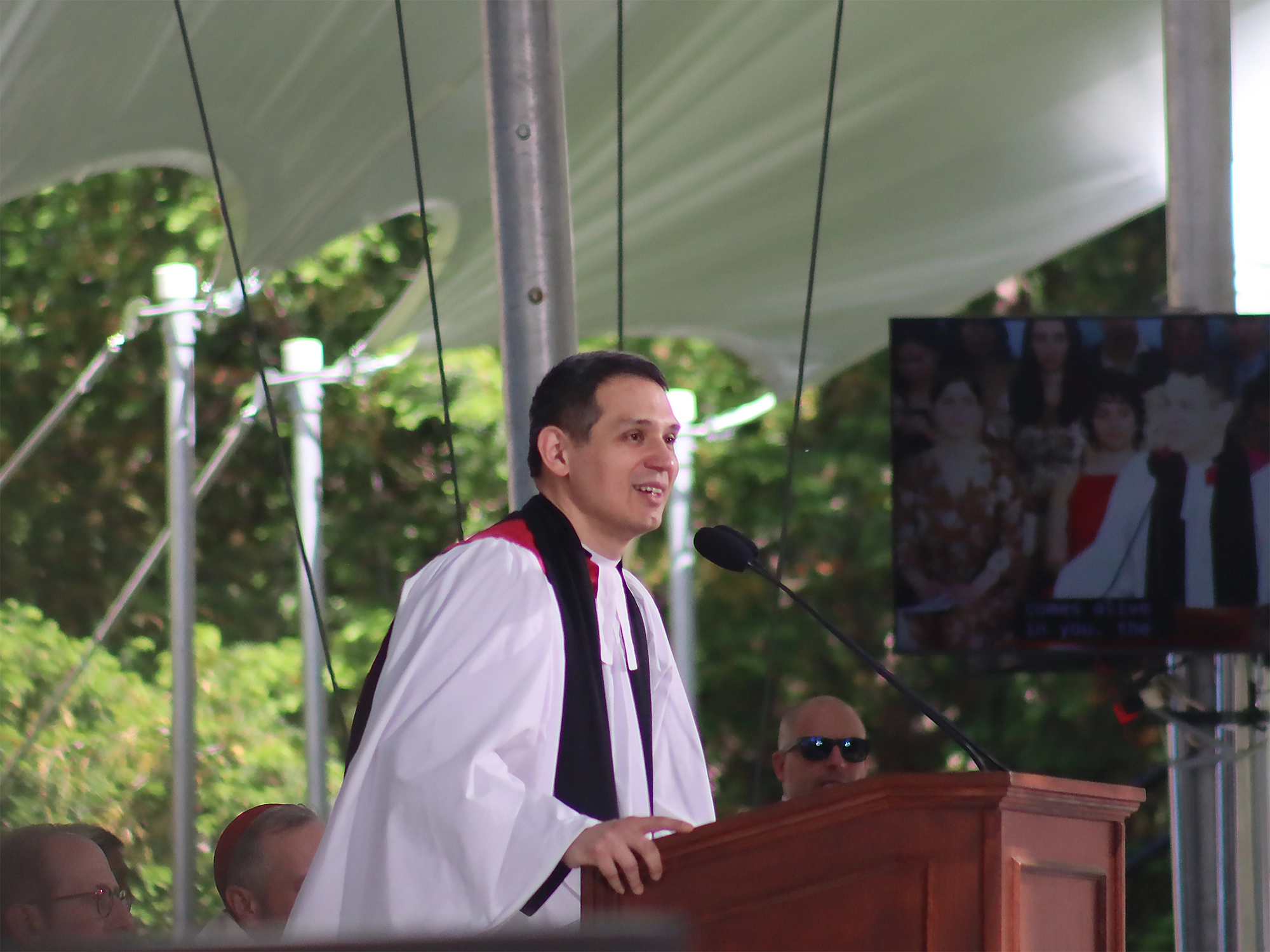
“Traditionally, Baccalaureate is a religious service. Today’s service, however, celebrates you,” said Revered Dr. Matthew Potts, the Plummer professor of Christian morals and Pusey minister, opening the service. “It celebrates all of the beautiful places and peoples from which you have come, from all around this wide world. You are the answer to their hopes and their prayers. You are your ancestors’ dreams come true.”
Rabbi Jason Rubenstein ’04, the executive director of Harvard Hillel, invited graduates to take Commencement week as an opportunity to pause and acknowledge the totality of their accomplishments.
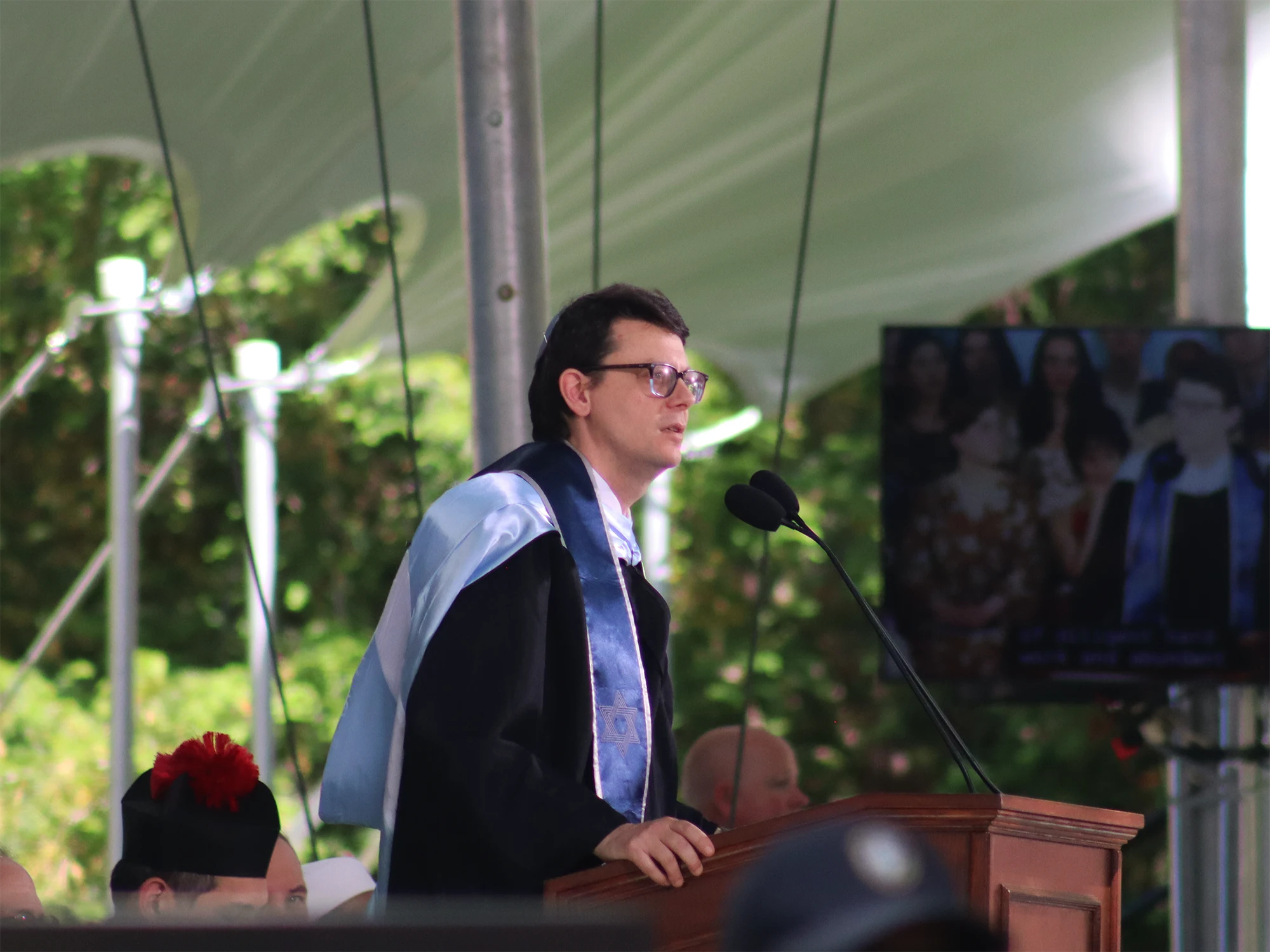
“This afternoon, and each of the next few days is…a detox from the rapid response of life here,” he said. “How many minutes until my text message is answered? How many hours until my email to my professor is answered? How many days until the next midterm? How many weeks until my internship applications come back? There’s a broader celebration today of four years of diligent hard work.”