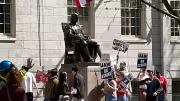
Thousands of Harvard graduate students walked off their jobs in classrooms and laboratories this week, after contract negotiations between the University and union leaders broke down Monday evening and a strike became, as one spokesperson said, “the only option.” On Tuesday morning, union members began picketing outside campus buildings in Cambridge and the Longwood Medical Area, shouting slogans and carrying signs with messages like, “Harvard Pay Your Workers,” and “Real Recourse Now.”
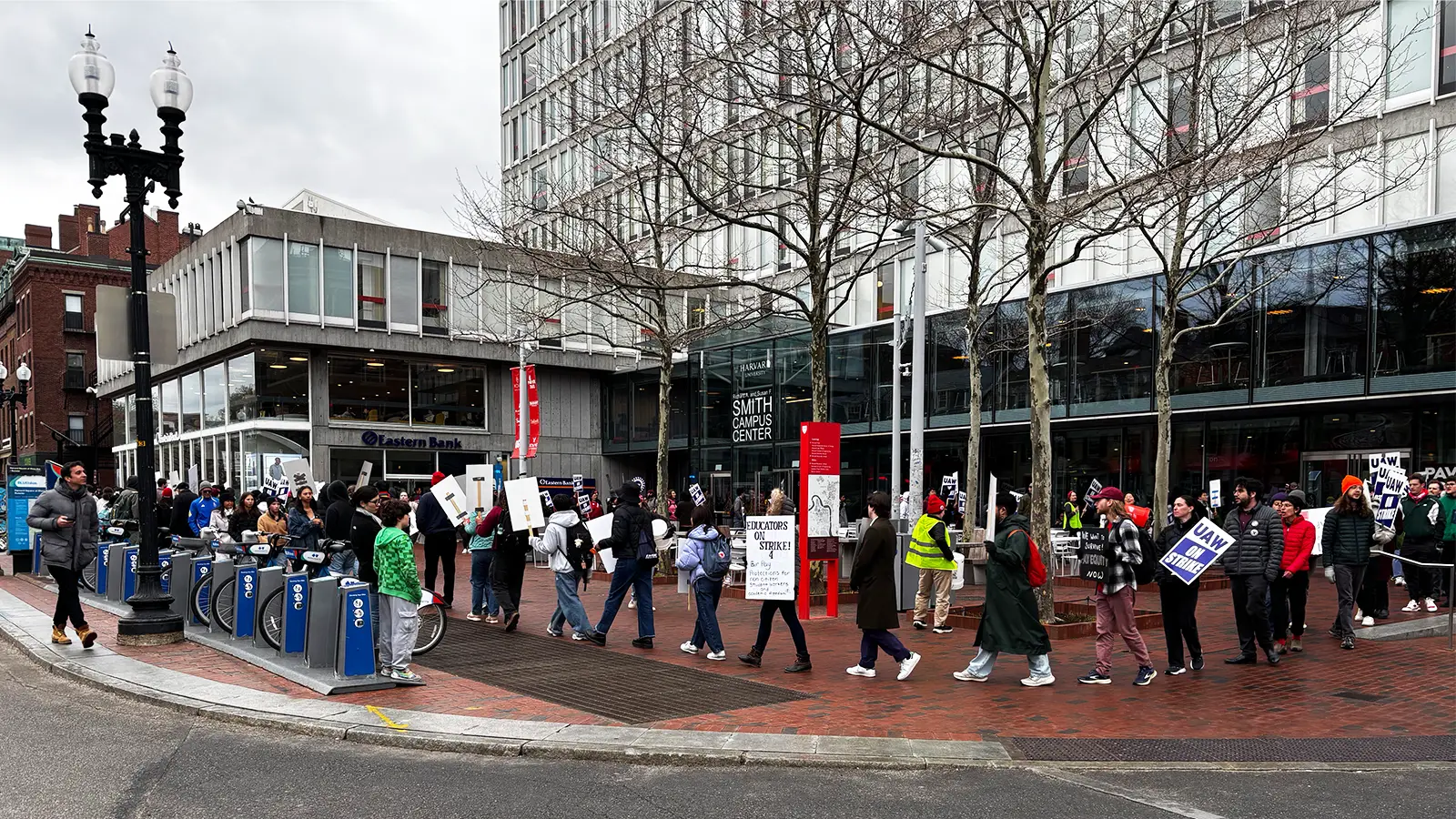
Leaders of the 4,000-member Harvard Graduate Students Union-United Auto Workers (HGSU-UAW), have had 23 bargaining sessions with Harvard administrators since March 2025. The union is calling for higher wages, protections for international student workers at risk of immigration crackdowns, and changes to the way the University handles complaints of discrimination and harassment. The union’s previous contract expired in June, 2025.
Late last month, members of the union—which includes graduate research assistants and instructors, and both graduate and undergraduate teaching fellows and course assistants—voted overwhelmingly to authorize the strike.
In an email to the Harvard community last Friday, provost John Manning and executive vice president Meredith Weenick wrote, “The University remains committed to negotiating in good faith and reaching an agreement with HGSU-UAW,” adding that any agreement must preserve “the integrity of our academic mission, our faculty's academic freedom in teaching and research, and the rights and educational opportunities of all our students.” The letter also included a link to the University’s bargaining proposals.
The union’s bargaining positions and goals are outlined on its website.
In an interview on Thursday, union spokesperson Jacob Wolf, a doctoral student at the Harvard Graduate School of Education, indicated that the two sides remain far apart. “We still have 23 articles of our contract that have not been agreed upon,” he said. “Additionally, there are nine proposals that the union has made over the last 14 months that the University simply has not responded to.”
Compensation is one of the major points of contention. The union is asking that research assistants and teaching fellows make a minimum salary of $55,000 per year. Currently, Ph.D. students are paid $50,000 per year, in what Harvard calls “living expenses support.” (Their compensation also includes subsidized health insurance, full tuition, and benefits that, according to University numbers, add up to $425,000 over a minimum of five years).
But 40 percent of union members are not enrolled in doctoral programs, and some teaching fellows make as little as $26,000 per year, Wolf said—“far too low for the cost of living in Boston and Cambridge.” In addition, the union demands a raise in wages for hourly positions, from $21 to $25 per hour, a 19 percent increase.
And, eyeing rising costs, union leaders are also asking for yearly increases in all members’ compensation, set at either five percent or the rate of inflation, whichever is higher. The University has proposed a 10 percent raise for salaried workers, spread out over four years, a raise that the union has called inadequate, although Manning and Weenick argued in their email that it is “in line with compensation offers in other recent labor negotiations.”
Besides pay, the union is demanding greater support for non-citizen workers, who are under increased threat from the Trump administration, which last year specifically targeted international students at Harvard. Union leaders are asking the University to guarantee up to 120 days of paid leave for students facing detainment or deportation (which would allow them to keep to their jobs if they are able to return to the United States in that time period). The union also wants Harvard to commit to refusing compliance with federal immigration agents who come onto campus without a judicial warrant. Another demand is that the University increase its assistance fund for non-citizen workers dealing with immigration legal fees from $30,000 to $225,000 per year.
A third sticking point in the contract negotiations involves the procedure for dealing with harassment and discrimination complaints. Currently, these cases are handled internally, by University offices overseeing Title IX compliance and anti-bullying and anti-discrimination policies. The union is asking for expanded protections, including explicit protections against retaliation for speaking out, the option of settling complaints through an independent third-party arbitrator, and temporary funding for workers forced to leave their labs because of harassment or bullying. “This issue is extremely important,” Wolf said, “because, unfortunately, many of our members have not been well served by the University's internal process for arbitrating claims of harassment and discrimination.” According to union data, one in five HGSU-UAW members report being bullied, harassed, or discriminated against in the workplace.
In their email, Manning and Weenick pointed to University-wide anti-bullying and non-discrimination policies adopted in 2023 and argued that the union’s demands would “would conflict not only with federal regulations for Title IX complaints, but also with the University’s policy that members of our community should have access to the same procedures.”
This week’s strike halted work in some University laboratories and forced some classes to shift online, as other faculty scrambled to cover union members’ teaching duties. This is the third time HGSU-UAW has gone on strike since the union was formed in 2018. Members staged a monthlong walkout in 2019, and they held a three-day strike in 2021, which led to an agreement with the University a few weeks later. (In this strike, HGSU-UAW may soon be joined by the Harvard Academic Workers union, which represents non-tenure-track faculty and postdoctoral fellows at Harvard. Late last month, its leaders opened a strike authorization vote to members; the vote remains open until the union chooses to close it.)
The next bargaining session in the negotiations between Harvard and HGSU-UAW is set for April 28, and the two sides have agreed to four additional bargaining sessions in May and June.