Why is the Trump administration trying to prevent Harvard from enrolling international students?
International students have become a focal point in the federal government’s broader crackdown on immigration—both illegal and legal. The Trump administration says it is revoking Harvard’s ability to host international students because the University allegedly failed to comply with federal requests for information about criminal and disciplinary incidents involving such students. Harvard says it has provided all materials required by law.
What are the methods the Trump administration is using?
On May 22, the Department of Homeland Security (DHS) announced it was revoking Harvard’s Student and Exchange Visitor Program (SEVP) certification, effectively stripping the University of its ability to enroll international students. Harvard promptly sued, and a judge blocked the department from enforcing that policy while the matter is being resolved in court.
The Trump administration then pivoted to other means. On May 29, Secretary of State Marco Rubio told consular officials to review Harvard visa applicants’ social media accounts for antisemitism, and to flag private accounts as suspicious. Then, on June 4, President Donald J. Trump issued a proclamation preventing Harvard’s international students from entering the U.S. In response, Harvard filed an amended complaint in its existing lawsuit, challenging the legality of the travel ban.
International Students by School
How many international students does Harvard enroll?
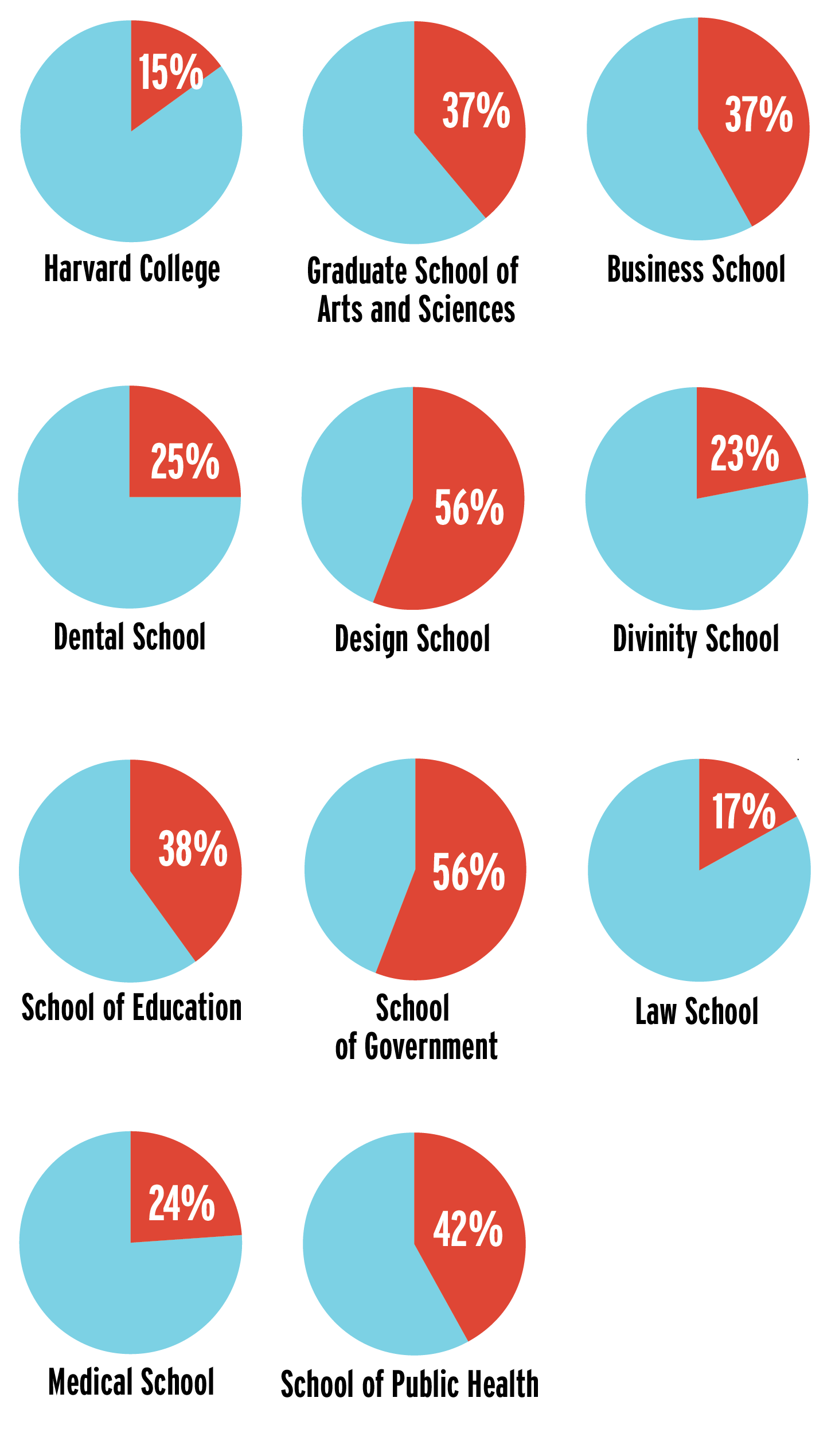
About 7,000 international students attend Harvard—or roughly 27 percent of total enrollment for the 2024-25 academic year. But that figure varies significantly by school. At the College—Harvard’s prestigious undergraduate program, which now admits just 3.6 percent of all applicants—only 15 percent of students are international. (That happens to match Trump’s proposed cap on international enrollment at Harvard.)
Other schools drive the overall percentage higher. At the Kennedy School and the School of Public Health—which attract global leaders and policymakers—56 and 42 percent of students are international, respectively. The Graduate School of Arts and Sciences also contributes, with 37 percent of students hailing from abroad—many pursuing advanced research in the sciences.
What happens if Harvard loses international students?
Much commentary has noted that international students often pay full tuition—and that their absence would hurt Harvard financially. That’s true for some programs. But at the Graduate School of Arts and Sciences, many international graduate-level researchers receive the same stipends as their American peers. There, the loss would be felt less in revenue and more in the scientific output that these students help drive. Foreign-born students have long powered American research: in 2013, Forbes estimated that between half and two-thirds of graduate students on U.S. campuses were born abroad. Foreign-born workers make up 19 percent of the U.S. STEM workforce—and 43 percent of STEM workers with a Ph.D., according to a 2024 National Science Foundation report. International universities are already stepping in to poach talent from the U.S.
Click here to read comprehensive coverage of Harvard in the Crosshairs
On international students:
“The fact that the international community is too scared to speak says something very scary and concerning about the state of American democracy. This is a country that was founded on the principle of free speech, and yet I’ve been told by everyone around me that using my voice will present a great risk to myself.”
—Alfred Williamson ’28,
U.K. citizen, interview with Harvard Magazine
“Admission into the United States to attend, conduct research, or teach at our Nation’s institutions of higher education is a privilege granted by our Government, not a guarantee.”
—Donald J. Trump, presidential proclamation, June 4, 2025
“With no basis in law, the Proclamation denies thousands of Harvard’s students the right to come to this country to pursue their education and follow their dreams, and it denies Harvard the right to teach them. Without its international students, Harvard is not Harvard.”
—Amended complaint, President and Fellows of Harvard College v. Department of Homeland Security et al. June 5, 2025
“The vice president has opined that international students are preventing domestic students from enrolling, taking their place in classrooms. This is simply not true. The very best and brightest domestic students always have a place to enroll. The challenge that the nation faces is that the domestic demand for human capital talent in numerous fields far exceeds the domestic talent supply available.”
—Sheldon H. Jacobson, professor of computer science,
University of Illinois Urbana-Champaign, The Hill