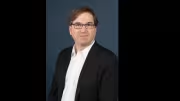
Tarek Masoud’s interest in political science began when he moved, at age nine, from Wisconsin to Saudi Arabia, and was faced with starkly different images of democracy and freedom for the first time. Now the Ford Foundation Professor of Democracy and Governance at Harvard Kennedy School (HKS), he has built a career shaping discourse about democracy, authoritarianism, and political developments in the Middle East.
In June, the Heterodox Academy, a nonprofit dedicated to advancing viewpoint diversity on college campuses, awarded Masoud its 2026 Courage Award, one of its Open Inquiry Awards, for fostering “polite but rigorous inquiry” into the polarizing conflicts in the Middle East. Masoud heads HKS’s Middle East Initiative and the Initiative on Democracy in Hard Places and led efforts to foster dialogue around the Middle East particularly after the October 7, 2023, terrorist attacks on Israel and the subsequent war in Gaza.
This interview has been edited for length and clarity.
Harvard Magazine: You’ve spent your career studying democracy in one of the world’s most difficult political environments. What do HKS and Harvard provide you—in terms of resources, access, or intellectual community—that you couldn’t find elsewhere?
Tarek Masoud: I’m a political scientist. At a place like the Kennedy School, you have to be engaged in the research enterprise and contributing to the political science literature, but you also have to do other things to earn your place. You teach master’s students. When you’re teaching people like that, you must translate academic work, and part of the work of that translation involves determining its real-world importance. I think 18 years of having the Kennedy School push me in this direction—to always think about the real-world implications of the things that I write and study—made me into a much more engaged scholar.
HM: As someone who has built your career here, what do you think outsiders most consistently get wrong about Harvard?
TM: The outside world has consistently mischaracterized our students. Our students are portrayed in the media as incapable of listening to opinions they disagree with without throwing a tantrum, [as people who] game the system on standardized tests because they have parents who got them extra time, as people who don’t earn their grades. They’re all wrong. My experience with the vast majority of Harvard students has been that they’re absolutely capable of listening to arguments with which they disagree, doing so in a polite fashion, and making their own counter arguments if they are put in an environment that enables that…without falling into mutual recrimination.
I also think people are getting our faculty wrong: the vast majority of our faculty are not “scholar activists” trying to preach their particular understanding of the world. They are, just like our students, what I would call earnest seekers of the truth.
HM: Can you walk me through what it was like to launch the Middle East Dialogues series?
TM: Right after October 7, I was putting together panels around this issue at the request of the school. The dean at the time, Doug Elmendorf, was very keen that there be educational opportunities for our students to learn about this in a way that maximizes light and minimizes heat. I did a lot of panels. [But] I had a dissatisfaction with [them], and I later learned the community was dissatisfied. I found I kept coming away from these panels with more questions than answers. There’s an article written by one of our students in the Boston Globe, where in the middle of me doing all these panels, she said, “Harvard is not really doing much to educate me on this issue.”
Part of my decision to launch the Middle East Dialogues with high-profile people who have really important perspectives—with which we need to grapple on this conflict—was that I thought, “This is going to break through in a way that the [panels] I did haven’t broken through, and I’m going to learn a lot.” Because it was a very bold enterprise, and because I launched it without talking to anybody—I just did it—I think people were understandably concerned that this could go wrong, especially when the outside world started picking through my list and found, “Oh, this person said these objectionable things,” or “That person did that thing that we don’t like.”
[Masoud’s invitation to Dalal Iriqat, a Palestinian professor at the Arab American University Palestine, sparked controversy due to a post Iriqat made on the social media platform X describing the October 7 attacks as a “normal struggle 4 #Freedom.” Elmendorf later made a statement distancing HKS from the dialogue series and personally rebuking Iriqat’s remarks. Masoud described his reaction to the statement.]
I’m not going to lie, I didn’t love that statement. The statement said, “Tarek has invited this person. The dean believes that what she says is ‘unconscionable and abhorrent,’ but Professor Masoud has academic freedom.” At the time, I felt that I wanted something more clearly supportive of my enterprise. Now I read that document very differently, as an attempt to defend academic freedom, with the dean acknowledging that this particular person’s views are views that are not shared by the Kennedy School. Our leadership at this University has been trying to thread this needle. At the time, I was not totally attuned to that.
HM: What does the recognition from the Heterodox Academy mean to you?
TM: This award that I got, the Open Inquiry Award, it’s for courage. And I am incredibly grateful for this recognition; it really is extraordinarily validating. But I wince a little bit at the description, because sometimes people can portray this as “Professor Masoud, the courageous seeker of the truth, fighting not just the forces of intolerance in the outside world, but also fighting the pusillanimous Harvard administration that has lost its way.”
The fact is, I couldn’t have done a single one of these events if the Harvard administration didn’t back me. This is a Courage Award that actually belongs to the whole Kennedy School. I think it’s important to acknowledge that whatever successes we have over the last couple of years in terms of promoting this kind of discourse is a success of Harvard, and it’s a testament to the fact that fundamentally the institution is sound.