On an icy morning a year and a half ago, my boyfriend, Carlos, and I pulled into the parking lot of the House Rabbit Network, an animal rescue shelter outside of Boston. In the back seat, crouched in her carrier, was our pet rabbit, Petunia. Newly single after the sudden passing of her rabbit companion, she was in the market for a new beau (or, in rabbit-world parlance, “husbun”). And although she didn’t know it yet, she was about to go speed dating.
Yes, that’s right: speed dating. Mostly out of vogue these days among humans (although dating app fatigue has fueled a recent revival), speed dating has long been the go-to matchmaking tool for domesticated rabbits. Shelters sometimes hold daylong events where people bring their rabbits for rapid-fire meetups with adoptable bunnies. Other times, the process is smaller and more targeted: a scheduled set of dates with a chosen handful of furballs. That’s what we’d signed Petunia up for.
“You’re here!” exclaimed Lauren Swank, opening the door when we rang the buzzer. She was holding a small black-and-white rabbit and wearing a hoodie with the words “Bunny Mom” printed across the front. Until recently, Lauren was the communications manager for the House Rabbit Network, a nonprofit that rescues about 400 domesticated rabbits every year in Massachusetts and is run almost entirely by volunteers. “Come in, Petunia!” she said. Petunia, a huddle of dark brown fur and floppy ears, did not look up.
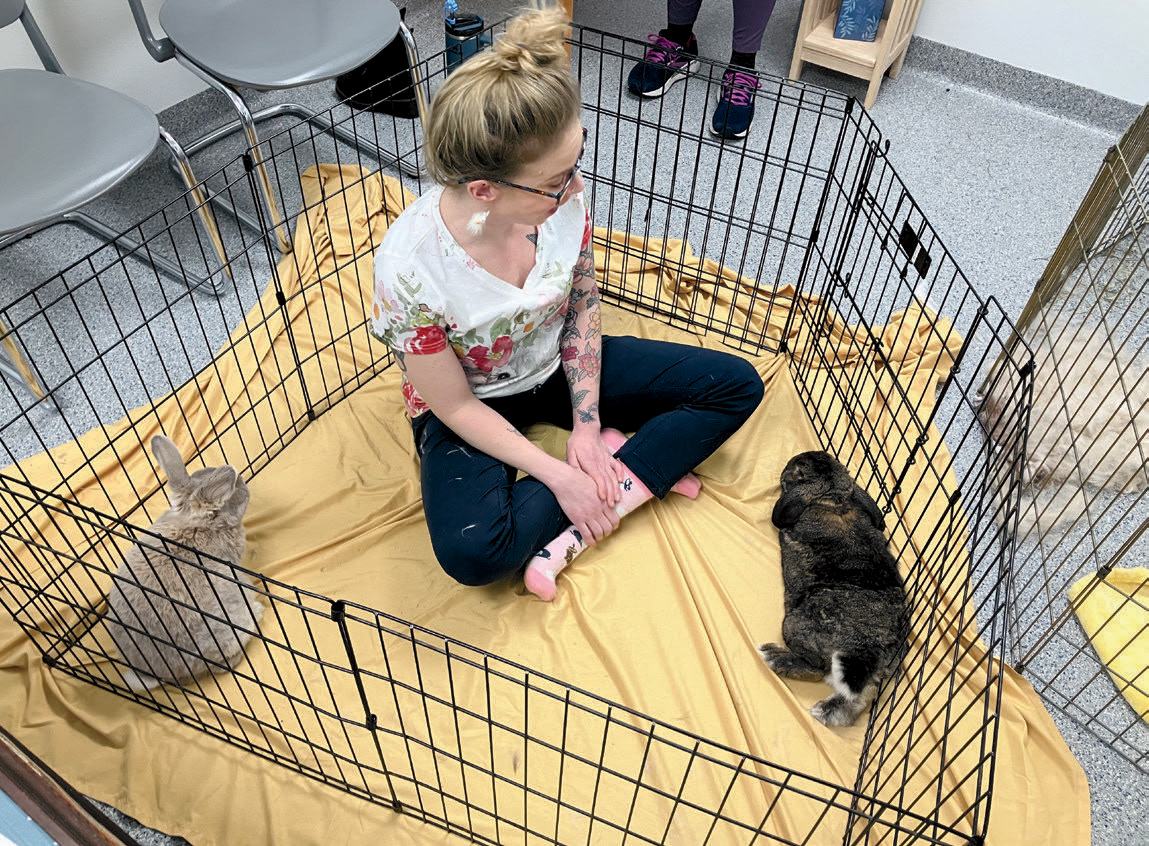
From the outside, the shelter looks like a cinderblock warehouse, but inside it’s more like an unusually tidy and cheerful barn. Dozens of rabbits lounge in little “condos,” each outfitted with soft blankets and toys and a name tag clipped to the front of the pen. Volunteers rush around with brooms and litter boxes and armloads of hay. Lauren led us down a hallway, where a small room had been set up for Petunia to receive her suitors, with a blanket on the floor and a big circular pet pen in the center. Waiting for us there was Rosie Malsberger, S.M. ’14, who volunteers at the shelter as a “bonding counselor,” helping lonely hearts bunnies find love.
It might seem like rabbits wouldn’t need any assistance in this department. After all, they breed like, well, rabbits. But this isn’t mating in the wild. It’s something much trickier—a lifelong bond between domesticated (and surgically fixed) rabbits, who eat, sleep, and play together every day. Bonded bunnies almost never stray more than a few feet from each other, and they spend hours cuddling. Sometimes they even poop side by side.
Understandably, they can be pretty finicky about who they choose for that kind of closeness. And yet, they need it. Like humans, rabbits are social animals. Petunia’s ancestors lived in groups in vast underground warrens, and her wild cousins still do. And bunnies don’t just thrive on companionship; they require it on a biological level. Because rabbits are so often used as laboratory animals, scientists have studied the effects of caging them alone or in pairs and have found that rabbits kept together are not only happier, but healthier. Their body temperatures are higher and their heart rates are lower; they’re less susceptible to illness and stress. And a growing mountain of research suggests that all kinds of animals, including rabbits, have rich social, emotional, and cognitive lives that we are only just beginning to fathom. Increasingly, veterinarians and animal rescue organizations recommend rabbit owners get their fuzzy creatures a friend. In Switzerland, pet welfare laws actually forbid keeping social animals like rabbits without a same-species companion.
If this concept resonates with you, it’s probably because it feels so much like the human condition. Loneliness is a recognized health crisis. A flood of dating apps and matchmaking services speak to our desire for companionship. And when we lose someone, we grieve and also wonder how to go on, how to honor the loss and still find the intimacy we crave with someone else. I went on this journey because I wanted to help Petunia. But her story also showed me how inseparable love is from grief and how profoundly our relationships shape who we are. Without the people we love, we are not ourselves.
One reason I was intent on finding a companion for Petunia was because I’d seen what she was like when she had one.
One reason I was so intent on finding a companion for Petunia was because I’d seen what she was like when she had one. In August 2024, Carlos and I adopted Petunia and her then-“bondmate,” Oliver, as a pair. They’d been rescued from a home in the suburbs, where they’d been turned out of the house and left to run loose in a driveway, with dry food and a bowl of water by the door. It’s likely they were out there for weeks—neighbors saw them darting underneath cars for shelter from the heat and predators. The shared ordeal seemed to intensify their attachment (“trauma-bonded,” as one veterinarian put it). Lauren told me that when they first arrived at the shelter, Oliver was so protective of Petunia that he didn’t want anyone to touch her.
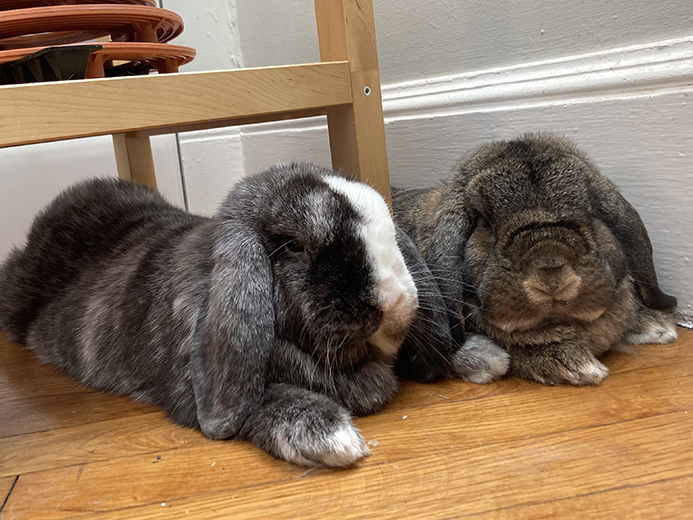
At home with me and Carlos, the rabbits settled in quickly, following each other around the apartment, flopping side by side under the front window, and playfully stealing parsley and cilantro from each other’s mouths during breakfast. Then, one day a few months in, Oliver suddenly fell ill, losing his appetite and his energy. As prey animals, rabbits instinctively hide sickness until it’s often too late, and despite multiple trips to see veterinarians and antibiotics that seemed to be working against what was ultimately diagnosed as a respiratory infection, Oliver was gone within two weeks. He died overnight, with Petunia next to him, at the vet clinic where they were staying together while he was being treated. She was with him for hours before the staff arrived in the morning.
I’ve had pet bunnies since childhood (we were never a dog-and-cat family), so I have grieved many rabbits. But until Petunia, I had never seen a rabbit grieve. It was clear her loss was profound. She avoided spots in the apartment where she and Oliver used to hang out, and she seemed unable to relax for more than a few minutes at a time. She stopped eating certain foods, and I started feeding her pieces of carrot every day (a sugary treat, not a staple, despite popular belief) just to keep her digestion moving. Obviously lonely, she sought out extra affection from me, and there were nights when I slept on the couch near her pen, just so she’d have another heartbeat in the room.
Mostly, though, what I remember was her rage. She didn’t seem confused by Oliver’s absence—she seemed absolutely furious. In her enclosure, she constantly pushed things around, shoving her litter box and food bowls with an almost violent force. Other times, for no discernible reason, she would stomp her back feet, a signal that typically means danger, or anger.
When I described all this recently to primatologist Christine Webb, she wondered if Petunia had experienced some form of PTSD. Now at New York University, Webb spent six years as a researcher and lecturer at Harvard, where she wrote The Arrogant Ape (2025), an encyclopedic critique of the “myth,” as she calls it, of human exceptionalism. Gathering scientific evidence from across the animal kingdom—from songbirds, to honeybees, to beavers, to chimpanzees—the book argues that humans aren’t the only species to think and feel in complex ways. When Oliver died, Webb said, Petunia was likely traumatized.
“That’s a word that’s becoming less taboo” in scientific circles, she explained, as research piles up on animals’ responses to trauma (there’s a particularly vivid, heartbreaking study of donkeys forced to work in Egyptian brick kilns). “PTSD requires a kind of memory of what happened,” Webb said, “which is something that we denied to other animals.”
If any person can possibly know what Petunia went through, it might be Stephanie Cacioppo. A neuroscientist at the University of Oregon, Cacioppo is an expert on the effects of human connections on the brain. She has also endured shattering loss.
Cacioppo and her husband, the pioneering social neuroscientist John Cacioppo, met and married in 2011, after a whirlwind, love-at-first-sight romance. For several years, they both taught at the University of Chicago, working side by side at a desk they shared and collaborating on research. John Cacioppo’s work focused on loneliness and its devastating consequences for both the brain and the body, all the way down to the cellular level. Without companionship, he found, people fall apart: our cardiovascular and immune systems, cognitive function, mental health, even gene expression, begin to falter. Chronic loneliness is so corrosive that some researchers have described it as more dangerous than obesity, smoking, or alcoholism.
Then, in 2018, John died from complications of a rare, aggressive form of cancer. In her 2022 book, Wired for Love: A Neuroscientist’s Journey Through Romance, Loss, and the Essence of Human Connection, Stephanie recounts the night John died in her arms and describes the grief that followed as a “cyclone.” “I was shocked by how much John’s death hurt,” she writes, “not just psychologically but physically. My heart literally burned for weeks.”
For animals and humans alike, “there’s a very strong neurobiological tie between love and grief,” Cacioppo told me when I reached out to talk about Petunia. Cacioppo is perhaps best known for mapping the human brain’s “love network,” a group of 12 regions that light up when we are in love, including the emotion and reward centers and the cognitive system. One area she found especially responsive to romantic love is the angular gyrus, a U-shaped region located behind the ear, involved in conceptual thinking, metaphorical language, and abstract representations of the self. Love is not simply a feeling, she writes, but “a way of thinking.”
In acute grief, she says, that love network powers down. The brain’s alarm center, the amygdala, fires up, putting the body in a perpetual fight-or-flight state. Meanwhile, the prefrontal cortex, the region responsible for planning, organizing, and decision-making, dims. That’s why people who’ve recently lost a loved one may forget to eat, or miss their turn on the highway, or struggle to make a cup of coffee.
Some of the higher-level cognitive areas that Cacioppo sees lighting up in human brains don’t exist in rabbits. But many responses to love and grief in the brain’s emotion centers are shared among social species, she says, and rabbits exhibit mimicking behaviors that suggest they have a cognitive mechanism similar to humans’ mirror neuron system, which helps people anticipate a companion’s intentions and actions. When couples finish each other’s sentences, that’s the mirror neuron system at work—and this, too, goes dark after a death. “The brain rewires itself when you fall in love,” Cacioppo says, “and it has to rewire itself again in grief.”
After a couple of months, Petunia began to emerge from her sorrow and anger—her agitation subsided and her appetite returned. But she still remained more subdued than before, quieter and less social. That’s when we started making plans for speed dating.
By the time we arrived at the shelter for Petunia’s first series of dates, I had been emailing with Rosie, the rabbit bonding counselor, for more than a week, gaming out which of the House Rabbit Network’s eligible rabbits might make a good match. A data engineer who works in insurance technology, Rosie studied epidemiology at the Harvard Chan School of Public Health. Caring for shelter rabbits is perhaps a different public health challenge from the one she imagined pursuing, but it’s clearly a calling. She adopted her first rabbit—whom she named after the Spanish Formula 1 driver Carlos Sainz Jr.—in 2021, after a knee injury ended her days as a competitive runner and the pandemic’s social isolation left her feeling rudderless.
Five years later, she shares her home with nine rabbits, almost all of whom she has bonded into pairs and trios. Since 2023, she has supervised the House Rabbit Network’s hotline, which handles everything from adoption inquiries to surrender requests to rabbit care questions. Most weekends, Rosie is at the shelter chaperoning speed dates, and she receives texts and emails almost every day from people seeking advice on bonding their rabbits. Sometimes she makes house calls.
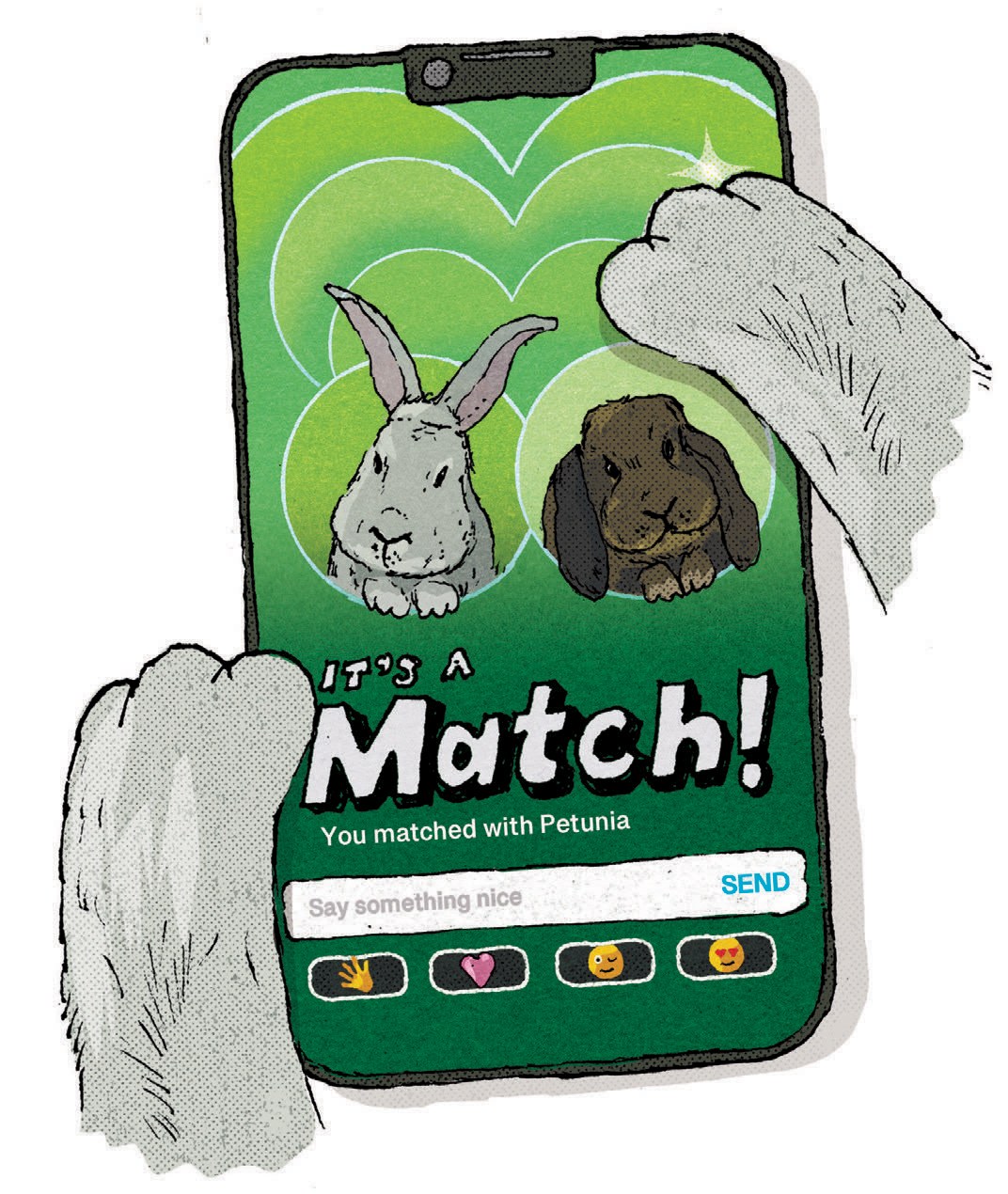
Looking through the online profiles of the shelter’s single, adoptable rabbits—a bunny version of Tinder, with photos, backstories, and personality quirks—Rosie and I settled on five suitors who seemed friendly and easygoing, and who might be capable of balancing out Petunia’s sassy intensity. (As my boyfriend and I had quickly discovered, Petunia is full of opinions.) First up was Gigi, a sweet-tempered female lop who looked like Petunia’s doppelganger: chestnut fur, a white-trimmed nose, and luxurious, floppy ears. (Same-sex pairings are less common in rabbits, but not unheard of.)
Lauren placed Gigi in the pen a couple of feet from Petunia. Rosie was on the floor next to them with a bag of treats, in case things got testy. For a few minutes, the two rabbits hardly engaged at all, just a few sniffs in each other’s direction. Both seemed nervous, especially Gigi. Finally, Petunia approached Gigi and lowered her head, a signal that she wanted to be groomed. For rabbits, grooming is a sign of affection, but also a way of establishing dominance—the rabbit who receives it the most is usually the one in charge. But Gigi, perhaps too anxious, didn’t respond to Petunia’s demand. So Petunia nipped her.
A bit of conflict early on is not a bad thing, and Rosie separated the bunnies to reset the interaction, but by then Petunia’s mood had shifted. She hunched into a ball and sat there, glaring.
Next, Lauren brought in Grigio, a five-month-old Flemish giant. He was goofy and big (full-grown Flemish giants average 15 pounds) and not easily rattled. “He’s going to roll with the punches,” Lauren said. “And if she bites him—”
Before she could finish the sentence, Petunia bit him. And unlike Gigi, Grigio bit back. A melee ensued, and Grigio was whisked back to the safety of his condo. The date lasted all of six seconds.
At this point, we threw out the carefully curated list of suitors and started improvising. Lauren chose a little guy named Blizzard, with eyes that matched his silver-gray fur. A veteran speed-dater, he had a knack, she said, for charming sour bunnies.
Petunia glowered as he sniffed the floor of the pen, exploring. When he approached her, she lunged, flipping him onto his back, his legs flailing. In one seamless motion, Rosie scooped him into the arms of another volunteer, and he clung to the woman’s shoulder with a look of terror and surprise.
By now, it was clear that no new rabbit would be coming home with us that day, but Lauren wanted to end the speed-dating session on a positive—or at least neutral—interaction. She fetched Zephyr, an extremely docile white rabbit with brown splotches on his nose and ears, and sat on the floor outside the pen with him in her lap. A few inches away, Petunia coiled herself into the shape of a bullet. After 20 minutes of stillness and head rubs, with Zephyr nearby but out of reach, she finally unclenched.
Bunnies don’t always find a match during the first speed-dating session, so three weeks later, we brought her back for another try. But it was more of the same: bites, lunges, angry hunching. A rabbit named Weasley took a kick to the face. A second date with Zephyr was decidedly meh. “Maybe she’s not ready yet,” Rosie said. “I think she just wants to be alone,” Carlos said. We decided to suspend the matchmaking for a while.
A few days later, Lauren sent me an email. There was a rabbit she wanted Petunia to meet, and like her, he was recently widowed.
But a few days later, Lauren sent me an email. There was a rabbit she wanted Petunia to meet, and like her, he was recently widowed. “He just lost his bondmate last night,” she wrote. She sent photos: he had khaki-colored fur, upright ears, and a cautious, plaintive expression.
His name was Spruce.
Whenever I tell people—friends, colleagues, strangers at dinner parties—about Petunia’s saga, they always want to know more. “Tell me everything,” Cacioppo said almost as soon as we got on the phone. For months, Carlos’s coworkers demanded updates on Petunia’s love life.
At first, I was surprised that people were so interested—and not just interested but invested. Part of the fascination with Petunia’s story is that it’s just so unexpected (speed dating? for rabbits?), but I think it’s also that it’s so relatable. “Dating is hard,” my sister texted, after I told her about Petunia’s disastrous first round of meetups. “I sympathize,” a friend wrote. “I’m on Team Petunia.” It’s easy to see ourselves in Petunia’s place: hungering for connection yet struggling to find it.
For humans and rabbits alike, the search for love can be difficult—and for some of the same reasons. Just like people, bunnies are picky. “We assume that animals’ social relationships and group formations are more fluid and indiscriminate than ours,” said Webb, the primatologist. “But every animal is an individual, with all sorts of idiosyncrasies and personality traits.” And many of the issues they must navigate—territory, power struggles, trust—show up in human relationships, too.
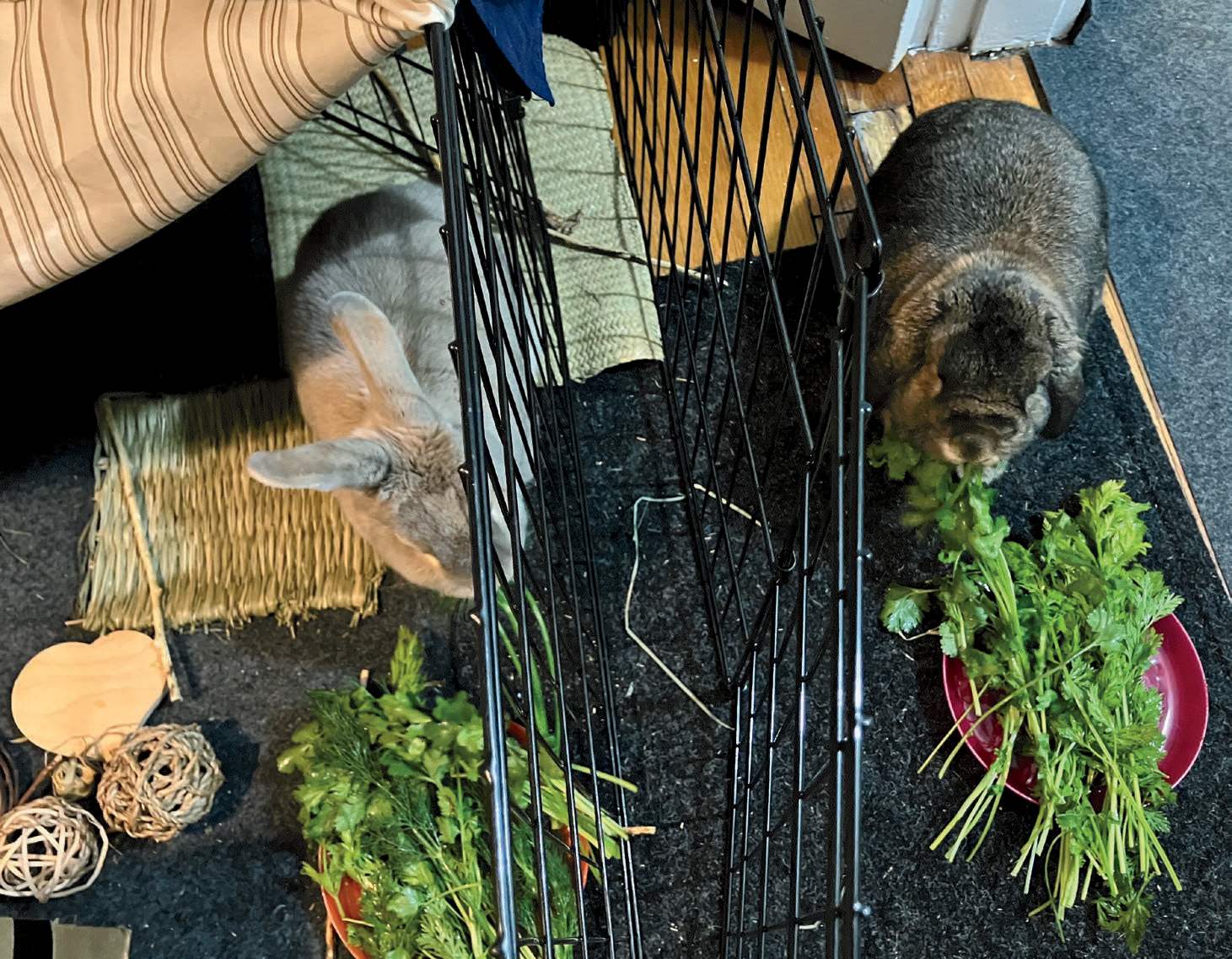
I’m not sure what sparked the chemistry between Petunia and Spruce, but from the first moment, their date was different than the others. When he hopped out of his carrier and into the pen where she was sitting, she didn’t stiffen. Instead, she seemed to pretend he wasn’t there and continued munching a pile of hay that Rosie had put down. “Oh, she definitely knows he’s there,” Rosie said. It was meaningful, she added, that Petunia was willing to eat with her back to him, a vulnerable position for a rabbit. “She feels safe with him,” Rosie said.
For nearly half an hour, the two rabbits carried on a delicate ballet, neither quite touching, both clearly curious, exchanging sniffs from a few inches apart. At one point, Spruce began to groom himself; then Petunia did the same. “That’s mirroring,” Rosie said. A very good sign. Spruce came home with us that day to begin the next phase of their courtship.
“I think he would have done anything to make it work,” Lauren told me later. Without his previous companion, Berry, who died of cancer—also overnight, with Spruce next to her—he’d become so depressed he stopped eating. Lauren was worried. Without intervention, rabbits sometimes simply die after losing a mate.
Petunia and Spruce are very different bunnies—she’s the go-getter who’s always scheming how to reach the treat shelf, and he’s a shy worrier who chews his toenails—but Lauren guessed that their shared experience of grief might make them compatible. And not just for touchy-feely reasons: rabbits who have been in relationships before tend to have better social skills, she said. They’re more adept at picking up on behavioral cues—and Petunia had shown she had no patience for any rabbit who couldn’t read her signals.
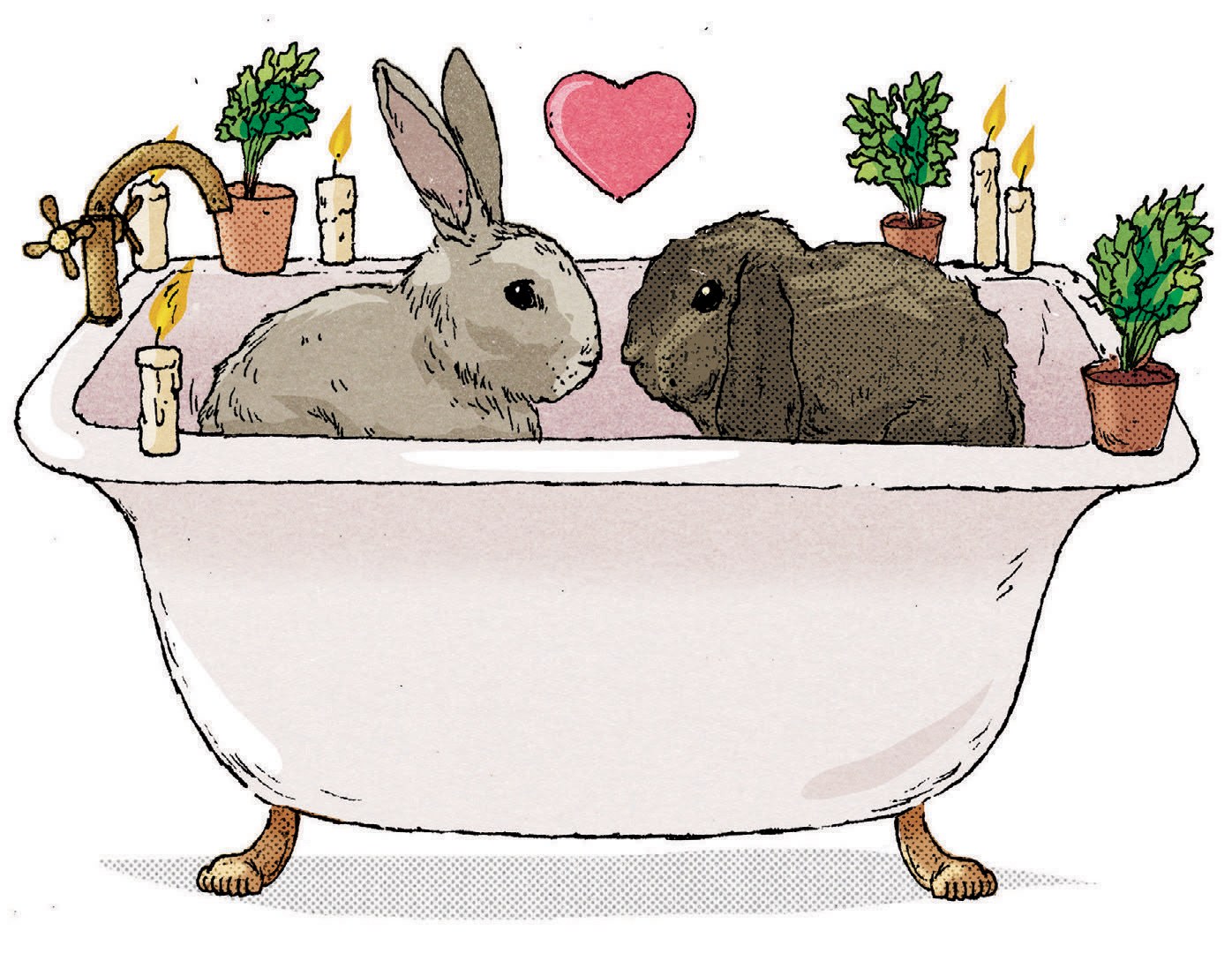
After we brought Spruce home, it took another four months for them to fully bond. Spruce slept in a separate pen next to Petunia’s, and we held at-home dates in the bathtub and the hallway next to the kitchen. Rosie came over to help a couple of times, and the shelter staff emailed me a 50-page instruction booklet on bonding, filled with detailed dos and don’ts. It explained that a certain amount of conflict is inevitable—and healthy—as rabbits sort out their hierarchy but warned against the dangers of a “bunny tornado,” a fight so intense it can doom a budding relationship. I learned what a degloving wound is (don’t look this up) and about the mesmerizing power of a trick called “bunny magic,” which involves holding two rabbits side by side while rubbing both their heads simultaneously. It gives each rabbit the impression of being groomed by the other, which can help bickering bunnies build trust and connection.
Mostly, though, we let Petunia and Spruce get acquainted by simply being near each other. We’d let one roam freely while the other stayed in the pen. This kept them physically separated while allowing them to see, hear, and smell each other. They could touch noses through the bars. “Rabbits are always communicating,” Rosie had told me. Even the way they breathe is a form of language. Stephanie Cacioppo had mentioned something similar about the importance of touch in human relationships. “A lot happens between the words,” she said. One of the neurochemicals that spikes when couples cuddle or look into each other’s eyes is a powerful peptide called oxytocin—or, as it’s also known, the “bonding hormone.”
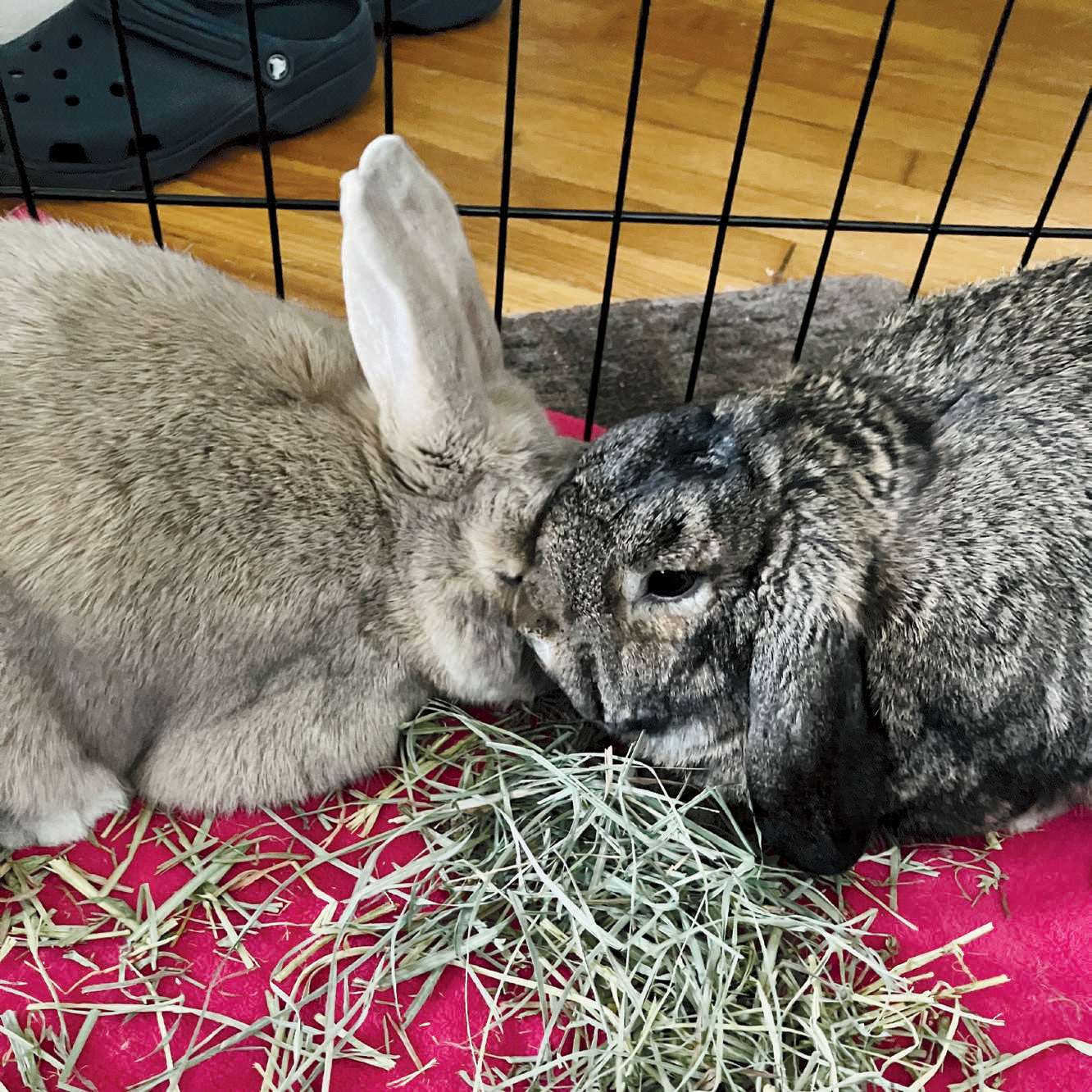
When Petunia and Spruce squabbled, it was usually over her refusal to reciprocate his grooming. Maybe she was trying to maintain her dominance, or maybe she was just tired: with Oliver, she’d done almost all the grooming. Finally, after holding out for months, she relented. The first time she licked Spruce’s ears, he closed his eyes and his whole body seemed to melt. A few days later, we consolidated their enclosures into one.
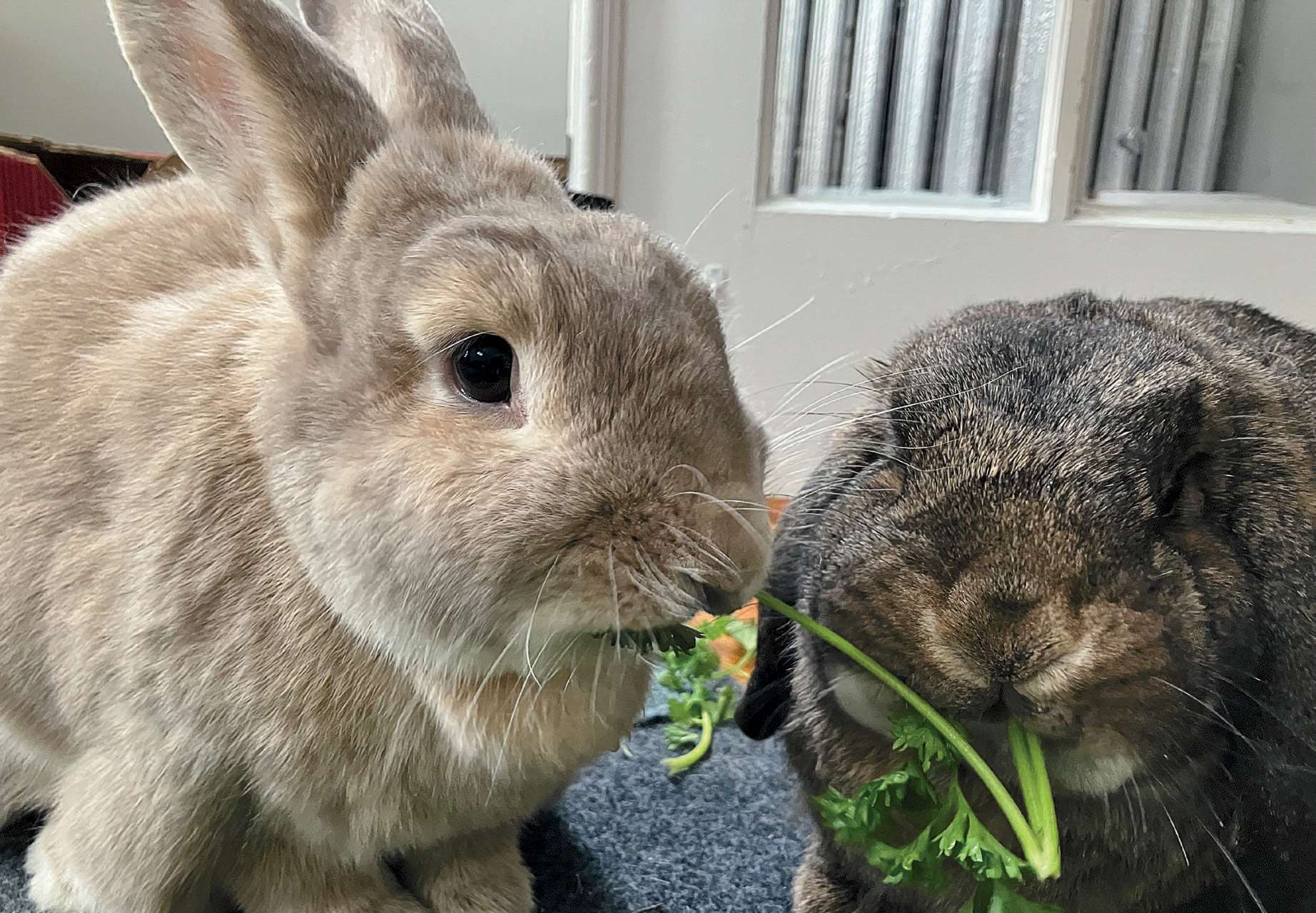
A year later, the two rabbits are inseparable. In the morning, after a shared breakfast of salad greens, they usually retire to a corner of the living room and take turns grooming each other until they doze off. At night, Spruce sometimes chases Petunia playfully, while she sprints ahead of him, almost—but not quite—allowing herself to be caught. More than once, I’ve seen him accompany her to their water bowl, just to lie next to her while she drinks.
These gestures of affection sound familiar to Robert Waldinger. A professor of psychiatry at Harvard Medical School and a practicing psychiatrist at Massachusetts General Hospital, he is the current director of the Harvard Study of Adult Development, which since 1938 has explored what makes human lives flourish. The Harvard Happiness Study, as it’s informally known, began with 724 participants, a mix of Harvard undergraduates and boys from troubled Boston neighborhoods. Eventually, the researchers incorporated the men’s spouses, and, as that original generation passes away, the study continues with nearly 2,000 of their descendants.
The survey’s resounding conclusion, after nearly a century of gathering evidence, is that good relationships are the single most essential ingredient in healthy, happy lives, outweighing other factors like wealth, fame, and intelligence. To a degree that stunned even the study’s researchers, strong emotional bonds were a powerful predictor of longevity and long-term health. “Like, how could your feelings about your partner make it more or less likely that you’ll get coronary artery disease, or Type 2 diabetes?” Waldinger says. “But it does.” Relationships “get into our bodies and shape our physiology.”
That benefit holds for all kinds of relationships, he adds, not just romantic ones. “It’s really about the quality of the connection,” he says. Cacioppo, too, has found that the brain’s “love network” is activated not only by romance but also by close friendships and even identification with a sports team, although the pattern and intensity are different. “It’s about expanding yourself into something bigger,” she says: a feeling of connectedness so strong that the self grows to include someone else.
This past winter, Carlos and I took Petunia and Spruce back to the shelter for a Valentine’s Day-themed photo shoot, where they shuffled tentatively among heart-shaped props on a pink-and-red blanket, finally settling down together next to a cartoonishly oversized “love meter” with its arrow set to “true love.” Petunia’s bond with Spruce seems as close as the one she once shared with Oliver, but it’s not exactly the same. There are different habits, different gestures, different rhythms. One rabbit is not simply a replacement for the other, and yet, for both Petunia and Spruce, the new relationship fills a hole left by a previous companion.
There’s a story Cacioppo tells in Wired for Love, about stumbling across an unexpected profundity from her late husband on the day of his funeral, in a YouTube video of a lecture that she hadn’t seen before. The talk was about caring for people who’ve lost a loved one, and John was describing what he’d learned from one of the Cacioppos’ research collaborations, a longitudinal study of elderly people in Chicago, many of whom had suffered the loss of a longtime spouse or best friend. Paraphrasing his insight in her book four years later, Stephanie writes, “It’s not time that heals grief but other people.” Or, for Petunia and Spruce, other rabbits.