“Five minutes!” begins the countdown from the floor director in a CNN studio, high in a modern skyscraper in Manhattan’s Hudson Yards. It’s 9:55 p.m. on April 15, 2026. Ablaze with lights, the studio ceiling towers above; on the floor, television cameras fix on a raised glass table on a small round stage. A stagehand’s puppy romps a bit at a respectful distance as a hair stylist circulates behind the guests, judiciously administering aerosol hair spray.
At the studio table, her six guests arranged at her sides, Abby Phillip ’10 faces a camera and ignores a cardinal rule of hospitality by featuring topics that etiquette experts have banished from the dinner table: politics, religion, and sex.
On cable news, anchors like Phillip regularly march into a landscape brimming with ideological landmines to stimulate political clashes among their guests. But even for cable, CNN’s NewsNight with Abby Phillip, which airs weeknights at 10 p.m., stands apart—for its willingness to touch the hot buttons and even welcome them. Night after night, the show gathers opinionated savants from the left and right to sit around a single table for an hour, sifting through the day’s news and, predictably, disagreeing sharply about what it means. Sometimes, Phillip comes across less as a moderator than a referee at a shouting match.
But there’s a method to her work here, and a philosophy behind it. Off-camera, Phillip is as calm as she appears on the air, and also philosophical; she describes the nightly fracas as a mission, made more urgent at a time when both the media and politics are changing drastically. NewsNight’s tagline, which Phillip recites in every installment, voices optimism: “Americans with different perspectives aren’t talking to each other, but here, they do.” Phillip is a rare journalist who tests out that concept nightly.
In some ways, a cable news show reflects an earlier time in media. In the past, echelons of professional gatekeepers—newspaper and magazine editors, radio and television producers, publishing industry professionals—filtered what the mass media offered the public. Now, almost anyone with a mobile phone can advertise their version of “what is happening” to the entire world.
“There is a bright side to this,” Phillip said in a relaxed, explorative conference-room conversation a few hours before the broadcast. She noted that, this winter, “protests in response to the ICE raids came about because regular people recorded events with their phones and posted what they saw. Otherwise, we’ll become heavily reliant on the government for information.”
Yet the facts themselves are often up for grabs, fueled by groundless assertions and conspiracy theories that go viral on social media—the dilemma compounded by the dwindling of local media and, globally, the contraction of foreign bureaus and reporters based abroad. Add in the rise of artificial intelligence-driven deepfakes and the extremes of today’s political rhetoric—from the White House down. “The challenge becomes factchecking,” Phillip says. “To navigate the political ecosystem, you must pay attention to what the president says and also know the underlying events. Our job as journalists is getting harder, and it is a big responsibility to have these platforms.”
“You…can’t let something incorrect stand, especially if it’s central to the ongoing debate—the conversation becomes a house of cards on a shaky foundation and will collapse.”
—Abby Phillip
A show like NewsNight, Phillip contends, can guide viewers through competing interpretations of events and model respectful debate. She notes that an admixture of opinion and factual reporting “has always been a feature of journalism, and it’s not always bad. Objective journalism was never a sturdy concept. When an opinion is clear and clearly disclosed, it can be OK. What’s helpful is to have more transparency around biases. Some are put off by that, but it isn’t where our problems start.”
On this April night, Phillip’s guests are former Republican strategist Ana Navarro, a CNN senior political commentator and co-host of the ABC show The View; former U.S. Representative from Florida Val Demings, a Democrat; National Review columnist Caroline Downey; senior CNN political commentator Scott Jennings, a Kentuckian who served in the George W. Bush administration and advised former Senate majority leader Mitch McConnell; gun control activist David Hogg, a former vice chair of the Democratic National Committee; and Margaret Donovan, a former assistant U.S. attorney and U.S. Army lawyer.
They represent the show’s typical spectrum of political views, from progressive left to MAGA right. NewsNight’s guest list is continually refreshed as the show’s staff suggests new faces, although it includes many returners. Phillip approves all participants. Discussants are media-savvy people who speak smoothly and articulately before a microphone or camera. Stage fright is not allowed.
The evening’s first fracas centers on the Iran war, then in its 47th day. A week earlier, in a Truth Social post, U.S. President Donald Trump had warned that if Tehran didn’t cede to his demands, “a whole civilization will die tonight, never to be brought back again.” Pope Leo XIV had also spoken out against the war, prompting public rebukes from Trump and U.S. Vice President J.D. Vance. Tonight, a clip of Vance advising the Pope to take care with his words prompts Navarro to bring up how Trump had cheered the deaths of Hollywood director Rob Reiner and former FBI director Robert Mueller. “J.D. Vance wants people to be careful with their words,” she says. “Maybe he should tell the guy he works for.”
Navarro adds that in the past, multilateral peace efforts took “years of cultivation of relationships, not 4 o’clock in the morning tweets. It’s irrational what he’s doing, and you know it,” she tells Jennings, who replies, “Well, it’s not irrational to stand up to Iran.”
Hogg then chimes in to ask, “Is that rational, Scott, to threaten a genocide of 90 million people on Easter Sunday?” Jennings dismisses this: “It didn’t happen.” That cues Phillip to step in: “Let me just reiterate to the audience. The president said in a message that an entire civilization may die tonight,” with Hogg adding, “on Easter Sunday.”
Straightening out Jennings on the president’s threat illustrates a recurring problem on NewsNight that is tricky to handle. “Many things that get said are very obviously untrue,” Phillip explains. “I’m not a robot, so I’m not all-knowing, and so there are going to be things that I don’t or can’t fact-check in the moment, because if I don’t know the answer, then it’s hard for me to intervene. But you also can’t let something incorrect stand, especially if it’s central to the ongoing debate—the conversation becomes a house of cards on a shaky foundation and will collapse. You need to have both humility and confidence in your knowledge, the discernment to either let things transpire, or to intervene and say, ‘You didn’t answer the question,’ or ask, ‘Is this also true?’ I need to decide what role to play in the moment. That challenge happens every single day on this job.”
Fiery debating among people with strong viewpoints often generates crosstalk as different guests erupt simultaneously, making the audio unintelligible to viewers. At such times, Phillip intervenes to “get everyone to calm down and rein them in—it takes a minute,” she says. “People need to be respectful of each other, and I can’t let things get disruptive. If somebody is intentionally ignoring me, I’m much less forgiving about that. They might not be invited back.”
An extreme case occurred in the early days of NewsNight when a Trump surrogate, Ryan Girdusky, implied that left-wing British-American commentator Mehdi Hasan was a terrorist. “We had to kick him off the air,” Phillip says of Girdusky. “He was asked to leave. Everyone was really taken aback, even the other conservative at the table.” Returning from a commercial break, Phillip explained to the audience why Girdusky was no longer present, and the clip went viral. “It was pretty dramatic and controversial,” she recalls. “And an important moment for NewsNight, because we had to set a standard for what was acceptable. We want a civilized debate, and we made the right decision. People still come up to me and say, ‘You handled that really well.’”
Phillip’s colleagues say her ability to manage a fast-moving situation—honed through years of breaking news reporting—is also a feature of her personality. “She has a calming presence that makes her easy to watch and understand, and she is like that in real life as well,” notes fellow CNN news anchor Dana Bash. “She also has a great sense of humor, which is critical these days in our business, not to mention our world.”
Phillip encourages humor on NewsNight to lighten a heated discussion. On that April night, during the dust-up over Pope Leo’s remarks, Navarro confessed to being a “flawed” Roman Catholic, observing, “When I go to church, it should burst into flames,” which prompted grins from the rest of the panel. At times, Phillip notes, it just takes the right guest. The academic and political activist Cornel West ’74 “is such an interesting character, so unconventional,” Phillip says. Like other leftists on the show, West always gets seated beside a conservative, and they typically leave the set as friends. “He’ll throw his arm over the shoulder of some fire-breathing right-winger and call him ‘brother,’” says Phillip.
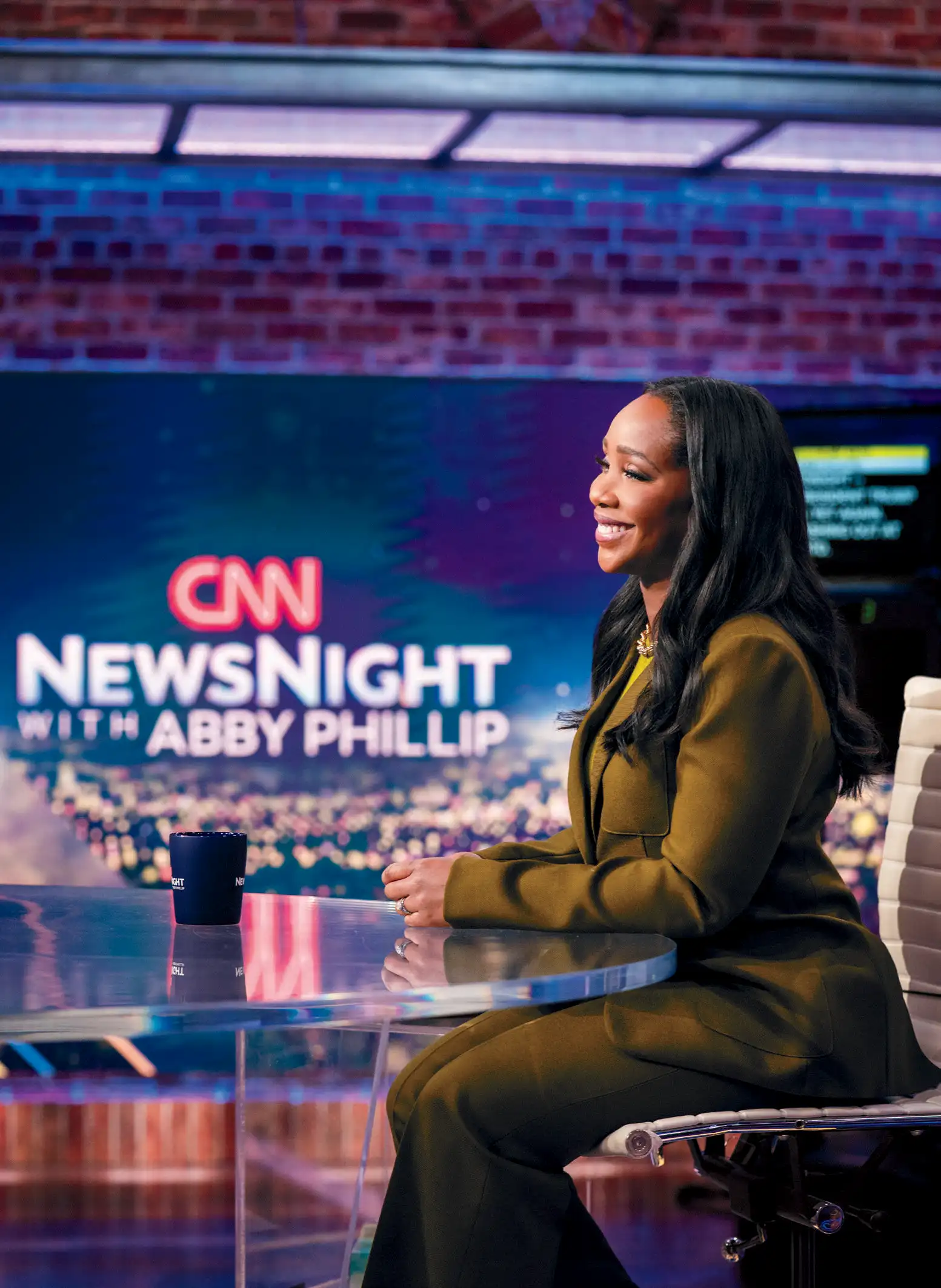
West also gesticulates energetically, and once knocked over his NewsNight mug, sending water flying everywhere. “Since then, he has not been allowed to have water in front of him on the set,” Phillip says, with a smile.
Naturally, NewsNight also has its detractors. Posts on Reddit boards, for example, call out its “chaotic discussions,” “heated exchanges that overshadow substantive debate,” or even “trashy, flashy entertainment-style news.” One critic complained that Philip booked “dumb podcasters…who only want to say provocative things” to promote their social media channels.
And the internet often picks apart the show’s most incendiary moments, such as Phillip’s 2025 run-in with podcaster and Biggest Loser trainer Jillian Michaels, who vociferously criticized Smithsonian Institution exhibits asserting that only one race (white) was responsible for slavery in the United States.
Phillip simply observes that the high-wire challenge of real-time moderation is part of the job. “If you don’t know that TV means a lot of uncertainty,” she says, “you are probably in the wrong business.”
In a way, Phillip has been preparing to connect disparate groups since childhood. She was born in Alexandria, Virginia, to Trinidadian parents; her family moved back to Trinidad when she was a few months old, then returned to Maryland when she was in third grade. “It was a formative experience for me,” she recalls. “There was a lot of balancing different cultural experiences and adapting to them.” They settled about an hour from Washington, D.C., in Germantown, Maryland, “a very diverse place, full of people from different walks of life—immigrants, white people, Black people, a true melting pot. You had to find common ground.”
The fourth of six children (three older sisters, a younger brother, and a younger sister), Phillip grew up in a “big news family” where TV news and NPR were often on, and she followed pioneering minority women journalists like Gwen Ifill and Soledad O’Brien ’88. (Years later, when Phillip met Ifill at a dinner, the broadcaster “gave me advice down to details like what shoes and jacket to wear on the Iowa campaign trail,” Phillip says. “We need more like her—there are too few journalists of color doing this kind of work.”)
Phillip describes her schoolgirl self as “very quiet. I kept to myself a lot…I had a lot of friends but didn’t get distracted by social life. And our parents were very strict!” Her father, Carlos Phillip, a teacher who became an educational psychologist, got a Harvard catalog in the mail and the siblings would flip through it, but the idea of applying to Harvard did not arise until her senior year at Bowie High School, another diverse venue with a nearly-even mix of Black and white students. “Not a lot of kids applying to Ivies,” she says. “It didn’t seem realistic.”
But a one-week summer program at Yale for high school students interested in current events made a difference. “Yale was where I learned to speak publicly, extemporaneously,” Phillip says. “It was incredibly eye-opening, being around these super-privileged kids. We didn’t really have those kinds of extracurricular activities at my high school.”
Nor did her family have abundant resources, but she made an early decision application to Harvard in the fall of her senior year. During Thanksgiving week, she was admitted—“a massive shock,” she recalls. Other colleges were less costly, but her parents were unequivocal: “You’re definitely going.”
Phillip began Harvard on a pre-med track but soon switched to social studies and joined the Crimson. (She bonded strongly enough with the newspaper that, in 2023, she spoke at the Crimson’s 150th anniversary celebration at Boston’s JFK Library instead of attending the annual White House Correspondents’ Dinner.) She also managed the Lamont Café and Quincy House Grill, “frying mozzarella sticks late at night.” The summer after her junior year, Phillip interned at Politico, then a new digital magazine, and as a senior, changed her concentration to government.
After college, Phillip joined Politico’s staff covering lobbying, campaign finance, and the Obama White House. She moved to ABC News for a digital fellowship, joined the network’s Washington bureau in 2013, and a year later moved to The Washington Post, which Jeff Bezos had just acquired. The Post had evolved into a “fast-moving online presence,” she recalls. “We won by being faster and more nimble.”
“Democracy is not about everyone agreeing with each other at the end of the day.”
—Abby Phillip
In 2018, Phillip joined CNN as a White House correspondent covering the first Trump administration. The COVID-19 pandemic derailed campaign coverage in 2020, but in the studio, Phillip co-anchored CNN’s convention coverage along with network stalwarts Dana Bash, Wolf Blitzer, and Jake Tapper. In 2021, CNN appointed Phillip the anchor of the Sunday morning Inside Politics show, and two years later she took over NewsNight. During her first week there, Hamas launched its October 7, 2023, terrorist attack against Israel.
The show has grown into one of CNN’s standouts: NewsNight is the company’s top show among advertisers’ coveted 25-54 age bracket and consistently ranks among the top 15 programs across all cable news in that demographic. In June, it was also CNN’s top performer in total viewers, drawing 697,000 viewers overall, according to Adweek.
Still, Fox News’s Gutfeld! drew about 2.6 million total viewers in the same 10 p.m. time slot. In network ratings, CNN consistently trails Fox and MS NOW, the successor to MSNBC. And all this unfolds amid an ongoing erosion of the television news audience. Fifty years ago, before the advent of cable, the broadcast networks’ nightly newscasts might reach 55 million viewers; today, it is closer to 20 million, despite about a 50 percent increase in U.S population, says Thomas Patterson, Bradlee professor of government and the press at the Harvard Kennedy School.
“Every year, TV is hemorrhaging viewers, who are aging out on them,” Patterson continues. “Holding onto their audience could mean a gradual softening or lightening of newscasts, a kind of ‘news lite.’”
A splintering audience also encourages networks to get creative—and anchors to get busy. On Saturday mornings, Phillip also anchors CNN Saturday Table for Five, with a similar format but focusing on the prior week rather than daily headlines. This summer, she also hosted Confessions & Obsessions, a streaming afternoon talk show on CNN.com in which public figures described some of their personal passions.
Last fall, Flatiron Books published Phillip’s first book, A Dream Deferred: Jesse Jackson and the Fight for Black Political Power. Phillip knew Jackson personally and interviewed confidants from his inner circle. Her biographical treatment also sketches the American political landscape, with a special focus on Jackson’s presidential campaigns in 1984 and 1988—when, she argues, he essentially built the modern Democratic coalition that recent candidates have mobilized.
In the rare moments when she isn’t working, Phillip enjoys family life in New York City with her husband, cybersecurity consultant Marcus Richardson, and their first child, a daughter born in 2021. They’re expecting another baby, a boy, in October.
In philosophical moments, she can also reflect on her work and how it might provide an oasis of connection and communication in a fractionated society. “It doesn’t mean we will all join hands and sing ‘Kumbaya’—democracy is not about everyone agreeing with each other at the end of the day,” she says. “But in our current climate, a show like NewsNight may be more important than ever. Opportunities to talk openly and frankly can break down the silos.”