On Monday, the union representing Harvard’s graduate student workers announced it was ending a strike that disrupted teaching and research at the University for more than a month. The strike did not manage to secure a new contract that meets union demands, but the organization’s leaders said in a press release that they were “hopeful that we have now reached a bargaining trajectory with the University that will allow us to do so.”
In an interview on Monday, union president Denish Jaswal said that during a bargaining session on May 29, “the University signaled pretty strong willingness to make movement on some core issues that we had brought to the table many months before.” She added, “It felt like a session where we were actually productively working toward some common solutions.”
Harvard deputy provost Jessica Soban and managing director of labor and employee relations Paul Curran emailed faculty on Monday to inform them of the strike’s end. In that message, obtained by Harvard Magazine, they wrote, “While a contract has not been agreed upon, the University remains committed to the ongoing negotiations with the student worker union and to bargaining in good faith.”
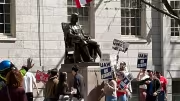
Members of the Harvard Graduate Student Union-United Auto Workers (HGSU-UAW) walked off the job six weeks ago, demanding improved wages and benefits, expanded protections for non-citizen graduate student workers, and stronger procedures for handling harassment and discrimination complaints. The strike shuttered research labs and sent faculty members scrambling to cover union members’ teaching duties—and, after classes ended, to score and submit grades without the help of teaching fellows.
Last week, members of HGSU-UAW picketed throughout Commencement, persuading Boston mayor Michelle Wu ’07, J.D. ’12, to withdraw as the keynote speaker at Harvard Law School’s Class Day.
In this week’s announcement, HGSU-UAW said that the university had agreed to expand benefits to all graduate students and to offer full dental coverage for Ph.D. students. Harvard negotiators also made a 1 percent increase to the University’s four-year raise offer, the union said. Harvard’s most recent previous offer, proposed on April 28, had included an 11 percent raise over four years for all teaching fellows and research assistants. Those offers are still short of the union’s demand to bring the salaries of all members up to a minimum of $50,000 per year (many teaching fellows earn about half that amount).
The message from Soban and Curran said that the University had extended to part-time student workers some of the same benefits received by full-time staff, including access to a legal services plan.
On two of the striking workers’ most contentious demands—protections for international workers and reforms to the grievance process for harassment and discrimination—the union said that the University had not budged, at least not in any formal proposal. But Jaswal said that at the May 29 bargaining session, Harvard negotiators had signaled verbally, if not in writing, an openness to discussing increased financial support for non-citizen workers and the possibility of allowing union members to pursue a union grievance procedure if a complainant remains unsatisfied at the end of the University’s Title IX complaint process. “We’re hopeful that that means there’s more progress to be made in these directions,” Jaswal said.
In their email, Soban and Curran did not mention any change to Harvard’s negotiating position on those issues. “The University has continued to make clear several of its longstanding positions,” they wrote, “including that all members of our community should have access to the same procedures under our University-wide policies and that our students must be able to pursue the full range of educational opportunities without being required to pay union dues.”
In addition to calls for a grievance process that goes beyond the University-wide policies, union leaders have also been asking for an agency shop agreement, which would restore contract protections to more than 900 students on research-based stipends, whom the University removed from the union rolls last summer. (The union disputed that decision and it is currently in arbitration proceedings.) In addition to restoring those students’ contract protections, an agency shop agreement would also restore a large portion of their dues to the union.
Now that the spring semester has concluded, a few union members are involved in teaching summer courses, and laboratory research continues for a few others, but for the majority, their jobs will resume in the fall.
Jaswal said that the union would continue to negotiate until a new contract is reached. Additional bargaining sessions are scheduled for June 9 and 23.