On Tuesday, less than 24 hours before her scheduled remarks, Boston Mayor Michelle Wu ’07, J.D. ’12, withdrew as convocation speaker for Harvard Law School. The withdrawal was first announced by the Harvard Graduate Student Union-United Auto Workers (HGSU-UAW). Members of the union have been on strike since April 21, and its leaders had publicly asked Wu and other Commencement speakers to boycott the week’s ceremonies.
“Mayor Michelle Wu will stand with our union striking student workers today, declining to cross a picket line,” HGSU-UAW president Denish Jaswal said in a statement on Wednesday. “One does not simply espouse values at a podium, but demonstrates them in moments like this one. We are deeply grateful for her solidarity.”
In an email yesterday to graduating students, the Law School said that Wu would not speak as planned and wrote, “We look forward to welcoming her back to campus in the future.”
Instead, the email said, the Law School’s convocation “will refocus the Class Day speaking program tomorrow more squarely on our student award winners and on remarks and tributes to be delivered by our Class Marshals.”
In a statement emailed to Harvard Magazine, a spokesperson for Wu said that the mayor was “honored” to be invited to speak at the Law School’s ceremony and “deeply disappointed” to not be able to attend. (The mayor was previously the College Class Day speaker in 2022.)
“Since learning last week that there would be a picket line at the event,” the statement read, “we made repeated efforts to reach a compromise with the union that would have enabled the Mayor’s participation, but were ultimately unsuccessful. The Mayor is a strong ally of the labor movement and believes in respecting picket lines, but wishes that the union had taken one of the many alternatives available. She sends her best wishes to the graduates and their families for a memorable and meaningful day worthy of their accomplishments.”
According to a source familiar with the mayor’s decision, Wu’s team offered several alternatives to cancelling the speech, including participating virtually or acknowledging the strike from the podium. After learning that there would be a picket line at the event, Wu attempted for several days, without success, to reach a compromise with the union.
In response, Jaswal acknowledged Wu’s “difficult decision” and said that, from the union’s perspective, a compromise would not have worked. “While we understand that Commencement activities will carry on, any speaker participation in those activities, regardless of format, would have required crossing our picket line. We thank Mayor Wu for opting not to. We remain committed to the principles that make a picket line meaningful. A picket line is only as strong as the solidarity it commands, and we are grateful to Mayor Wu for her support.”
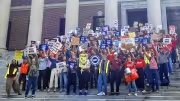
Wu’s withdrawal is the latest twist in what has become the longest strike in HGSU-UAW history, outlasting a 29-day walkout in 2019. After a bargaining session last Thursday with University officials ended without an agreement, union members this week began picketing Commencement events. On Tuesday, they protested outside the Science Center, at times drowning out President Alan M. Garber’s Baccalaureate ceremony remarks.
“The goal is not to detract from the celebration for folks who are graduating—I mean, several of our own leadership members are graduating,” said Jaswal, a Ph.D. candidate in philosophy, in an interview late last week. “But it is to make our presence heard and felt by the administration. It’s also an opportunity to tell the broader University community—the graduates, their families, potential donors, and other public figures—how terribly Harvard is treating its workers.”
The 4,000-member union—which includes graduate research assistants and instructors, along with both graduate and undergraduate teaching fellows and course assistants—walked off the job in April calling for higher wages, expanded protections for international student workers at greater risk amid heightened federal immigration crackdowns, and changes to the way the University handles complaints of discrimination and harassment. The union’s previous contract expired in June 2025.
In a statement on Wednesday, a University spokesman said, “The University has continued to engage at the bargaining table through 27 sessions and put forward in recent weeks a packaged proposal for a full contract in a good-faith effort to move the two sides closer to an agreement. We appreciate that HGSU-UAW’s bargaining team has continued to consider elements of that proposal and remain optimistic that there is a path forward for resolving the differences that remain.”
The next bargaining session between HGSU-UAW and the University is set for this Friday, and others are scheduled in the weeks ahead. It will be the fourth meeting since the strike began and the 28th since March 2025, when contract negotiations first began. Fifteen months later, the two sides still appear to be far apart on some core proposals.
As the strike enters its sixth week, Jaswal said she and other union leaders are prepared for a long fight. “We’re ready to be out here in the fall if needed,” she said, “and we’ve communicated that to the University as well. Maybe they don’t believe it, but our members are pretty committed.”