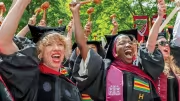
When invited to address the College class of 2022 at Class Day, Boston Mayor Michelle Wu ’07, J.D. ’12, had two initial thoughts. The first, she told the Tercentenary Theatre crowd this afternoon, was “What makes me qualified, just six months into my new job, for this incredible honor?” The second was, “Actually, this is kind of awkward, because I had already told one of the Harvard graduate schools that I wasn’t available to be their graduation speaker.”
Fifteen years ago, Wu shared, she sat in the same seats as the students in attendance today. And—again truthfully—she admitted that “you likely won’t remember anything from these speeches.”
But if there is one word you might hold on to from your time here, let it be the word that's on your shiny class rings, on the sweatshirts you'll return to for comfort and coziness, the hats you've been hastily giving to family members as you dashed home for the holidays over the years from the COOP: Veritas.
“My truth is,” Wu boldly announced, “I came to Harvard for the clam chowder.” She had no grand career plans as a student, nor a clear academic passion, she said, but she did eat a lot of soup in Annenberg. The oldest child of immigrant parents from Taiwan, Wu recalled always eating at home with chopsticks. On the rare occasions when the family dined out, it was to Old Country Buffet, where, no matter how stuffed, she always found room at the end for soft serve ice cream and a “glorious” bowl of clam chowder. “So at prospective students’ weekend, when I learned there was always ice cream in the dining halls and clam chowder on Fridays,” she said, “that was that.” Another bold truth was that while she is still a proud former alumna of Currier House, she was initially disappointed to get Quadded and confused as to why the House mascot was a tree “when other houses had animals that were fierce and regal, or at least cute.” And finally, and perhaps most embarrassingly, she admitted that she met her husband at The Game—and that he’s a Yalie.
But Wu had more serious truths to share. Her Commencement, just 15 years past, was one of the last events her mother attended before having a major mental breakdown. She had started showing signs of illness—paranoia and delusions—but “in the culture in the family that I grew up in, we couldn’t bring our business to the public.” It took months for her mother to seek treatment and many more months for Wu to share with her friends what was happening in her family.
Accepting this truth had a profound effect on Wu’s life. Soon after graduation, she stepped in as her mother’s caregiver, began raising her sisters, and opened a small tea shop to stay financially afloat. Through these experiences, Wu began to see that “the systems we had to interact with weren’t designed for people like my family,” she said. She also saw that she could have a role in fixing them.
Since leaving the Yard in 2007, Wu said she’s learned three things about Veritas. “First, your own deep truth sets the foundation for your happiness, health, and impact,” she said, urging students to take care of themselves and figure out what gets them excited to wake up in the morning.
“Second, see what’s real,” she said. “There is no substitute for lived experience.…[I]f you’re trying to solve a problem in the world, understand what it feels like first, seek out those closest to the challenge, and those who will be most impacted by that solution.” For Wu, a self-proclaimed “transit nerd” who has vowed to make the MBTA subway and bus system free of charge in Boston, that means taking public transportation to work every day and seeing the system’s strengths and limitations up close.
Third, and finally, “Tell the truth when it’s hard,” she urged. “‘I’m not just talking about admitting to a deep love for clam chowder or even working to break the stigma of mental illness,” she said. “In politics, and in family, and in work, speak your truth and feel true to the urgency you feel. Because fundamentally, speaking truth is the only way to build a foundation for trust—and that is what we are missing in our society and our democracy today.”
Wu encouraged everyone to take some time for themselves once in a while—hug a friend, lie in the sun, read a book. “And when you’re ready,” she said, “seek the truth.”
In a speech preceding Wu’s, Danoff Dean of Harvard College Rakesh Khurana had a similar message. After laying out a vast vision of a utopian future of 2036—one with boundless renewable energy, little threat of war, and a healing physical environment—Khurana implored the class of 2022 to become “bridge-builders” of that sort of future:
Whether you realize it or not, you are already an experienced class of bridge-builders. And I have already seen glimpses of the bridges that you are building to our future. When you left campus in 2020, I was in awe of the way your class bridged across time and space. You carried Harvard with you to locations around the world, you connected with each other by creating check-ins at the start of your extracurricular meetings to make sure people were doing okay, and by modeling vulnerability and authenticity in your interactions.
“Social change begins with bridge-builders,” he concluded, “and I know that you are all ready to step into that role.”