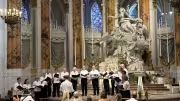
During its first international tour, in 1921, the Harvard Glee Club inspired French composers Francis Poulenc and Darius Milhaud to write new pieces for the group. Milhaud set Psalm 121. Poulenc penned a drinking song. So began a tradition that continues this April 11, when the club premieres opera and choral composer Dominic Argento’s Apollo in Cambridge at a gala 150th-anniversary concert in Sanders Theatre (see www.harvardgleeclub.org).
The debut caps an eight-year project. In 2000, Bernard E. Kreger ’59, secretary of the Harvard Glee Club Foundation, donated $25,000 (which was matched by the foundation) to commission a new piece of men’s choral music annually, culminating in a major work for the sesquicentennial. He formed a five-man committee and began considering likely sources. He even remembers a vacation spent driving all over Maui, “listening to a stack of CDs to see if I could whittle it down to a couple that I thought were really worthy.”
The committee ran its selections by director of choral activities Jameson N. Marvin, the group’s conductor, and began commissioning composers, including Charles Fussell, a professor at Boston University, and Sir John Tavener, who composed music for Princess Diana’s funeral. “We probably do more twentieth-century music than any genre,” explains Marvin. The commissions help because “in general there’s not a lot of great male chorus music out there.” Kreger and current Glee Clubbers agree that their goal is not only to support the group, but also to push the boundaries of men’s choral music with every piece.
Of the new works, club president Quentin Sedlacek ’08 says, “Some are now performed by choirs throughout the country.” The professional men’s group Cantus recorded Sedlacek’s favorite, “Ave Dulcissima Maria” by Morton Lauridsen, a winner of the National Medal of the Arts. Peter Lifland ’10, who “came to Harvard for the Glee Club,” enjoys “Credo,” by Paul Moravec, but says some audiences—put off by its dissonant cluster chords—don’t. He admits that the new pieces can be difficult, sometimes requiring months of rehearsal.
Nothing has been more difficult than Apollo in Cambridge, a setting of works by Harvard-affiliated poets James Russell Lowell, Oliver Wendell Holmes, and Henry Wadsworth Longfellow that Marvin introduced in rehearsal more than a year ago. Argento’s 15-minute piece contains three sections, each with its own shifting time signatures, syncopated rhythms, and flurries of sharps, naturals, and flats. But the challenges and intricacies, say the singers, don’t mean the piece isn’t fun to listen to. “It sounds really luscious,” agrees Kreger, who serves as an accompanist for the group. “[Argento’s] not an ‘out-there’ modern composer making odd noises.” Sedlacek sees the new music connecting the group’s present with its storied past. “This anniversary,” he says, “will really highlight that continuity.”