When conductor Andy Clark co-founded Cambridge Common Voices (CCV) in 2018, he envisioned the all-abilities community chorus as cutting-edge and explicitly political.
“I had these lofty ambitions of an innovative group that would reject the common practices and pedagogies of choral music,” says Clark, the director of choral activities and a senior lecturer on music at Harvard University. He thought the repertoire would include “music to advocate for the world we wanted to see and bring to light the ways callousness toward folks with disabilities compromises the quality of life for everybody.”
The group’s members, however, didn’t want any of that. They just wanted to sing.
“So many were pushing for choir as their friends had experienced it,” Clark recalls. “They wanted a conventional experience, and they wanted to perform music about love, about loss, about joy.”
A partnership between Harvard’s choral department and Lesley University, Cambridge Common Voices has 40 members from across the Boston area with a range of abilities and profiles, from physical impairments to autism to—in many cases—prodigious musical gifts. Some members have encyclopedic memories of particular eras or genres; some play multiple instruments or write music; several have perfect pitch and rhythm. Yet traditional choir singing, with its physical demands (standing still for long periods), rigid behavioral expectations, and narrow avenues for learning songs (reading sheet music or by ear) can be a poor fit for singers outside the typical mold.
Adam Roberge was one of them. Born blind due to a congenital condition called Norrie disease, Roberge, 32, took private voice lessons but had had frustrating chorus experiences, especially through his public high school years. Sheet music wasn’t available in Braille; because he rocks back and forth when he stands, teachers assumed he couldn’t remain upright through a concert.
“Directors were not willing to have me in a choir,” says Roberge, a tenor.
He heard about CCV through a friend and became one of its earliest members. Since then, he has performed with the group at Fenway Park and at a celebration for Cerebral Palsy Day in New York; he has sung with the Longwood Symphony Orchestra and at Berklee College of Music. In themselves, those types of experiences embody the more overt messaging that Clark thought would characterize the group in the beginning.
“If there is a message, it comes through with more nuance—in the ways in which we sing, in which we make music and are with one another,” Clark says.
The group’s musical framework, too, is quietly groundbreaking. CCV’s directors draw on universal design, an idea that first emerged in architecture to make buildings more accessible. In the past decade, the concept has made its way into education—teaching to different learning styles and capabilities, based on a foundation of cognitive neuroscience. Principles of Universal Design Learning, as outlined by the education nonprofit CAST, emphasize lessons with multiple avenues to understanding any topic, rather than a one-size-fits-all structure.
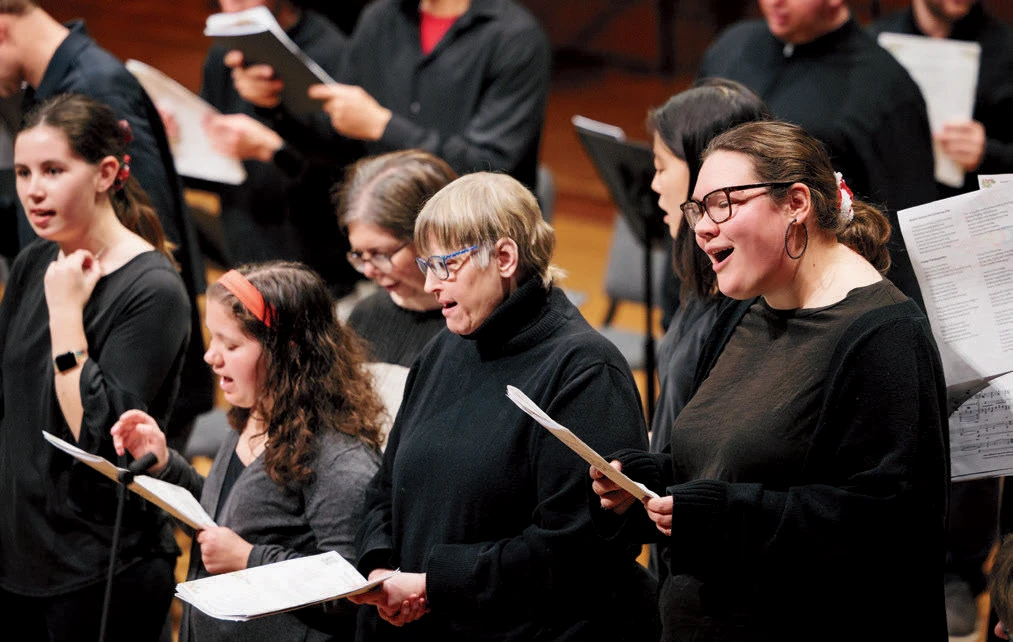
In musical practice, that translates to several different, complementary ways to learn a given song. CCV can make use of traditional sheet music, lyric sheets, Braille, and solfège scales—in which each note corresponds to a hand signal that indicates whether the pitch is moving up or down. Roberge, for instance, learns through Braille and listening to rehearsal tracks on YouTube.
“There are aspects of our rehearsals that are very familiar,” Clark says. “We have a warm-up. We have an agenda of the progress we want to make. Then there are aspects that might be somewhat unconventional—we’re offering multiple modalities representing the music.”
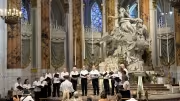
At a holiday concert this past December, CCV’s full range was on display. To kick off the afternoon’s program in Harvard’s Sanders Theatre, the group led the audience in a sing-along of favorites including “Let It Snow,” “Have Yourself A Merry Little Christmas,” and “Let It Go,” from the movie Frozen. Dressed in Christmas sweaters and Santa hats, singers danced to the music and shook maracas and tambourines; a CCV member introduced each song with a bit of trivia.
Next, CCV joined Harvard’s student singers and orchestra members in a world premiere staged reading of Charles Dickens’s A Christmas Carol, with settings of standards including “God Rest Ye, Merry Gentlemen” and “It Came Upon a Midnight Clear.” The score is modern and a little tricky, with multi-part vocal lines woven around a central narration and trading off melodies with the instruments.
“Andy’s very firm on wanting to be like any choir—sharpening skills and taking on new, challenging pieces,” says James Gutierrez, CCV’s managing director. “The sing-along is, I think, the group’s comfort zone, but we also push them to do more complicated stuff with three- and four-part harmony.”
Cambridge Common Voices came about as a collaboration between the Harvard choral department and Lesley’s Threshold Program, a residential college curriculum for neurodiverse students. Clark teaches classes on music and disability, and he conceived of the choir as both an addition to Lesley’s offerings—at the time, despite the school’s robust arts therapy curriculum, there weren’t many musical outlets for Threshold students—and as a service-learning opportunity for his Harvard students, who sing in the choir, serve as teaching assistants, and sometimes compose original music through the Harvard Choruses New Music Initiative. CCV songs including “Where I’ll Go” (by Rachel Guo ’22) and “We All Have Dreams (by CCV member Nathalie Bereel and Rebecca Araten ’23) came out of the program.
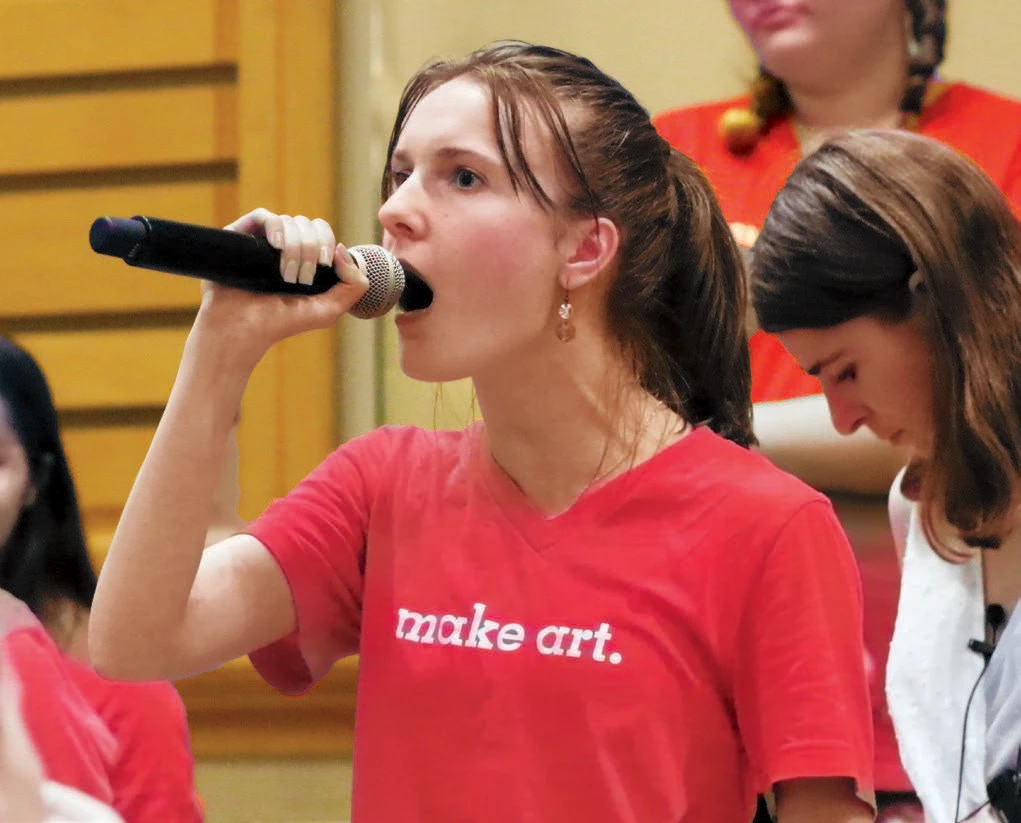
In recent years, CCV has sharpened its focus on creating and performing such originals, in keeping with the principles of universal design. Clark likens the group’s musical selections to buildings: Some are retrofitted versions of traditional standards, akin to a 300-year-old campus building with an elevator and a wheelchair ramp. Others are built from the ground up with broader accessibility in mind.
For example, “The CCV Blues” has a way in for just about anyone; the song includes two-part call and response harmony, spoken word, and improvisational solo sections. Rehearsal resources include lyrics, a sound file, and traditional sheet music.
The rehearsals and original songs also make use of members’ singular abilities, Gutierrez notes. Roberge, for one, has great ears: an automotive enthusiast, he can identify the year, make, and model of many classic cars by the sounds of their engines. Ellie Slager, a 25-year-old soprano, is a prolific lyricist; she is working with the group’s arranger in New York to set a few of her poems (she’s written over 100) to music.
“I would be a whole different person if I wasn’t in CCV,” she said. Before joining, the group singing available to her was via small, informal after-school programs. The choir is woven into her social circle, and a few fellow members are her roommates.
At the end of 2025, the group completed its first album, consisting entirely of new music and recorded on campus. Much of the material, like the song “Give Me A Chance,” hearkens back to Clark’s activist vision for the choir, but cast in personal terms. Composed by member Zach Jacobson, a multi-instrumentalist with perfect pitch who is on the autism spectrum, the lyrics nod to his strengths while making CCV’s larger existential case:
Give me a chance to come along
Give me a chance to play
Give me a chance to speak
I might have something to say.