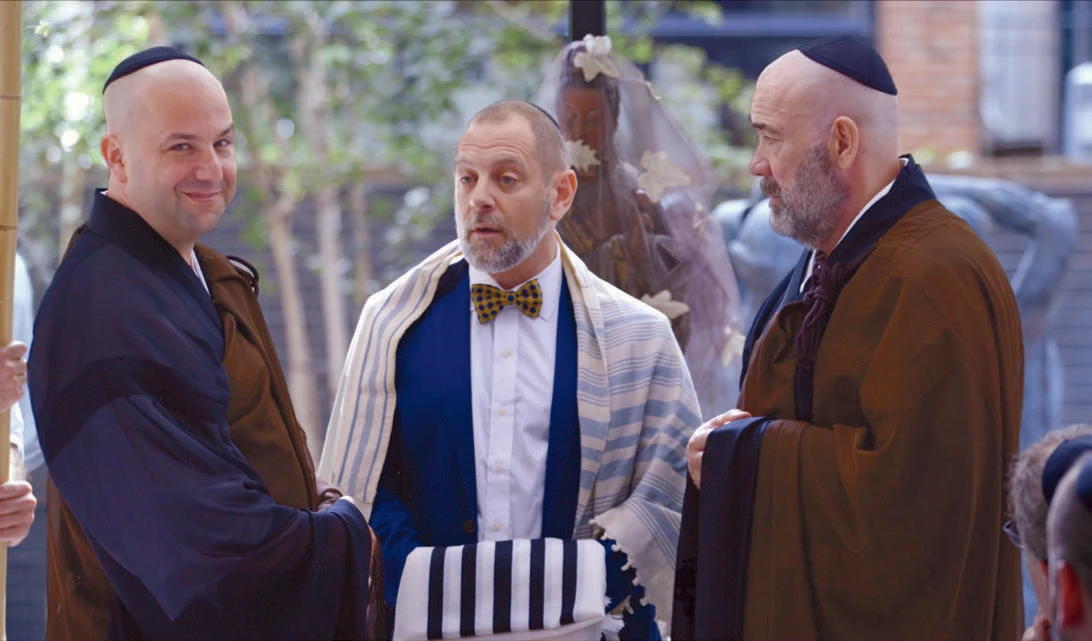
Sabbath Queen, the 2025 documentary produced and directed by Sandi DuBowski ’92, opens tensely: in the courtyard of a Manhattan home, Rabbi Amichai Lau-Lavie prepares to flout the doctrine of the Conservative Judaism movement in which he was ordained by officiating the marriage of two men, Koshin and Chodo. The problem isn’t that they’re gay—Conservatism allows same-sex unions. It’s that Koshin is Jewish and Chodo is not, and the movement forbids interfaith marriage.
That opening is intended “to establish a frame,” says DuBowski. “It says to the audience, ‘This is a burning question that the film will return to, and also here are the larger stakes around these two versions of Judaism—one traditional and fundamentalist, and the other progressive and open.’”
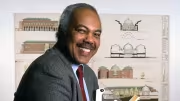
That tension is at the heart of Sabbath Queen’s very intense subject, Lau-Lavie, 56, the Israeli-born descendant of one of Judaism’s most prominent dynasties of rabbis. His quest to forge a community of Judaism more in tune with modern life and pluralistic values led him down several paths. In 1999, he co-founded Storahtelling (a sort of theater group for reinterpreting Old Testament stories) and, several years later, Lab/Shul (an “artist-driven, everybody-friendly, god-optional, pop-up, experimental community for sacred Jewish gatherings”).
He embraced and then rejected the strictures of being a Conservative rabbi, such as not officiating interfaith weddings. And he created for himself a drag persona named Hadassah Gross—a widow of six rabbis whose Hungarian accent and huge hair and sunglasses serve as a Trojan horse for her God-is-love ideas about Judaism. Lau-Lavie has been called “a rock star” by The New York Times for his reach in expanding ideas of what Judaism can look like.
“Expansive” also describes Sabbath Queen, which DuBowski—whose best-known prior documentary, Trembling Before G-d (2001), explored the dilemma facing gay Orthodox Jews—made over the course of a two-decade-plus friendship with Lau-Lavie. The two met in the ’90s when DuBowski, an openly queer and progressive Brooklyn native, was in Jerusalem searching for people to interview for Trembling. “Everyone kept saying that I should meet the chief rabbi of Israel’s gay nephew, which was Amichai,” DuBowski says. “But Amichai is such a diva that he wanted his own movie.”
When Lau-Lavie moved to New York shortly after, the two began hanging out. DuBowski, intrigued by both Lau-Lavie’s radical vision and his drag alter ego, began casually filming him.
Such was the start of what would become two decades of shooting, six years of editing, nearly 3,000 hours of footage, seven cinematographers, four editors, and more than 10 producers. This “epic process,” in DuBowski’s words, cost in the low seven figures and was funded in part by 15 benefit events over the years, held in several cities. It led to a documentary that is unusually capacious, moving freely between “ancient time and contemporary time,” as DuBowski puts it. The film also showcases Lau-Lavie’s ever-evolving identities: heir to hidebound tradition yet gay maverick iconoclast; indie performer yet enrollee of the august Jewish Theological Seminary.
Boxing all that into a 105-minute film wasn’t easy. “Even once we were in the editing room, I was still shooting,” DuBowski says. He followed Lau-Lavie between New York, Israel, and Poland (where his family lived before the Holocaust). “I didn’t even know when I started shooting that he was going to become a rabbi,” he says, “or have three children with a lesbian couple, or that his father would die.”
To work out a map for the editing, he says, “we had a vision board where every one of Amichai’s identities was color-coded. We were constantly tracking time, trying to figure out who would be the main characters. At one point, my main editor said, ‘This film needs a narrator, and I think it’s you.’” DuBowski agreed to give it a try—until viewers at an early screening said it didn’t work. Amichai’s brother, Binyamin, became the new narrator—a prominent Israeli rabbi of a more traditional mold who, throughout the film, speaks compassionately of his rebel brother’s spiritual quest while gently disagreeing that traditional Judaism can be opened up as freely as Amichai would like.
“He became the counterpoint to Amichai,” says DuBowski, “a straight Orthodox rabbi with a progressive queer brother. He’s allowing people to understand the context and culture that Amichai both comes from and is challenging.”
Additionally driving the narrative was the almost filial friendship between Amichai and DuBowski, who now shows up only intermittently onscreen but enough to make clear that he is not merely an observer but also a participant in Lau-Lavie’s alternative Judaism. There’s a moment late in the film when the fourth wall comes down and Lau-Lavie complains to DuBowski of being exhausted with his endless questions and filming.
“If you’re a queer religious person like Amichai, you feel you always have the eye of God on you, and for him the camera became that eye,” says DuBowski.
The film, which The Hollywood Reporter called “a rich and intimate portrait,” has yet to be picked up by a streaming distributor, but it has already been screened at more than 100 film festivals and arthouse cinemas internationally.
Sabbath Queen continues DuBowski’s pattern of documentaries about people challenging their religions from within. (DuBowski also co-produced, with director Parvez Sharma, the 2007 documentary A Jihad for Love about queer Muslims.)
“We’re in a moment of great shift around what is the baby and what is the bathwater of our ancient traditions,” DuBowski says, “especially regarding gender, sexuality, tribalism, and violence.” Sabbath Queen allowed him to explore these questions by following one seeker’s journey. Even the ending is unresolved.
“I not only submitted to the not-knowing for this film,” he says, “but embraced it as part of the process.”