The year is 2036 and the global temperature is 2.3 degrees Celsius above the pre-industrial average. Grace Chan is preparing to take office as the leader of Ocean Independent State, a governing body created to solve a climate emergency. That night, she crashes her pickup truck amid rising tides. As she faces death, memories surge forward: a youth shaped by climate disasters in Malaysia, her work combating rising sea levels through the ambitious “Fairhaven” infrastructure project, and the hopeful stories she writes to cope with her climate anxiety—imagining alternative outcomes to historical disasters such as the sinking of the Titanic.
This is the arc of Fairhaven: A Novel of Climate Optimism (2024) by Steve Willis and Genevieve Hilton ’94, who writes under the pen name Jan Lee. The book is a recent entry in the genre of climate fiction—an increasingly popular vehicle for writers and readers to process their climate anxiety through narratives rather than polemic, as one literary agent puts it.
Long before climate data became a part of daily life, science fiction and speculative works imagined the consequences of ecological collapse. J. G. Ballard’s The Drowned World (1962) offered a vision of humanity reshaped by climate change, while Octavia Butler’s Parable of the Sower (1993) depicted a society unraveling under the pressures of climate change, inequality, and violence.
In recent years, many imprints have begun to formally tag books as “climate narratives,” rather than keeping them under the umbrella of science fiction, says literary agent Mark Gottlieb, the executive vice president of Trident Media Group. Since the mid-2010s, Gottlieb explains, he has seen a substantial increase in both climate-related submissions and acquisitions: “Climate fiction has shifted from a niche concern to a central narrative engine across literary and commercial publishing,” he says.
Today’s climate fiction, or “cli-fi,” addresses a new urgency, as misinformation proliferates, distrust in scientific institutions increases, and the statistics around global temperatures and sea levels grow more dire. Some cli-fi authors imagine their fiction could raise awareness and galvanize action—reaching audiences who may never pick up nonfiction works like Rachel Carson’s Silent Spring (1962) or David Wallace-Wells’s The Uninhabitable Earth (2019).
And some believe fiction can add something else to the climate debate that data-driven climate news often lacks: an element of hope. “I joke that Fairhaven is a bit of propaganda—it’s a book with a mission,” Hilton says. “We want people to read it and think: ‘Things are bad, but I’m going to do something.’”
Novelist Tim O’Brien, the author of The Things They Carried, once described the purpose of fiction as “getting at the truth when the truth isn’t sufficient for the truth.” Cli-fi books implicitly engage in that endeavor—and in debates over the advantages and pitfalls of channeling fiction for a higher purpose.
For Hilton, fidelity to scientific truth—and the urgency of addressing it—is paramount. She co-writes with Willis, an environmental engineer, who grounds their narratives in technological plausibility. “You don’t need to address climate change explicitly,” Hilton says. “But if you’re writing a story set in 2050, and a character looks out the window and the weather is the same as in 2025, it breaks from the story’s verisimilitude. You need to explain that to the reader.”
“Climate change stories are also stories of family, friendship, dreams, home, belonging,” says Megha Majumdar.
In recent years, calls for climate accuracy in narratives have extended beyond novels into film and television. The Climate Reality Check, a collaboration between Colby College and the climate consulting firm Good Energy, offers a way for storytellers to assess climate representation in their narratives. (It’s modeled on the famous Bechdel-Wallace Test, which evaluates women’s representation in movies.) The climate check poses two questions: does climate change exist in this world, and do the characters know it?
But accuracy and bleak realism can sometimes provoke despair rather than action. A 2018 Yale University–affiliated study found that only 26 percent of respondents reported a positive emotional response to cli-fi, with many expressing feelings of futility and hopelessness. When fiction is too prescriptive to a higher purpose, it can backfire.
That’s why, though Hilton aims to inspire change, Fairhaven notably resists dystopian tropes, instead emphasizing action-oriented solutions. Its hopeful outlook aligns with emerging subgenres sometimes described as “thrutopian,” “solarpunk,” or “techno-optimist.”
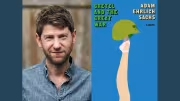
But not all writers who tackle climate change want to assign their books an explicit social mission. “I don’t think fiction has an obligation to do anything,” says author Megha Majumdar ’10, whose second novel, A Guardian and a Thief—a finalist for the 2025 National Book Award—explores the moral consequences of climate change through what Majumdar calls the “specific texture of lived experience.” The book is set in a near-future Kolkata, India, as a family prepares to flee a climate-ravaged city with food shortages. Their immigration documents are stolen by a thief acting out of desperation and hunger. Over seven intense days, the narrative complicates notions of hope, duty, and survival in two families linked by circumstance.
“Climate change stories are also stories of family, friendship, dreams, home, belonging,” Majumdar says.
Anxiety about environmental destruction takes a different shape in Habitat, the genre-bending debut by Case Q. Kerns, a staff member in Harvard’s English department and a contributor to The Harvard Review. Kerns’s interconnected stories explore immersive habitats both literal and figurative: bunkers, the lives of cloned animals, and the ecosystem of body transplant culture. These speculative coping mechanisms for the future come with ethical costs.
“I focus less on the ‘climate’ of climate fiction,” Kerns says. “To me, extinction is just as central, and more intimately horrifying—the disappearance of species entirely innocent of the systems that destroy the environment.”
In the story “Armstrong,” a father sells an heirloom watch to buy his daughter a Christmas gift—an off-market clone of Armstrong, the canine star of her favorite television show. This Gift-of-the-Magi-esque move is its own meta-critique of the future. The cloned dog exists “trapped between two worlds”—alive, yet stripped of instinct and natural habitat, created solely for human consolation and consumption. Armstrong becomes an embodiment of the intimate, ethical quandaries sparked by a future ravaged by climate destruction.
“How do we take care of each other in the future? How do we cope?” Kerns asks. “That, to me, is realistic.”
In the end, he says, fiction’s own resistance to conform to labels and rules may be its most powerful tool for engaging a wider range of audiences in climate conversations. “There’s no wrong way,” Kerns says, “to start thinking about how the world could be better.”