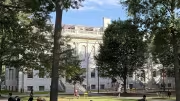
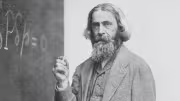
During Tom Hyry’s childhood in Ironwood—a small town in Michigan’s Upper Peninsula—he played hockey, baseball, football, golf, basketball, and track. But he was not a jock, he says: what he really loved was being on a team. His parents (a court reporter and a school superintendent) let him order whatever he wanted from Scholastic book catalogs. Now associate university librarian for archives and special collections and Fearrington Librarian of Houghton Library, Hyry coordinates the decentralized systems of four libraries and the University Archives and speaks with faculty, alumni, and donors to shape collections. At Carleton College, he studied history and pursued social justice, protesting the Rodney King beating and joining the Activist Coalition for Multicultural Education. Having enjoyed his term-time library jobs, Hyry earned a master’s from the University of Michigan School of Information. Still interested in activism, he studied twentieth-century anarchists and learned how to use special collections for research. Then he spent nine years at Yale, first as an archivist and later as head of the manuscript unit. His colleagues, noting his team skills, encouraged him to go into administration. After four years directing special collections at the University of California Los Angeles, he joined Houghton Library in 2014. Here, he seeks to improve the library’s accessibility, both physically (a major renovation) and philosophically (demonstrating the diversity of its collections). He also hopes to improve the library’s online discovery system, increase the scale of material digitization, and explore how generative AI can assist archivists. But he won’t abandon physical books, especially at home. Hyry says that he, his wife (also a librarian), and two children “don’t have enough bookshelves for the number of books we have.”
Updated December 15: Hyry's father was a superintendent, not a teacher.