In 1898, a 12-year-old Japanese boy arrived, penniless, in New York City. When he died in Tokyo almost 70 years later, the American ambassador spoke at his funeral. In the decades between, Takashi Komatsu, A.M. 1911, devoted himself to fostering ties between the two countries that shaped his life.
Forced by his father’s bankruptcy to work as a youngster, Komatsu had persuaded a departing missionary to take him along to New York. Living at the YMCA, he worked long hours for an import company, but dreams of higher education faltered until missionary connections in Monmouth, Illinois, invited him to move there, changing the trajectory of his life.
Komatsu called his hosts in Illinois his American mother and father. He earned a bachelor’s degree at Monmouth College, along with accolades as a debater, and enrolled at Harvard to earn a master’s in international law in 1910. At Commencement the following June, an audience including honorands Henry James and Supreme Court Justice Oliver Wendell Holmes Jr., A.B. 1861, LL.B.’66, LL.D. ’95, heard him deliver one of the graduate student addresses, “The Dawn of Peace.” He emphasized the benefits of reciprocity between East and West and spoke of a “new day [when] the world will forget a man’s color, and study only his character and his quality of hand, mind, and heart.”
On his return to Japan, Komatsu took a legal job with a shipbuilding firm and earned extra money as a private tutor. These contacts led to a new post: private secretary to the powerful industrialist Soichiro Asano. When Komatsu turned a nearly bankrupt ship-leasing company into a profitable enterprise during World War I, greater responsibilities followed. At the Washington Naval Conference in 1921-1922, Komatsu served as chief translator for his country’s delegation and its leader, Prince Iesato Tokugawa—the president of the Japanese House of Peers who would become the second president of the America-Japan Society.
Komatsu became part of that effort, traveling frequently to the United States to assess American sentiment toward his country and convey the ongoing effort to maintain democracy in Japan as the military gradually usurped power. He represented the America-Japan Society, served as president of the Tokyo Rotary Club and Japan’s Harvard Club, and was a Japanese commissioner for the World’s Fairs in Chicago (1933-1934) and New York (1940). In 1936, he and U.S. Ambassador Joseph Grew, A.B. 1902, helped arrange an exhibition of rare Japanese artworks at the Museum of Fine Arts to honor Harvard’s Tercentenary. Prior to Pearl Harbor, when he was called in for questioning by Japanese government officials as a longtime expert on the United States, he spoke out forcefully against war.
The Japanese military worried about Komatsu’s loyalty but needed his skills. When ordered to run a large steel company forcibly merged with his shipbuilding company, he complied. After Japan’s surrender, the American occupation forces asked Komatsu to participate in his country’s economic recovery. He responded by helping procure materials, tools, and manpower for new housing and repurposing destroyed military equipment for industry. Conservatives in a new Japanese government charged him with misspending proceeds, but he was exonerated in 1950.
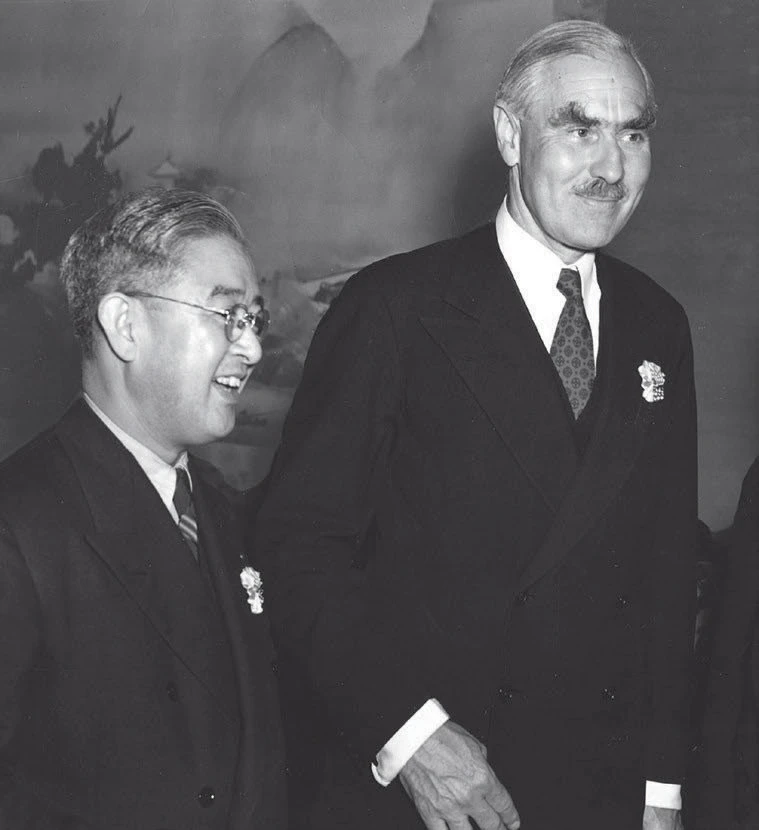
By then he was president of the America-Japan Society, returning to his earlier efforts to promote friendship and commerce between the two countries. Echoing the art exhibit he’d helped to arrange in 1936, he worked with John D. Rockefeller III to create a blockbuster exhibit at the Museum of Modern Art in 1954: the Shofuso Japanese House and Garden, official gifts from the Japanese people to the United States.
Honoring a friend, he became the first president of the Grew Foundation, which provides scholarships for Japanese students at U.S. colleges. In 1963, his lifelong quest to connect his homeland and the United States brought him Japan’s Medal of Honor with Blue Ribbon, which recognizes those “who have made efforts in areas of public interest and welfare.” At his funeral, U.S. Ambassador Edwin Reischauer called him “above all else, a friend to his fellow man. We all remember him best for his many years of devoted efforts to further understanding and friendship between Japan and the U.S.”