Yesterday’s News

A co-ed experiment that changed dorm life forever

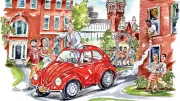
A busy hallway with diverse people carrying items, engaging in conversation and activities.

Illustration by Mark Steele

Spring 1970 A group of Harvard and Radcliffe students volunteered for a radical social experiment: co-educational living. The student-led move came amid tumultuous cultural and political changes—the fight for civil rights and the sexual revolution, for starters—that were rapidly altering the lives of undergraduates. Classes and many extracurricular activities had been shared for years. Already gone, or fading fast, were the long-held parietal rules governing how men and women interacted in the Radcliffe dorms (e.g., curfews, sign-ins, and the much giggled-at “one foot on the floor at all times” requirement). Yet the dorms and dining rooms were still segregated; to eat with the men, women had to be signed in as “dates” through a personal invitation.

Amid these incongruities, and a Harvard-Radcliffe Policy Committee’s formal recommendation to College leaders, the test was launched. About 150 men from Adams, Lowell, and Winthrop Houses traded places with 150 women from what were then known as South, East, and North Houses. The swap yielded positive enough results that it was continued and expanded. By 1972 co-residency was a University-sanctioned option for undergraduates. As the Harvard-Radcliffe Policy Committee report lauding the “educational advantages” of permanent co-ed living and dining put it, such progressive arrangements ultimately enabled men and women “to view each other more as people than dating objects.”

Read more articles by Nell Porter-Brown
Related topics

You might also like

A Forgotten Harvard Anthem

Published the year the Titanic sank, “Harvard’s Best” is a quizzical ode to the University.

Highlights from Harvard’s Past

The rise of Cambridge cyclists, a lettuce boycott, and Julia Child’s cookbooks

Wadsworth House Nears 300

The building is a microcosm of Harvard’s history—and the history of the United States.

Most popular

Garber to Serve as Harvard President Beyond 2027

A once-interim appointment will now continue indefinitely.

Open Book: A New Nuclear Age

Harvard historian Serhii Plokhy’s latest book looks at the rising danger of a new arms race.

Explore More From Current Issue

A football player kicking a ball while another teammate holds it on the field.

A Near-Perfect Football Season Ends in Disappointment

A loss to Villanova derails Harvard in the playoffs. 

A bald man in a black shirt with two book covers beside him, one titled "The Magicians" and the other "The Bright Sword."

Novelist Lev Grossman on Why Fantasy Isn’t About Escapism

The Magicians author discusses his influences, from Harvard to King Arthur to Tolkien.

A man skiing intensely in the snow, with two spectators in the background.

Introductions: Dan Cnossen

A conversation with the former Navy SEAL and gold-medal-winning Paralympic skier