IT IS A TRUTH universally acknowledged that Harvard has the best college songs. “Up the Street,” “Our Director,” “Gridiron King,” “Soldiers Field,” “Harvardiana,” “Ten Thousand Men of Harvard,” “Yo Ho, the Good Ship Harvard”—we may not know them by their titles, or recall all the words, but when the University Band strikes up one of those stirring standards, Harvard hearts tend to beat in sync with the band’s big bass drum.
With the exception of “Our Director” and “Up the Street,” both published in 1895, the classics cited above were composed between 1903, when Harvard Stadium was completed, and 1914, when war broke out in Europe. Remarkably, all but one—“Our Director”—were the works of undergraduates.
Other songs from that epoch enjoyed an ephemeral vogue but in time were consigned to oblivion. The Harvard Song Book, compiled in 1922, contains such relics as “Harvard Every Day,” “Onward to the Goal,” and “The Sun of Victory.”
It does not include “Harvard’s Best.”
Published in 1912, that now-forgotten anthem had lyrics by Edward S. Martin, class of 1877, and music by A. Baldwin Sloane. Martin, a founder of the Lampoon, was for 46 years the chief editorial writer for Life magazine. Sloane, not an alumnus, had been a prolific songwriter for Broadway musicals.
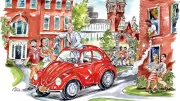
An occasional contributor to the Pump found sheet music for “Harvard’s Best” while culling a tranche of old papers. “I had no idea where it came from,” he writes, “but I liked the cover art and thought the song might be of interest.”
Our correspondent goes on to annotate the lyrics.
“It is not a fight song,” he begins. “The tempo marking is ‘allegro moderato,’ not ‘march time.’ The first verse sounds an elegiac note:
The elms in front of Holworthy are little more than stumps, / They’ve stood a hundred years or more and now they’re in the dumps / The pump is gone, there’s plumbers’ pipes in halls that once were bleak / They say that Harvard hardiness is somewhat now to seek.
“The next verse rehashes some knocks on the alma mater:
They say she’s idle, say she’s proud, they say that she’s a scold, / They say her head is in a cloud, and that her heart is cold.
“But verse three is a volte-face:
The elms may die by Holworthy, the pump may go to pot, / But Harvard’s in the running still, you’ll know it when she’s not / She’s old, but she’s no fossil, she is agile and she’s tight, / And on her shield her Veritas gleamed never yet more bright.
“The final refrain affirms lustily that
…it’s Harvard, Harvard, Harvard / She has got it, she will do! /…And it’s Harvard what she puts her hand to, sure she’ll carry through! / And it’s Harvard long she’s led the East, and she shall lead the West, / For there is no school of manhood that can better Harvard’s best!”
“A quizzical song, for sure,” our correspondent concludes. “But perhaps appropriate for Harvard in her current travails.”
“THE PUMP IS GONE,” the lyrics tell us. How so? The original College pump, built in 1764 in the Old Yard near Hollis Hall, had been blown to bits by vandals in 1901. The venerable landmark would be restored for Harvard’s tercentennial celebration in 1936, and a half century later would be replaced by an oak replica, a 350th anniversary gift to Harvard from Radcliffe College.
THE YEAR 1912 not only saw the composition of “Harvard’s Best” but also the sinking of the Titanic and the only presidential election with three Ivy Leaguers on the ballot. Democrat Woodrow Wilson, of the Princeton class of 1879 and a past president of that university, carried 40 states to win the White House. Former President Theodore Roosevelt, of the Harvard class of 1880 and the Bull Moose Party candidate, carried six states to place second. The incumbent, Republican President William Howard Taft, Yale class of 1878, won just two states—Vermont and Utah—and finished a distant third.
That fall’s unbeaten Crimson eleven might have given Roosevelt’s Harvard supporters a measure of solace with a 16-6 defeat of Princeton and a 20-0 shutout of Yale. (For an account of the eventful football season just past—the first since 1919 to extend to postseason play—see page 17.)