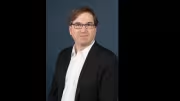
Astrochemist Karin Öberg, Cabot professor of the natural sciences, has been named Harvard’s senior vice provost for faculty affairs—a position that plays a key role in shaping and analyzing the demographic composition of the faculty.
Öberg will replace Conant professor of education Judith Singer, who held the position for 18 years and advocated for the advancement of women through appointments to leadership positions. Singer announced that she would step down in late February. Öberg will start her new role on July 1.
The senior vice provost for faculty affairs is a pivotal position within the administration, charged with recruiting and retaining outstanding scholars. In practical terms, the responsibilities of the office can range from helping faculty find housing, to assisting spouses in finding local work, to ensuring the availability of childcare—key elements in maintaining a healthy work-life balance.
“I believe that a flourishing faculty, free to pursue academic excellence, is at the heart of Harvard’s mission,” Öberg said in a statement. “I am deeply honored and excited at the opportunity to serve the University and support the next generation of scholars in this new role.”
In a University statement, President Alan M. Garber described Öberg as “a widely admired faculty member whose excellent judgment and efforts to nurture academic excellence have already made a difference at Harvard.” She is “a brilliant scientist,” added Provost John Manning, “a dedicated teacher, a respected academic leader, and an exemplary institutional contributor.”
A native of Sweden, Öberg studies the ice chemistry of distant solar systems and was the first person to observe a complex organic molecule in the freezing cloud of gas and dust surrounding a young star. The chemical antecedents of life, she has noted—if it exists elsewhere—would likely begin on or inside a grain of ice.
In the astronomy department, Öberg has served as director of undergraduate studies. Within the Faculty of Arts and Sciences, she has served on the faculty council and the committee on appointments and promotions. And she was an early participant in efforts led by former Dean of the College Rakesh Khurana to ensure “intellectual vitality” among undergraduates at a time of rising concern over constrained speech on campus.
Öberg is also professionally active outside Harvard. According to the University announcement of her appointment, she has served on the governing board of Chile’s Atacama Large Millimeter/submillimeter Array (ALMA) telescope since 2018, and as its chair from 2019 to 2020. She was a trustee of Associated Universities, Inc., a nonprofit that partners with federal agencies to plan, build, and operate large-scale scientific facilities, from 2020 to 2022. A convert to Catholicism, she also serves as a trustee of the Pontifical University of Saint Thomas Aquinas, an international theological institute based in Rome, of which she became vice chair in 2025.