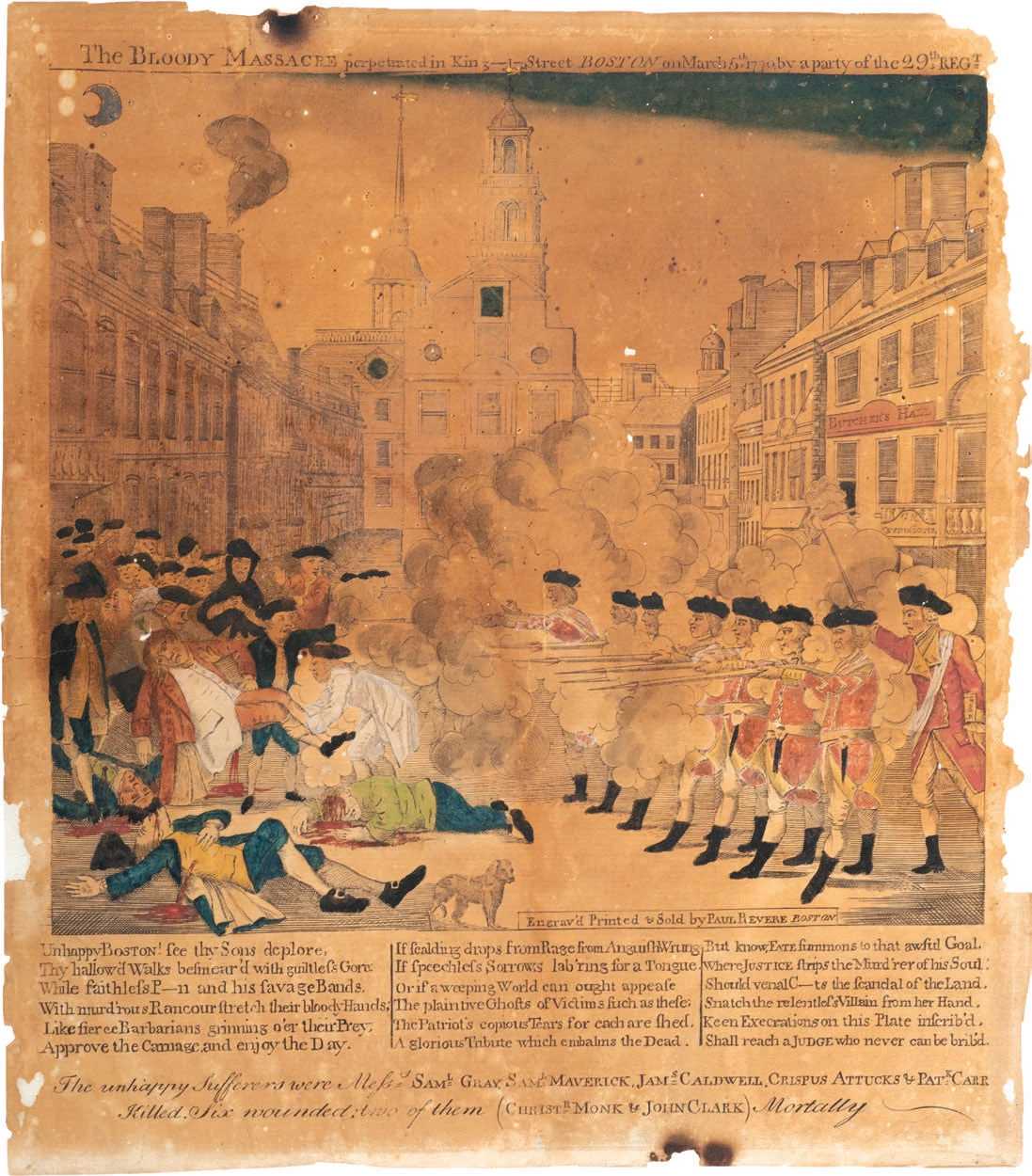
Historical scene in colonial Boston depicting British soldiers confronting civilians, with smoke rising, in a city street.

Paul Revere’s propagandistic 1770 engraving depicting what would come to be known as the Boston Massacre (please see below for the full image) | Photograph by Stu Rosner

Houghton Library Displays Revolution-era News and Propaganda

A new exhibit reveals how early Americans learned about the war.

For related content visit:
Harvard Celebrates America’s 250th 

Six months before the Declaration of Independence was signed, an anonymous pamphlet went the colonial era’s version of viral. Common Sense; Addressed to the Inhabitants of America argued, in fervent prose, for independence from Britain, calling the cause of America “the cause of all mankind.” It was an immediate bestseller. No one readily guessed its author was a newly immigrated Englishman named Thomas Paine. He’d left school at 12, failed in marriages and at making a living, and had barely survived typhus during the transatlantic journey. Yet here, in a nascent republic, he made his mark. In plain language, Paine declared that the colonies would thrive under economic freedom, that an island ruling a continent was absurd, and that monarchical systems were abnormal and oppressive. “Tyranny, like hell, is not easily conquered,” he wrote, “yet we have this consolation with us, that the harder the conflict, the more glorious the triumph.”
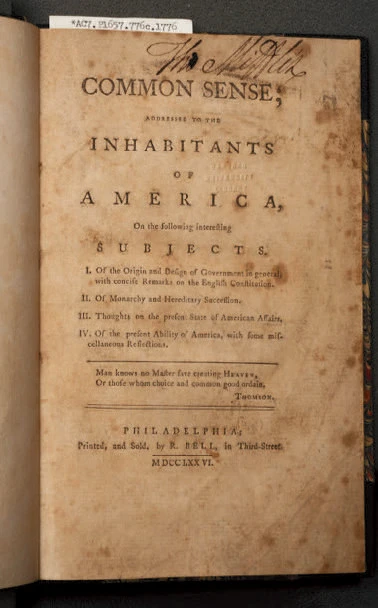
Original copy of Common Sense by Thomas Paine
Common Sense; Addressed to the Inhabitants of America by Thomas Paine | Photograph by Stu RosneR

This incendiary document is part of a new exhibit, War of Words: A Citizen’s-Eye View of the Revolution, at Houghton Library (May 18 through August 7). About 60 items explore what “the people of the period would have used to learn about the events of the Revolution,” notes John Overholt, curator of the Hyde collection of Dr. Samuel Johnson and early books and manuscripts. Documents on display also include an original copy of the Declaration of Independence (see below) printed on paper made from pulped rags (only 26 of the estimated 200 initially printed are known to exist today). Colonists would have read it as a public poster or in a local newspaper, Overholt says. So crucial was the document, he adds, that its first signer, John Hancock, sent copies to leaders of the Continental Army so the troops would know what they were fighting for. Six years earlier, Paul Revere’s propagandistic 1770 engraving (see below) depicting what would come to be known as the Boston Massacre had sent that message in graphic terms: British soldiers are portrayed as a firing squad, and the colonists as their hapless victims. In organizing the exhibit, Overholt wanted to emphasize not just the history, but the tone. “Showing the kinds of publications and images of the period, how people were expressing themselves and reporting the news,” he says, seemed like “something that visitors would find relatable.”
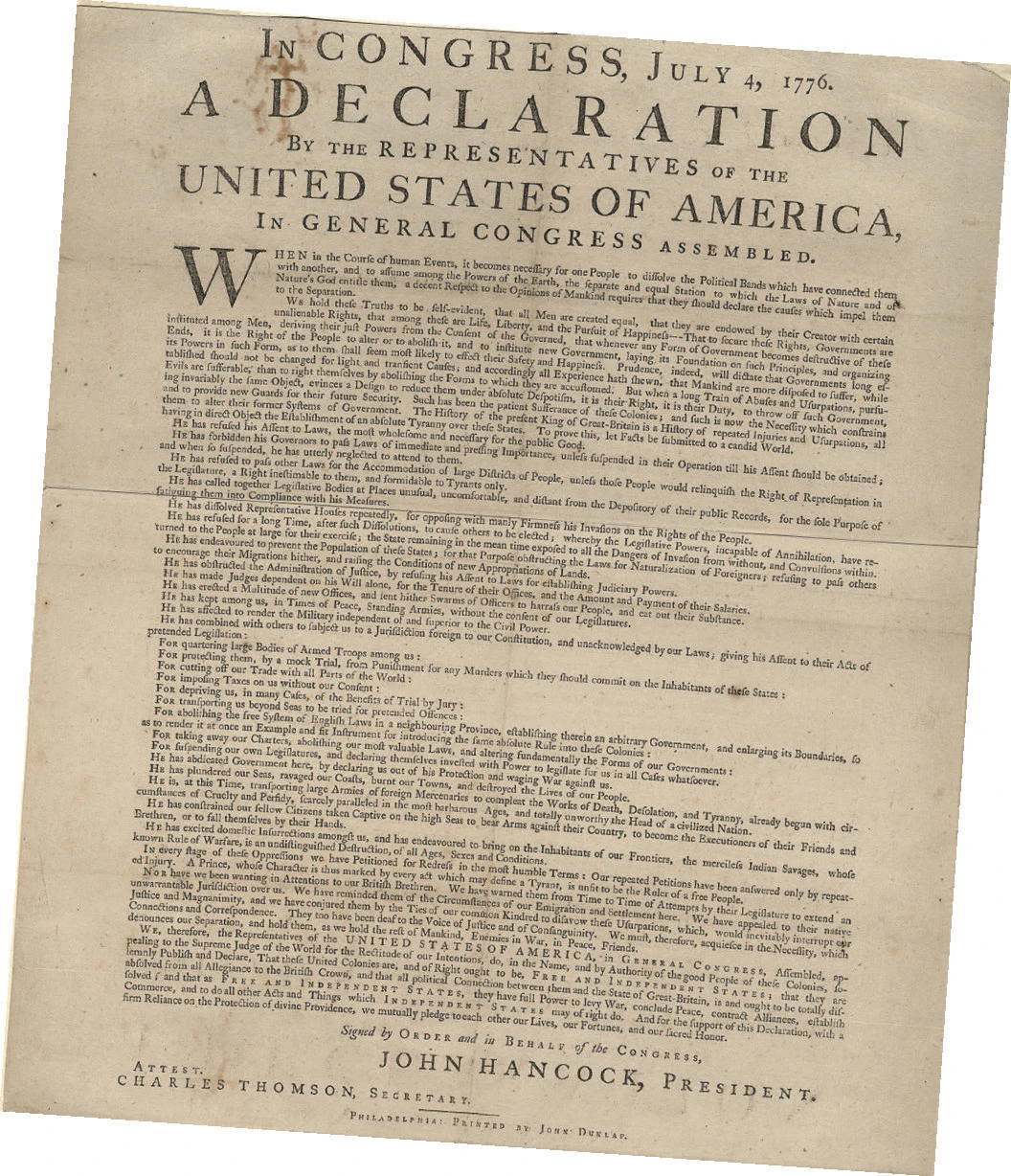
An original copy of the Declaration of Independence
An original copy of the printed Declaration of Independence| Image courtesy of the Houghton Library
Engraving by Paul Revere shows colonists being shot at by British soldiers in what would be known as the Boston Masacre
Full image of Paul Revere's depiction of what became known as the Boston Massacre | Photograph by Stu Rosner
Read more articles by Nell Porter-Brown

You might also like

AI Hunts For Stolen Harvard Coins

A museum curator and a computer scientist track down ancient coins taken in a legendary heist.

The Framer Who Refused to Sign the Constitution

Harvard’s Elbridge Gerry helped draft the U.S. Constitution, but worried it might create a new monarch.

Radcliffe Acquires a Black Feminist’s Archive

An architect of Black women’s studies, Barbara Smith introduced the concepts of “identity politics” and “intersectionality.”

Most popular

250 Years Ago, Harvard Was Home to a Revolution

A look at the sights, sounds, and characters that put the University on the frontlines of history

When the Revolution Hit Cambridge, Harvard Moved to Concord

College students broke hearts and windows during their year in exile.

The Harvard-Trained Doctor Who Urged a Revolution

Before his heroic death, General Joseph Warren was dubbed “the greatest incendiary in all of America.”

Explore More From Current Issue

White House and Harvard University buildings split diagonally with contrasting colors.

Harvard Weathers a Year of Turmoil

The federal government has launched unprecedented actions against the University. Here’s a guide.

A dancer in a black leotard poses gracefully in a bright studio, with mirrors reflecting her movement.

A New “Black Swan” Musical Cranks Up the Tension

The creative team of the A.R.T.’s new show dish on adapting Darren Aronofsky’s thriller classic from screen to stage.