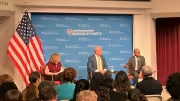
Professors in the Faculty of Arts and Sciences (FAS) have approved a proposal to cap the number of A’s awarded to Harvard College students, part of a broad proposal aimed at reducing grade inflation.
Starting in the fall of 2027, courses will limit A grades to 20 percent of enrollment, plus an additional four A’s per class. Voting was conducted by email over the past week, and the results were announced on Wednesday morning. Faculty members voted 458 to 201 to approve the grading cap, one of three provisions that were voted on separately and the central pillar of the proposed reforms.
Decisions on the other two provisions were split. By a vote of 498 to 157, faculty members approved a plan to calculate internal College honors and prizes using students’ average percentile rank instead of grade-point average. But they voted down a provision that would have allowed instructors to award a “satisfactory-plus” grade to courses that opt out of the grading cap; the vote tally was 292 for the provision versus 364 against. Those courses that opt out will be graded as “satisfactory” or “unsatisfactory” and will not count toward the average percentile rank.
The voting concludes months of intense campus debate about the proposal at town hall meetings, in departmental meetings, and in one-on-one conversations. Students expressed overwhelming disapproval of the grading reforms, both in meetings with administrators and a February survey conducted by the Harvard Undergraduate Association, in which 85 percent of respondents rejected the grading cap. The proposed grading reforms dominated discussions at the last two FAS meetings, in which professors voiced both intense opposition and strong support.
Harvard’s overabundance of A’s has become an increasingly acute issue in recent years and has been a subject of formal faculty debate since 2023. An FAS report released last October found that solid A’s comprised 60 percent of all undergraduate letter grades in 2025, up from just 24 percent in 2005.
“Today the Harvard faculty voted to make their grades mean what they say they mean,” said members of the faculty subcommittee that developed the grading proposal, in a statement on Wednesday. “This matters for our students above all. A Harvard A grade will now tell them, as well as employers and graduate schools, something real about what a student has achieved. An A will once again be what Harvard’s guidelines have long said it is: a mark of extraordinary distinction. And an A-minus need no longer be a source of anxiety, encouraging students to explore new subjects and take intellectual risks.”
The statement was signed by subcommittee chair Stuart Shieber, the Welch professor of computer science; co-chair Alisha Holland, the Gates professor of developing societies; and members Joshua Greene, the Lin professor of civil discourse, and Paulina Alberto, professor of African and African American Studies and of history.
“Today’s vote reminds us that universities can effectively govern themselves in the face of hard problems,” the members wrote. “We hope other universities will follow.”
Dean of undergraduate education Amanda Claybaugh expressed that same hope in her statement on Wednesday. Grade inflation is a widespread problem in the Ivy League and in colleges across the country. “This is a consequential vote,” Claybaugh wrote, adding that she believed it would strengthen Harvard’s academic culture and calling it “an important step toward ensuring that our grading system better serves its central purposes: giving students meaningful feedback, recognizing genuine distinction, and sustaining the academic mission of the College.” Claybaugh also thanked members of the subcommittee, who she said “did not shy away from controversy, nor content themselves with half measures.”
In an email to Harvard Magazine, Stephanie Burt, the Loker professor of English, applauded the decision to approve the grading cap and the average percentile rank. “I voted confidently for all three proposals and I’m happy to see that the first two have passed,” she wrote. Like many faculty who spoke in support of the reforms in recent FAS meetings, Burt acknowledged drawbacks but argued that the benefits outweigh them. “A hard cap on straight A’s comes with disadvantages, among them disincentives for collaboration in certain courses that rely on group work,” she wrote, “but it’s a price worth paying so that our faculty can address a problem of collective action that has made Harvard grades almost unintelligible to many employers and graduate schools.”
Grade inflation has also led undergraduates to seek out large survey classes with abundant A’s, Burt noted, and “persuaded too many (not all, but too many) Harvard College students that an A-minus is a bad grade.” The negative consequences and harmful pressures, she added, disproportionately affect non-tenured faculty.
Burt said she was “disappointed” by the vote to reject the “satisfactory-plus” grade. Even in classes that don’t need to award letter grades, she said, it should still be possible to “award distinctions of some sort to students whose work stands out.”
Richard Thomas, the Lane professor of the classics, who spoke in opposition to the grading reforms at last month’s faculty meeting, was chagrined about the results of the vote. “While respecting democratic processes,” he wrote in an email, “I continue, along with more than 200 FAS colleagues, to believe this was not the way to have dealt with what we all agree is a real problem—though hardly the greatest problem confronting higher education right now.”
He expressed particular concern about the effect that a grading cap will have on smaller classes. “Any college class of 20 or fewer students—the ideal size, in my view—should involve collaborative learning not subject to a baked-in and imposed outcome that will likely breed cut-throat competition,” he wrote. “Having been privileged to teach such classes at Harvard for almost 50 years, I worry about this particular climate change.”
The approved provisions will be implemented in the 2027-28 school year. After three years, the Office of Undergraduate Education will present a review of the new policy to the faculty, although any changes to the policy would have to be done through the regular faculty legislative process.