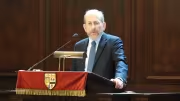
Professors in the Faculty of Arts and Sciences (FAS) will begin voting next week on a proposal to curb grade inflation by capping solid-A grades at 20 percent, plus an additional four A’s per class. The vote, conducted by email, will open on May 12 and close a week later; results will be announced on Wednesday, May 20.
The quota on A’s is one of three provisions, each to be voted on separately, that faculty members will consider in an email ballot. A second would calculate internal honors based on students’ average percentile rank rather than their grade point average, and a third would allow for courses to opt out of the grading cap and instead offer grades of “satisfactory” and “unsatisfactory,” with an added option of “satisfactory-plus.”
Each provision requires a simple majority to pass, and would not be implemented, if passed, until the fall of 2027. After three years, any new policy would go through a review process; changes after that would require a new vote from the faculty.
Professors discussed the proposal at length on May 5 at the final FAS meeting of the academic year, gathering for the third time this semester in a Science Center lecture hall to accommodate a crowd of more than 200. As at two previous faculty meetings where grade inflation dominated the agenda, some faculty voiced strong support for the proposal and some vehement opposition; both sides drew applause. (This week’s meeting was extended, by vote, for an extra 15 minutes to allow a few more professors to make their arguments.)
Grade inflation at Harvard has soared in recent years, to the point that solid A’s make up nearly two-thirds of letter grades awarded, and both the problem and the proposed solution have drawn national attention.
Gates professor of developing societies Alisha Holland, who served on the FAS subcommittee that developed the grading proposal, told colleagues that the proposed change was an opportunity for Harvard to lead on an issue that has plagued many elite universities. “For once, the question isn’t whether Harvard is going to follow someone else’s lead,” she said. “The question is whether we’re going to take our own.”
Speaking at the start of the discussion, Holland described months of robust conversations about the proposal that was first released in February—in department meetings, town hall meetings, one-on-one conversations, and “email threads long enough to qualify for independent study credits.” Once faculty members learned more about the proposal, she said, many came to support it.
“Junior faculty quietly told us they felt relief,” she said, “at the idea of having cover to give the grades they wanted to give.”
Holland also cited a recent report on falling trust in higher education from Yale University, which contained a far more draconian idea for curbing grade inflation: a targeted mean GPA of 3.0, or a B average. “What we’re asking you to vote on is far gentler,” she said. Later in the meeting, she reiterated that point: “We are trying to use the lightest touch possible.”
Harvard’s proposal is, indeed, limited: it puts no restrictions on the number of A-minuses a professor can give. And though it would impose a strict percentage cap on A’s, it would also allow four more individual A’s in any course, regardless of size—a move designed to encourage students to take rigorous small seminars.
But several professors who spoke at the meeting urged their colleagues to address different problems before tackling grade inflation directly. Some spoke about the destructive effects of student evaluations, arguing that a bad Q score—Harvard’s course evaluation metric—can torpedo course enrollments and harm professors’ bids for tenure, discouraging professors from grading accurately. Some argued that the faculty should be more focused on figuring out how to evaluate student work in the age of artificial intelligence, when chatbots can produce convincing writing.
Other faculty took issue with the speed of the process and the arbitrary nature of a quota. Several imagined how a cap on A’s might affect student behavior when choosing classes, evaluating professors, and working with their peers.
Professor of astronomy and physics John Kovac, chair of the FAS Standing Committee on First-Year Seminars, said he personally supports the cap on A’s and the changes to the internal ranking system. But he said his committee unanimously opposed the addition of a “SAT-plus” grade for courses without letter grades, which are designed to “encourage intellectual risk-taking.”
Adding a higher-ranking to those courses, he said, “will introduce hierarchy, competition, imposter syndrome, superiority signaling, and most importantly, grade complaints.”
Lane professor of the classics Richard Thomas said he worried that a quota on A’s would discourage students from helping one another and working collaboratively. He recounted a discussion about the proposal with students in one of his seminars; even seniors who had no stake in the change, he said, were concerned about its effects on younger students. The overall reaction, he said, was: “‘I know about competing; that’s how I got into Harvard. I don’t want to keep doing it. I’d much rather work in groups with my peers.’”
But professor of psychology Fiery Cushman argued that exposure to imperfect grades would be healthy for students, building resilience and removing unrealistic pressure.
“If a kid somehow were never to be allowed the opportunity to skin their knee on the playground, they wouldn’t go there to have fun; they’d go there terrified of falling down,” he said. “If you engineer an environment around ensuring constant perfection, that is a recipe for anxiety.”
Amanda Claybaugh, the dean of undergraduate education, acknowledged other challenges that faculty members face as they confront AI and other pressures. Still, she urged her colleagues to support the proposal, calling it a necessary step toward improving teaching and learning.
“Our current grading practices are the impediment to everything else we want to do,” she said. “We are in a system that disincentivizes our faculty from teaching rigorous and meaningful courses, and that disincentivizes our students from taking them.”