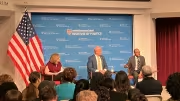
Many members of the Faculty of Arts and Sciences (FAS) expressed measured support for a proposal to reduce grade inflation during a spirited discussion at a crowded faculty meeting this week. Nearly 200 people attended the Tuesday gathering, which was moved from its regular room in University Hall to a large Science Center auditorium. Edgerley Family Dean of the FAS Hopi Hoekstra said that a vote on the proposal—which won’t take effect without faculty approval—could come as early as next month.
Developed by a FAS subcommittee after months of deliberation, the proposal aims to curb Harvard’s overabundance of A’s, which has become increasingly acute in recent years. A FAS report released last October found that solid A’s made up 60 percent of all undergraduate letter grades in 2025, up from just 24 percent in 2005. “Our current practices are not only failing to perform the key functions of grading,” the report said, “they are also damaging the academic culture of the College.”
Since it was unveiled on February 6, the reform proposal has become a hotly debated topic on campus, including at a pair of town hall meetings, where students expressed overwhelming disapproval. The proposal recommends two major changes: placing a 20 percent cap on A’s in every course (with four additional A’s permitted for each class, regardless of size) and calculating internal honors and prizes using students’ average percentile rank instead of grade-point average. The version of the proposal introduced at this week’s FAS meeting also included a requirement that the policy changes be reviewed after three years.
Among the dozen or so faculty members who spoke during a lively hourlong back-and-forth at the meeting, reactions ranged from strong support for the proposal to intense ambivalence to rueful rejection. Quoting Winston Churchill on democracy, professor of government Steven Levitsky said that after talking with a number of colleagues and students, he believed the proposal was “less bad than all the available alternatives.” Like other speakers, though, he acknowledged that there are drawbacks: “It’s a really blunt instrument,” he said. “It feels pretty arbitrary. It imposes real constraints on faculty autonomy, and it does little to improve actual teaching and learning.”
But, importantly, he added, the proposed changes would incentivize students to focus more attention on their classwork and might help disrupt the growing tendency to prioritize extracurriculars above academics. (A February 2025 FAS committee report found that students are often overwhelmed by non-academic activities like athletics, pre-professional organizations, and social clubs.)
Other faculty members said they hoped the proposal would help make the grading system not only more meaningful, but also more fair. “It breaks my heart,” said Jason Furman, Aetna professor of the practice of economic policy, “when a student gets a perfect score on everything and another student gets quite a lot wrong,” yet both receive A’s and equal consideration for honors. He also wondered whether the changes might encourage faculty members to make their courses more challenging and creative, freed from the expectations of automatic A’s.
Loker professor of English Stephanie Burt broached an issue that has become a particular point of contention among the proposal’s detractors, who argue that a mandated scarcity of A’s would only worsen student anxiety and obsession over grades. Burt said she’d invited students to share their reactions to the proposal with her during office hours, and more than one had brought up this concern. But she believes the change would actually be beneficial to students’ mental health. “I think there’s a good deal of evidence that if the median grade stops being an A,” she said, “that psychological toll will decrease.”
Mental health was an issue that Gates professor of developing societies Alisha Holland had addressed in earlier remarks. A member of the subcommittee that produced the proposal, Holland laid out the recommended changes and their rationale at the start of the meeting. She recalled that many faculty members decided during the COVID-19 pandemic to increase the number of A’s they awarded, in an effort to reduce student stress. But student stress remained high, as did competition. Holland argued that “normalizing an A-minus” (which, unlike A’s, the proposed changes would leave unrestricted) makes for a “healthier” campus environment. “A meaningful grading system frees students to take courses that genuinely interest them, knowing that they’ll be graded by the same standards across courses and departments,” Holland said.
Some of the objections that faculty members voiced during the meeting echoed similar worries from students: the arbitrary nature of the 20 percent cap, the risk of inflaming classroom competition, the proposal’s lack of emphasis on the practice of teaching itself. More than one faculty member complained that the reform effort focused more on grades than education.
A couple of speakers advocated a revision that would give faculty members more flexibility in grading. According to the proposal, instructors can petition to opt out of the 20 percent grading cap, but work produced in their courses would instead be scored as satisfactory/unsatisfactory (essentially, pass/fail), rather than given letter grades. At the meeting, a few faculty members argued for the idea of adding one extra tier—an “honors” distinction for students who not only pass a course but perform exceptionally well. (Within the FAS legislative process, faculty members have an opportunity to offer amendments, which could be folded into the proposal before a final vote.)
Some faculty members said they felt the process was moving too fast. Professor of government Ryan Enos said that he was one of two FAS faculty council members (among the 14-person group) who had voted against bringing the proposal to the full faculty. One reason, he said, was simply the speed at which decisions were being made. Calling this proposal “one of the most consequential” changes that “any of us will ever vote on,” Enos cautioned his peers to think about the unintended consequences it may bring and encouraged them to slow the process down. “I don’t think there’s a reason why we can’t carry on the discussion for another semester, or another year,” he said, to make “absolutely sure” that the final decision is the best possible option. After he spoke, a small round of applause erupted.
Although the proposal has been out for only a month, the faculty’s larger discussion about grading reform began years ago—and intensified in 2023 after the Office of Undergraduate Education released its report showing steadily rising A’s among College students. That report sparked FAS-wide conversations about alternative grading schemes. The subcommittee that produced the February proposal was formed in November 2024.
At Tuesday’s meeting, the discussion ended with a few hands still in the air. Hoekstra assured faculty members that they would be able to continue the conversation at next month’s FAS meeting.
Create your own user feedback survey