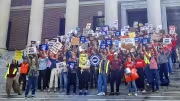
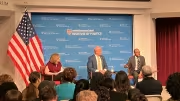
On a day with leaves glowing golden outside the clear windows of Memorial Church, more than 200 people gathered inside—in uniforms, their Sunday best, or flannel shirts and jeans—at 11 a.m. on 11/11/2011 to celebrate Veterans Day, 17 Medal of Honor recipients, and the return of the Reserve Officers Training Corps to Harvard.
In welcoming President Drew Faust and the rest of the congregation, Thomas P. Reardon ’68, president of the Harvard Veterans Alumni Organization Inc. (HVAO), which sponsored the service of commemoration, noted that it had been a very good year for the relationship between the University and the armed forces of the United States. Besides praising the “genuine commitment” made to further the growth of all branches of ROTC on campus, he expressed his group’s shared satisfaction that after 40 years, in their view, respect for alumni and serving veterans and for Harvard’s long and distinguished record of military service to the nation was being restored and recognized. And he read an RSVP via telegram from Colonel James C. Bayley ’73: “I would gladly attend but am currently deployed to Afghanistan. Have a great occasion and thank Drew Faust for what she has done.” And Reardon did, to a round of applause.
Major General John E. Hyten ’81, director of space programs for the U.S. Air Force, delivered the principal remarks; the personal experiences he shared suggested why ROTC’s formal return resonates deeply for alumni veterans. Many fellow officers, he noted, bond readily over common experience at the service academies or in ROTC units at large public universities and find it “unique…uncommon…odd” when they learn he went to Harvard; rarely, he said, does he meet other alumni in uniform. Yet Harvard sustained him: he welcomed debates about his decision to serve as “part of what a university is about” and recalled that not once during his undergraduate years did a single student or faculty member verbally abuse him when they saw him in uniform—very different from the situation “outside the walls.” He thanked Faust for bringing ROTC back on campus and “reaching out and recognizing those of our community who serve our country” in the military, including “a new generation…serving willingly and well.” When he finished, the congregation rose to sing “Fair Harvard.”
Then HVAO director Terence “Terry” Roche Murphy ’59 formally presented the new plaque honoring Harvard’s Medal of Honor recipients to the church. Seventeen names are inscribed on the slate memorial, with space for five more below. “We do not yet know the story of tomorrow’s heroes,” General Hyten had noted in his tribute, and the dedicatory text that Murphy read reflected the same reality:
Harvard, their Alma Mater—their nourishing mother—salutes her valorous and forever-young Recipients of the Medal of Honor, and those among her ten thousand men and women of this ancient academy who may follow them.
Memoria conservetur.