The College this week notified students of a new alcohol policy that takes effect in the fall. Posted on a webpage accessible only to students, the revised policy addresses the types of alcohol that may be served at private parties, on-campus events, and House formals, whether on or off campus.
In the most notable change, mixed drinks may again be served at House formals, but they must be dispensed at a cash bar or with a drink ticket system. (Hard liquor was banned at on-campus House formals in 2010, and the ban was extended to off-campus formals in 2011.) The restrictions are looser for beer and wine, which may be distributed at an open bar.
Speaking to the Crimson, Catherine Katz ’13, co-chair of the Quincy House Committee, praised the rule change as evidence that administrators considered students’ input.
Hard liquor is still banned at other social events on campus, other than private parties, to which separate regulations apply.
Students who wish to host private parties will be required to meet with a resident tutor before hosting their first party each year, to discuss applicable laws and how to “create safe social environments.”
The policy states explicitly:
Activities that promote high-risk drinking, such as excessive and/or rapid consumption of alcohol, particularly of a competitive nature, are not permitted. It is expected that hosts will plan parties where drinking is not the central activity.
Kegs remain banned at athletic events, including at Harvard-Yale tailgate parties, but are permitted at other on-campus events with the approval of a House tutor or College staff member.
The College’s amnesty policy, which follows, remains unchanged:
Students may bring an intoxicated or drug-impaired friend to University Health Services or to a hospital, or seek assistance from College residential life staff or HUPD, and by doing this, neither they nor the friend will face disciplinary action from the College for having used or provided alcohol or drugs.
The alcohol policy’s purpose, according to the website, is “to support a residential and educational community that is culturally, intellectually, and socially enriching for our students, and to acknowledge that while alcohol has a role in social activities, its role is ancillary to our mission and purpose as a College.”
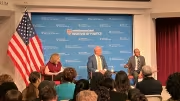
A committee that included students as well as faculty and staff members updated the policy; the group, chaired by Bower professor of leadership development Rakesh Khurana, master of Cabot House, and dean of student life Suzy M. Nelson, met five times this academic year. Representatives of the dean’s office are holding three sessions for questions and public comment on the new policy this week. The remaining sessions are April 4 at 6 p.m. in Ticknor Lounge, Boylston Hall, and April 5 at 8:30 p.m. in the Eliot House Junior Common Room.